


This was a nightmare scenario.
A heavily loaded airliner is in cruise flight when the first officer attacks the captain with a knife and points the airplane towards the ground. The airplane hurtles towards the ground with hundreds of people on board and a madman at the controls.
In the case of FlyDubai 1073, the nightmare has a happy ending. Several of the 174 passengers, most of them Israelis, rushed the cockpit and subdued the mutinous first officer, an Omani national. A passenger regained control of the airplane, and another pilot, traveling as a passenger, ultimately took over the flight, landing safely at Tabuk, Saudi Arabia.
It was a close thing. Radar data shows that the Boeing 737 MAX 8 lost almost 20,000 feet in a matter of minutes. Such a massive loss of altitude would come with an increase in airspeed that likely exceeded the airplane’s structural limits. Just pulling out of the dive without ripping the wings off would be a challenge, especially for a nonpilot. In fact, the airplane seems to have lost its rudder, a movable piece of the vertical tail used in lateral steering.
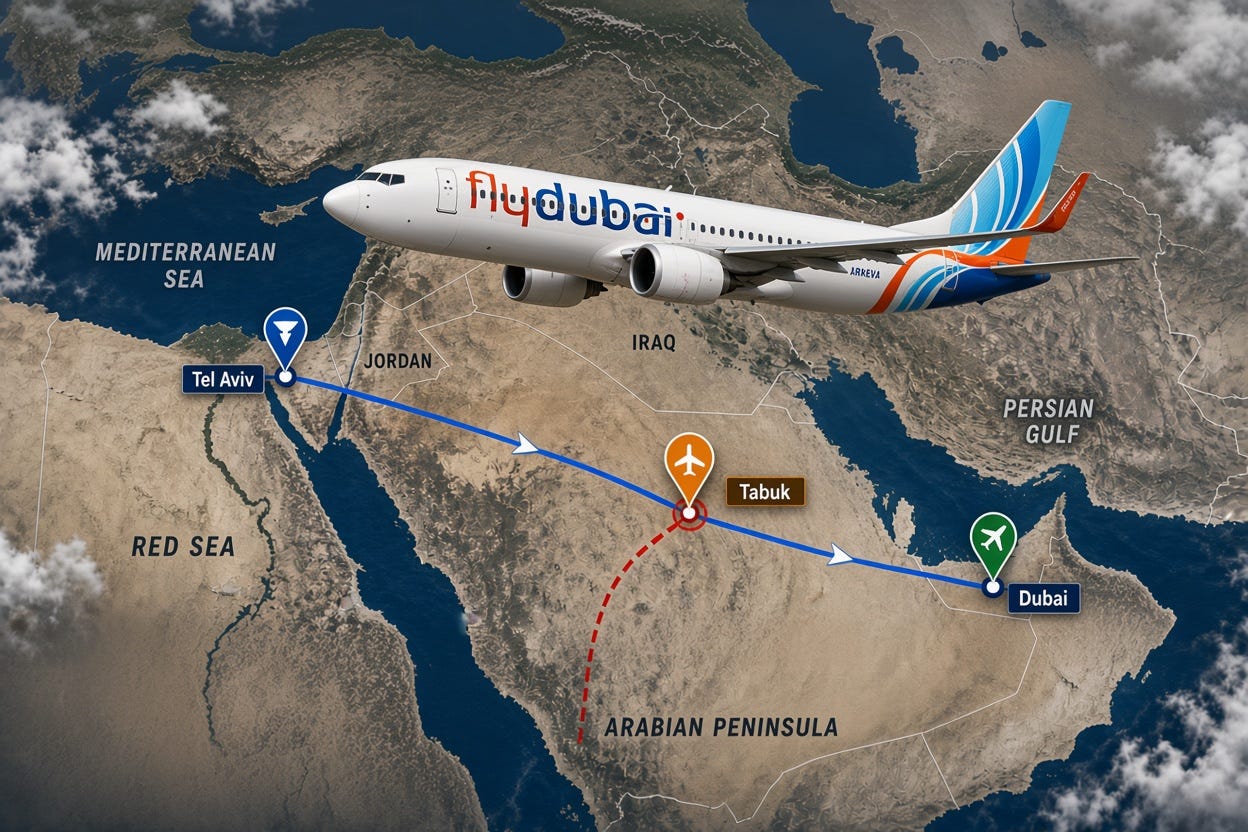
The Israeli man credited with pulling the airplane out of its dive said that he knew what to do from watching “Air Crash Investigation,” which the show should put on its commercials. This is an important point because airplane flight controls are somewhat reversed from the video game controls that many are used to. In a video game, you typically push the control up to go higher, but in an airplane, you pull back on the controls to raise the nose and climb.
In our flight simulator training, we regularly practice recovering from an extremely nose-low unusual attitude. Beyond pulling the nose up, typical steps include reducing power and deploying speed brakes or flight spoilers to reduce the airspeed. Simultaneously, the pilot rolls the wings level and pulls back on the controls to bring the nose up, but this must be done carefully, especially if the speed has exceeded the red line limits. Pulling up too quickly, especially if the airplane is in a turn, could overstress the airframe and cause structural failure.
Miraculously, no one was killed, and only the two crew members seem to have been seriously injured. Even the captain, an Indian national, and the first officer are both alive and recovering.
The obvious question here is motive, and Israel’s Benjamin Netanyahu has said the first officer “underwent Islamic radical indoctrination.” That’s definitely a possibility, but there are other explanations as well.
This story is very reminiscent of the September 11 attacks, specifically the heroic actions of the passengers and crew on United Flight 93, but what happened here is even more insidious, as well as more common. Rather than a hijacking by passengers, this was a mutiny by a crew member, which is even more difficult to guard against.
The phrase “suicide by cop” has long been used to describe people who intentionally goad police officers into killing them, but suicide by airliner, while not common, is also not unheard of in the aviation industry.
Other than the September 11 attacks, there have been several infamous examples of airline crewmembers committing suicide with their planes. One of the best-known was Germanwings 9525 back in 2015. Since then, we’ve had a Horizon Airlines maintenance worker who stole and crashed a Dash 8 turboprop in 2018 and China Eastern 5735 in 2022. Malaysia Airlines 370 and Air India 171 were also likely the result of intentional pilot action.
An additional incident occurred in 2023 when an off-duty Alaska Airlines pilot riding in the cockpit jumpseat tried to shut off both engines in flight. The pilot was restrained by the crew, who maintained control of the aircraft, and a spot opened up on the Alaska Airlines seniority list.
Reaching deeper into the past, a FedEx crew in 1994 was also attacked by a jumpseating crewmember, this one a flight engineer who boarded with a guitar case filled with hammers, knives, and a spear gun. The flight engineer attacked the crew with the hammers, intent on killing himself for a life insurance payout for his family, and then the flight devolved into a free-for-all that included aerobatic maneuvers in a DC-10. The crew was severely injured but was ultimately able to land the plane safely.
As a cultural reference, I’ll also add a relatively forgettable 1996 John Travolta film called “Broken Arrow.” I won’t spoil it, but the movie involves an attack on the crew of a stealth bomber.
A big question many are asking is how this could happen. Since September 11, most airliners have been built with hardened cockpit doors, but in these cases the threat came from inside the cockpit. Apparently, the door was either open or unlocked, which allowed the passengers to wrestle the first officer away from the controls.
In the US, flight crews go through the same TSA screenings that passengers endure. As an airline pilot, I was not allowed to carry a pocketknife, even when I carried my government-issued firearm as a Federal Flight Deck Officer. I could give you a list of things TSA has taken from me that include an Allen wrench that came with my suitcase that I didn’t even know was there.
That isn’t necessarily the case in other parts of the world, however. Not all countries are as security-conscious as the US, nor as fastidious about following security rules. For example, in the US and Europe, the flight deck door would probably have been locked from the inside, but in this case, a locked door would have spelled disaster.
Malicious acts by flight crews present a real and difficult security problem. Pilots have to have access to the flight deck, and when the flight deck is secured against outside attack, it can also protect a suicidal pilot from intervention.
Better security screenings of flight crews are a possible answer, but there is already a weapon in the cockpit. Federal aviation regulations require airliners to be equipped with a crash axe that is “accessible to the crew but inaccessible to passengers.” Jack Torrance would approve.
Better mental health screenings and professional help for pilots, as I mentioned in another post recently, would help, as would paying attention to what crewmembers do in their off time. The FlyDubai FO had allegedly posted about killing Jews, but at least in this country, examination of social media posts for radical beliefs and behavior probably wouldn’t fly (pun definitely intended). Still, other employees and fellow pilots should be encouraged to look out for the red flags of both murderous and suicidal behavior. In fact, these days, we should all familiarize ourselves with these warning signs.
Even though suicide-by-airplane is more common than you think, it’s still rare, and aviation is a very safe way to travel. Safe is not the same as risk-free, however, so keep your seatbelts fastened.
FAIRFORD UPDATE The bomb scare at RAF Fairford had a big plot twist when it was revealed that the vans did not contain explosives. As a result, the five suspects were released on bail. It’s possible that the incident was part of a dry run preceding an attack. The investigation is continuing, and there has been a new arrest involving a British-Iranian man.
SHAMELESS PLUG Our friend, Stan Mitchell, is once again cranking out podcasts. We encourage you to check him out here: https://linktr.ee/stanrmitchell
Stan is a Marine, a centrist, a Christian, and a pretty smart guy (for a Marine) as well as a nice one. His podcast covers politics and military affairs. If you like our stuff, you’ll probably like him.
WHAT I’M READING I went on a Stephen King binge this summer, broken mainly by a detailed history of Guadalcanal by Richard B. Frank. When I checked out “It” and “Guadalcanal: The Definitive Account of the Landmark Battle” at the same time because I had them both on holds that arrived together, it was about seven inches of books to read with the clock ticking. Both were good reads, but I can’t really recommend “It” because it is so deeply weird.
From there, I went to “Shining,” which was also pretty intense. Stephen King novels often make more sense than the movie versions, and that was the case here. The final moments of the movie are almost incomprehensible, but the book explains what the movie expects you to know.
As it turns out, there is also a sequel to “Shining” called “Dr. Sleep.” The sequel follows Danny Torrance as he grows up. Again, it’s intense, but a good read.
After that, I went in a different direction. I’ve always wanted to read Robert Heinlein’s “Starship Troopers,” but it’s hard to find copies. I located an internet copy and then found a library copy, so I was off to the races.
Let me just say that the movies are only very loosely based on the book (like a Stephen King movie). The book is good, but the action is almost an afterthought. I’d almost call it a sci-fi military version of Ayn Rand’s “Atlas Shrugged.” There’s a lot of detail about Basic Training for the Mobile Infantry as well as Officer Candidate School. These set the stage for political and philosophical discussions about the morals and structure of the Terran Federation with a lot of criticism of late 20th-century society.
I’m enjoying the book, but it’s definitely not what I expected.
Additionally, I do a lot of studies on the YouVersion Bible app, but the Sermon on the Mount study that I’m doing now has been really good. It’s a 19-day study that almost seemed a little too juvenile at first, but as I got deeper, it got deeper with excellent insights. The Sermon on the Mount is radical today, let alone for its time. Maybe that’s why so many people scroll back to the “thou shalt nots.”
SOCIAL MEDIA ACCOUNTS: You can follow us on social media at several different locations. Official Racket News pages include:
Facebook: https://www.facebook.com/NewsRacket
Twitter/X: https://twitter.com/NewsRacket
Threads: https://www.threads.com/@theracketnews
Blue Sky: https://bsky.app/profile/newsracket.bsky.social
Mastodon: https://bird.makeup/users/newsracket
Our personal accounts on the platform formerly known as Twitter:
David: https://x.com/captainkudzu
Steve: https://x.com/stevengberman
Jay: https://x.com/curmudgeon_NH