


There are more ancient laws than American rules of warfare, and more respected acts than what military lawyers parse in rules of engagement. On Friday, the Washington Post reported that Secretary of Defense War verbally ordered American military personnel to conduct a second strike on a suspected drug boat in the Caribbean, in order to kill any survivors of the initial strike. If this happened, it would be an egregious violation of our laws, but it would be much worse than that. It would be a loss of face for the United States, and a slap in the face of every U.S. service member who has ever acted with valor.
If Hegseth ordered a strike against survivors at sea, in a civilian vessel, whether we designate it as military or not, even Republicans could not muster any defense of such a thing. Republican Rep. Mike Turner of Ohio, told CBS’ Face the Nation, “Obviously if that occurred, that would be very serious, and I agree that that would be an illegal act.” Republican Sen. Roger Wicker of Mississippi, chairman of the Armed Services Committee, teamed with the ranking Democrat Sen. Jack Reed of Rhode Island, wrote in a statement, “We will be conducting vigorous oversight to determine the facts related to these circumstances.”
Killing survivors at sea elicits a visceral, bipartisan reaction among anyone who has served or sailed in the ocean. Some of the more heinous examples of war crimes in World War II came when survivors of sunk vessels were machine gunned, or when prisoners or war were massacred on a sinking transport vessel. On September 7, 1944, the converted cargo steamship Shinyō Maru was headed for Manila, transporting 750 Allied prisoners in its hold. The Shinyō Maru was one of what prisoners called “hell ships,” which were meant to prevent the liberation of captured troops by Gen. Douglas MacArthur’s task force.
The U.S. submarine USS Paddle was assigned to find the Shinyō Maru, which intelligence believed carried Japanese troops, traveling in a convoy with seven other vessels, including Japanese torpedo boats. Shinyō Maru was struck by two of Paddle’s torpedoes and began to sink. A second transport was also hit twice and its captain grounded the vessel on the nearby shore. As the Japanese crew abandoned ship, guards opened up with machine gun fire to kill all the POWs. The Japanese massacred or executed 668 of 750 Allied POWs, all but five were American. This was clearly a war crime.
In another incident, Japanese troops behaved with valor. On October 25, 1944, in the Battle of Sibuyan Sea, the USS Johnston, a Fletcher class destroyer assigned to task force Taffy 3, engaged with a powerful Japanese fleet, including four battleships, seven cruisers, and at least 12 destroyers. The battleships Kongo and Yamato engaged Taffy 3, hitting the Johnston with 14-inch and 6-inch shells. Having expended all its torpedoes, Johnston joined the other destroyers, responding to Admiral Clifton “Ziggy” Sprague’s order for another torpedo run against the larger Japanese force. One of Johnston’s gunnery officers later said, “We felt like little David without a slingshot.”
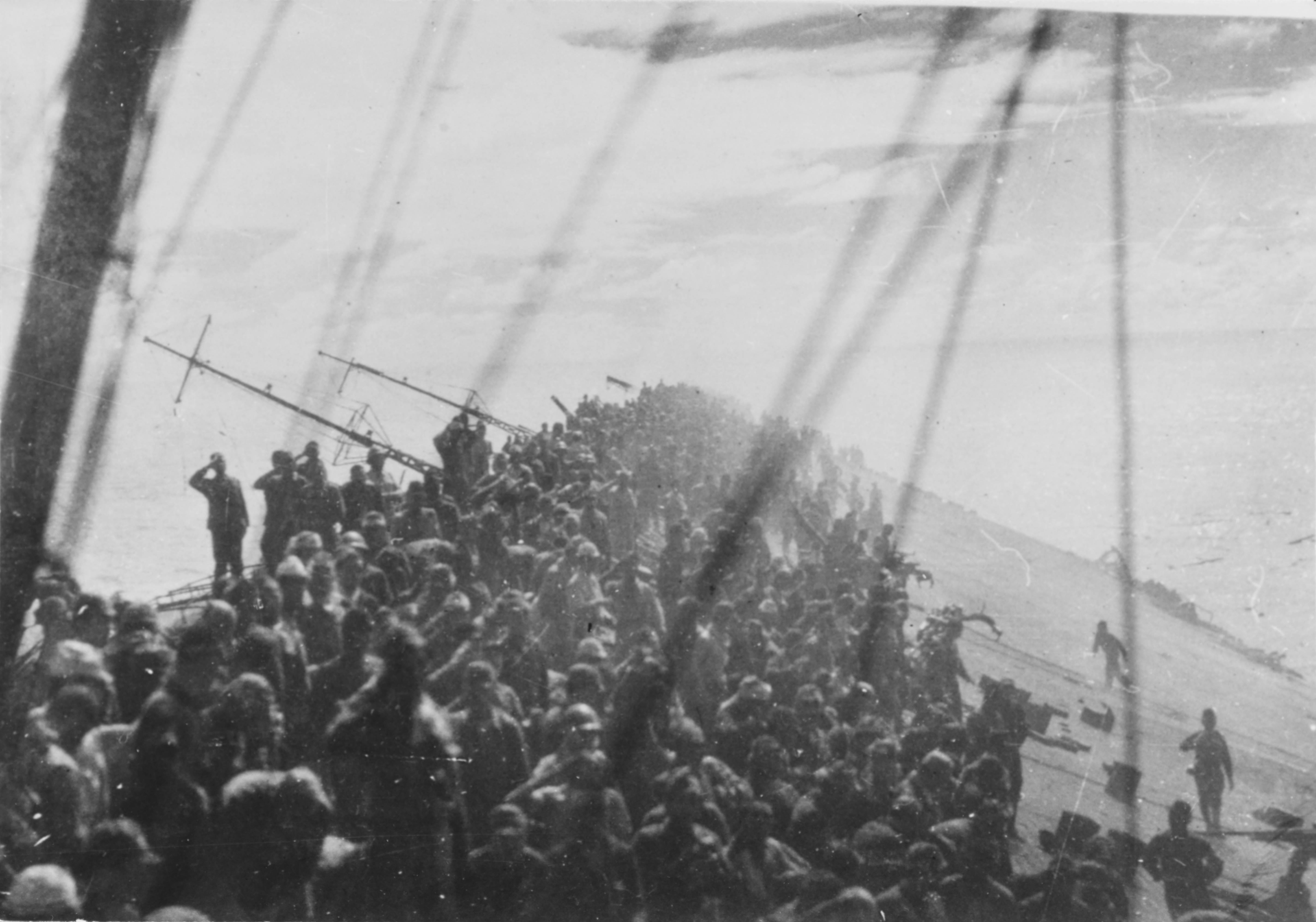
The damaged Johnston was surrounded by Japanese destroyers firing continuously until its skipper, Commander Ernest E. Evans (who was posthumously awarded the Congressional Medal of Honor) gave the abandon ship order. As she sunk, the survivors prepared to be machine gunned in the water as a Japanese destroyer passed close. Instead, survivor Clint Carter said he saw a “smartly dressed officer... on the wing of the bridge” saluting, along with Japanese sailors on deck, standing at attention.
Mariners know that sailing in the ocean requires a degree of courage. The sea is a merciless mistress. When a vessel is attacked and disabled, the attacking force recognizes the valor of her crew. Even—especially—if this is a civilian vessel, even one engaged in illegal smuggling, this recognition is due. If you’ve been watching Ken Burn’s PBS series “The American Revolution,” you have learned that one of the more egregious examples of King George III’s insults against the colonists is the use of the Royal Navy to confiscate and interdict American smuggling vessels, which sought to avoid punitive tariffs on British goods headed to the colonies. The Royal Navy frequently gave “no quarter” to smugglers.
The sea is a place for chivalry among mariners. The U.S. Coast Guard does not machine gun smuggling vessels. It orders them to “heave to,” boards them, and arrests the master and officers. Whatever part of the crew is needed to operate the vessel is treated according to the chivalry of the sea. Of course, if the smuggling boat decides to attack the Coast Guard, then they get what they deserve. But Americans do not machine gun sailors at sea, or survivors in the ocean.
Americans are known for treating POWs in such splendor compared to other nations, that in World War II, retreating Germans were willing to kill their own countrymen for the privilege of surrendering to us, versus being taken by the Soviets.
If no quarter is given, then no quarter should be expected, is a reasonable assumption. A suspected drug boat is not a foreign military vessel. Smuggling drugs is not an act of war. Attacking a smuggling boat to disable it may be a lawful act of law enforcement (though U.S. law provides for that, in that we have a Coast Guard, which is part of the Department of Homeland Security, to enforce laws at sea). Having other branches of the U.S. military commit an act of war against a foreign civilian vessel, then a “double strike” to kill the survivors may be a war crime, simply because the first attack is an act of war, and the second is the crime.
Regardless of that, it is a violation of the more ancient laws of the sea. Naval personnel do not murder survivors. Americans do not order “no quarter” against other mariners. It is not done, and doing it turns the U.S. into a nation not to be feared, but to be hated.
Sen. Mark Kelly, who is the subject of a Department of Defense investigation into remarks regarding refusing illegal orders (and not following uniform practices), that Hegseth called “seditious,” expressed “serious concerns about anybody in that chain of command stepping over a line that they should never step over.”
The Washington Post report alleges that after a September 2nd missile strike on a boat, “there had been survivors in the water after the first missile strike and the military carried out a second one to kill them because of Mr. Hegseth’s orders.” President Donald Trump told reporters on Sunday that he “wouldn’t have wanted” a second strike to kill survivors, and that Hegseth denied the allegations. Hegseth, without denying the Post’s report, called it “fabricated and inflammatory,” and in a statement, wrote that the strikes were designed to be “lethal, kinetic strikes.”
Even if there is a hint of the United States conducting strikes against survivors in the water, this demands a full investigation. It rises to the level of My Lai or Haditha, Iraq. No, it’s actually worse. Killing civilians in an actual war is a war crime. Killing mariners and survivors, civilians, at sea, is more than a war crime. It’s a violation of the ancient laws of the sea. It’s one of King George III’s tyrannies against the colonies that our founders included in the Declaration of Independence.
In fact, as my brother Jay has observed, we led a revolution against the British crown for less than what the Trump administration, and Pete Hegseth, have done. Giving the “no quarter” order against survivors on the high seas is beyond the pale. If this happened, Hegseth must suffer justice.
SOCIAL MEDIA ACCOUNTS: You can follow us on social media at several different locations. Official Racket News pages include:
Facebook: https://www.facebook.com/NewsRacket
Twitter/X: https://twitter.com/NewsRacket
Our personal accounts on the platform formerly known as Twitter:
David: https://x.com/captainkudzu
Steve: https://x.com/stevengberman
Jay: https://x.com/curmudgeon_NH
Tell your friends about us!
I strain to imagine a second strike scenario on a small boat after the first strike hit where the person launching ordnance doesn't know the status of the target. The main issue here is what's the SecDef doing calling tactical and giving verbal orders to troops? Unless we're talking a special ops mission like UBL, there's no reason Hegseth needs to be issuing orders at all. If the mission is authorized, it has an objective. If the objective is "kill them all," that's an illegal order. The entire thing must be investigated down to the second, to the word, and to the action.
What do you expect from a Commander in Chief who defends and honors war criminals?
That something like this would happen was entirely predictable, albeit not from the Secretary of Defense (a war criminal fan himself). Pete's a moron, but I didn't think he would be THIS stupid.
I'm calling it now, Trump grants him a pardon before any consequences can actually be levied.