


2026 seems to be the year of the near misses. At least that’s true for aviation.
The most recent near miss can’t be blamed on Pete Hegseth, unlike a couple of US military incidents earlier this year, but over the weekend, spectacular video emerged of two airliners very nearly striking a stadium in South Africa.
The scene was a bright, clear day in Capetown. South Africa and New Zealand were about to play a “football match”in DHL Stadium, if the lingo from”Ted Lasso” is to be believed. Incidentally, I’m late to that party, but it’s a great show, and it almost makes me care about soccer.
As is sometimes the case in the US, the game, or “match,” was preceded by a flyover. Rather than military aircraft, the Capetown flyover consisted of not one but two airliners. This was unusual for several reasons. Commercial aircraft don’t normally do flyovers, although maybe they would if Pete Hegseth was an airline executive. They also don’t normally fly in formation, and the the only time they normally fly near the ground is takeoff and landing.
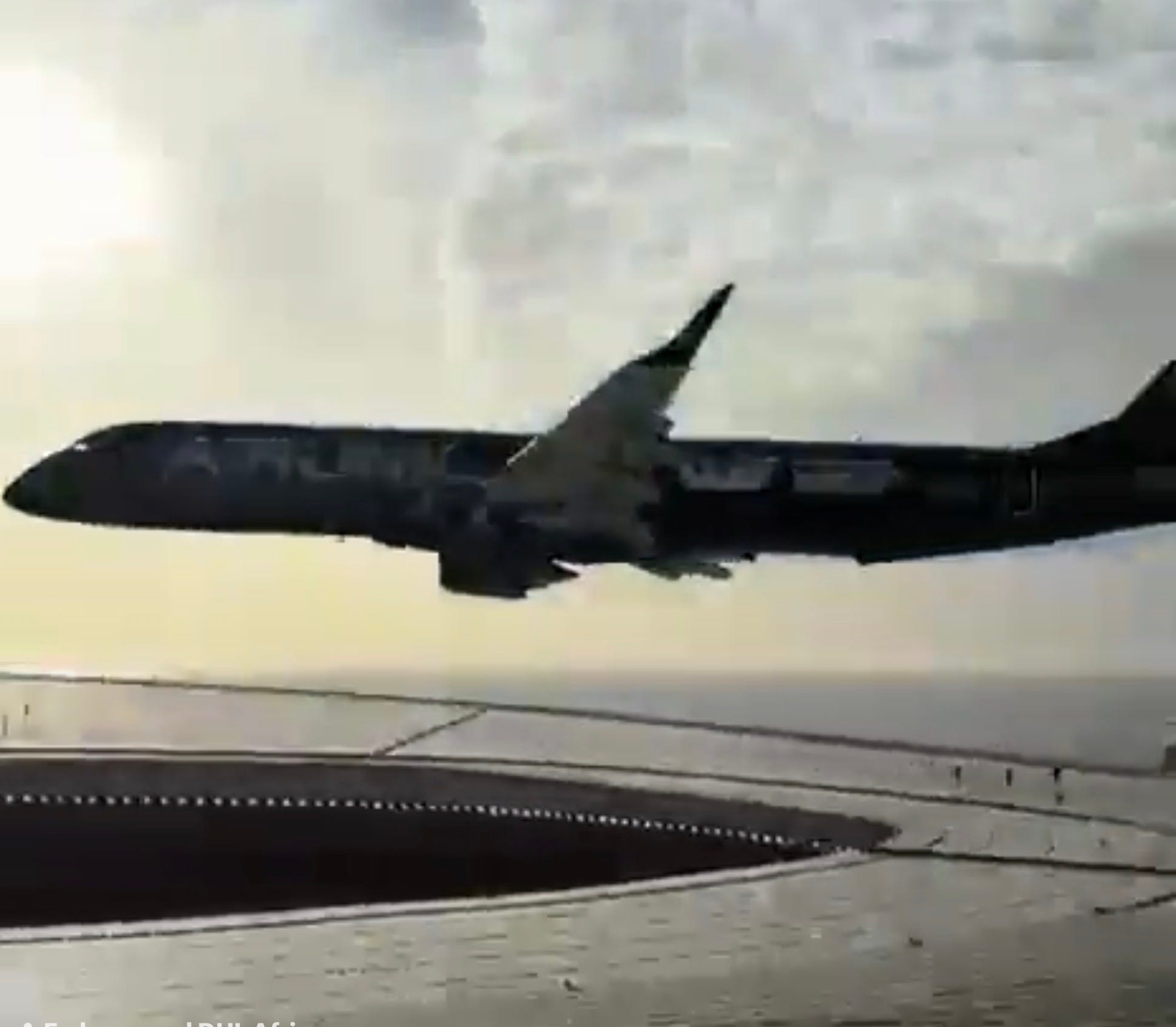
There were a large number of videos showing the flyby from various angles. This includes both inside and outside the stadium, closeups and shots from a distance.
Here’s what I saw. The two Embraer 195 airliners approached in formation, with the wingman in echelon off the lead’s right wing. The pictures show that the first plane was slightly lower, skimming just above the roof of the stadium, the second jet followed slightly higher, probably to avoid wake turbulence and wingtip vortices, either of which could cause loss of control. Pyrotechnics fire as the planes go over, and video shows the second aircraft flying through the smoke from the fireworks, leaving red swirls.
As with Blue Angel low pass over Florida in July, this was visually stunning, but at the same time incredibly dangerous. The big difference is that this was planned, rather than being a miscalculation. That makes it incredibly stupid as well.
To get an idea of just how close this was, FlightRadar24 reports that the planes crossed the stadium at 205-210 feet above mean sea level (MSL). This is the attitude read off the altimeter in the cockpit. The height of the stadium is 164 feet. That math indicates that the planes were less than 50 feet from the stadium filled with more than 50,000 people.
To put that in perspective, the E195 is only 35 feet tall with a wingspan of 95 feet. That means that the distance from airplane to stadium was about half a wingspan or just over one airplane vertically. That’s close.
Airlink, the South African airline that owns and operates the planes said in a statement, “The flight data recorded by both aircraft confirms that the flights were performed within the SACAA’s [South Africa Civil Aviation Authority] approved and rehearsed safety altitude and speed limits for the flypast.”
The company went on to note, “The two aircraft were flown by highly-experienced crew, with each comprised of three senior captains operating in the roles of commander, co-pilot and safety/technical officer.”
It’s probably true that the planes were flown by experienced formation flyers. The crews were probably former military pilots with low-level formation experience.
I don’t believe, however, that the flyby as conducted was approved by South African authorities. South African aviation regulation CAR 91.06.32 bans flights below 1,000 feet above the highest obstacle with 2,000 feet. That mirrors US FAA rules in FAR 91.119. The South African rules allow exemptions for lower altitudes for airshows or flybys, but I seriously doubt that regulators would approve a 50-foot pass, five percent of the usual requirement.
I fly a different Embraer model than the Airlink 195s, but I can tell you that airline and corporate aircraft are not designed fly straight and level at low altitude. The airplanes are equipped with a ground proximity warning system (GPWS) that alerts the pilots if they are too low when they aren’t in the vicinity of an airport. Unless the pilots disconnected the GPWS, something else that I have a hard time believing regulators would allow, they were probably getting yelled at for the whole maneuver by an automated voice insistently saying, “Don’t sink,” “Terrain, terrain,” and the chilling, “Pull up, pull up!”
The flyover reminds me a lot of a 1988 Airbus flyover at an airshow in France. The airliner experienced an issue with the fly-by-wire flight control system and serenely continued down the flight line into the trees. Three people on board died in that crash, but a malfunction on the Airlink planes would have been much more catastrophic.
And that’s why I think this was a rogue operation. Aviation regulators are notoriously strict when it comes to risking the lives of paying passengers and innocent people. I think the chances that South African civil aviation authorities would allow two airliners to come within 50 feet of 55,000 people are somewhere between slim and none.
There’s a saying in aviation that superior pilots use their superior judgment to avoid having to use their superior skill. The Airlink pilots were undoubtedly highly skilled, but it’s their judgment, along with that of their bosses, that is in question.
SOCIAL MEDIA ACCOUNTS: You can follow us on social media at several different locations. Official Racket News pages include:
Facebook: https://www.facebook.com/NewsRacket
Twitter/X: https://twitter.com/NewsRacket
Threads: https://www.threads.com/@theracketnews
Blue Sky: https://bsky.app/profile/newsracket.bsky.social
Mastodon: https://bird.makeup/users/newsracket
Our personal accounts on the platform formerly known as Twitter:
David: https://x.com/captainkudzu
Steve: https://x.com/stevengberman
Jay: https://x.com/curmudgeon_NH
I read everything you write about aviation safety because I think you are good at your job. That's based on my assumption that you have several thousand take-offs and landings with no crashes. I do believe that the Blue Angels are perfectly capable of low altitude flyovers and that their planes are designed for such maneuvers. I have to agree that it would almost as exciting if they provided the thrills a hundred yards seaward of the sunbathers, surfers, waders and swimmers.
I just hope you did not select this incident as an excuse to sling a few more slurs about the Trump administration. I can stand in my driveway and watch the line of planes about two or three miles apart approaching the ATL from the NE. One of them could be yours delivering corporate bigwigs from Charlotte to Atlanta. If you experienced really bad problems somewhere in the vicinity of Jefferson GA or Braselton GA, how do you select which subdivision to crash into. Mine is near the intersection of Friendship and Spout Springs roads.
Not the same thing at all, but when you get a chance you might watch some of the United 747 flight demos at SF Fleet Week - like this from 2017: https://youtu.be/jlo9aFWLUzs?is=oFoLaEtU_ZqXssyK