


One of the most interesting shows that I’ve watched recently was “Death By Lightning,” a four-episode Netflix series about the assassination of Garfield. When I say “Garfield,” I mean James A. Garfield, our 20th president, and not the more well-known lasagna-loving cartoon cat.
President Garfield [spoiler alert] was shot by a deranged supporter only a few months after taking office. He died after a long struggle with infection from a wound that probably would have been survivable had it not been for the doctors of the day. The series is both informative and entertaining. Nick Offerman, best known as Ron Swanson on “Parks and Recreation,” steals the show as the corrupt-but-redeemable Chester A. Arthur. (Be aware that Garfield’s assassin, Charles Guiteau, spent time in a sex cult, and this is graphically depicted.)
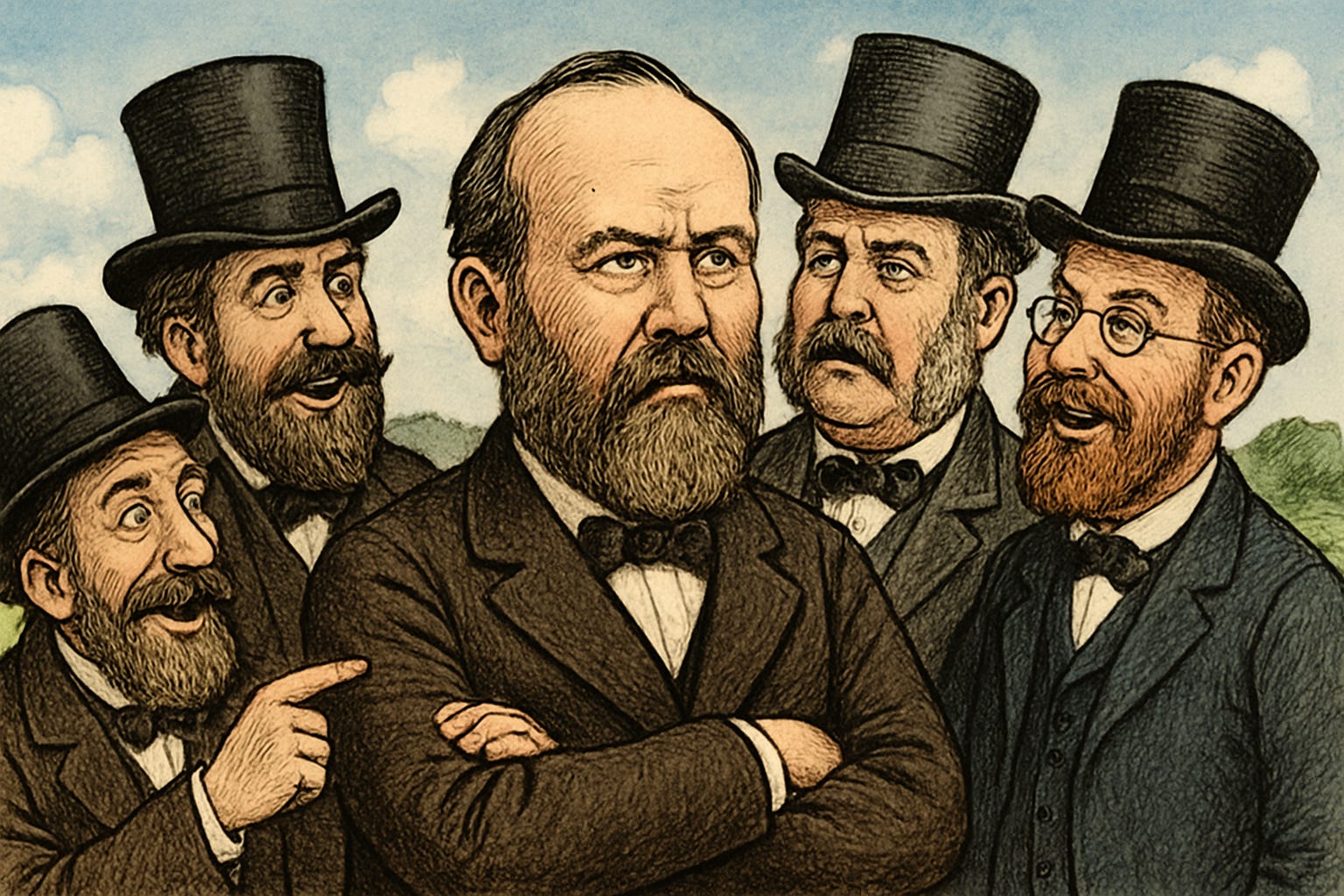
This little-known episode of American history is relevant today because Garfield was a reformer (and an anti-tariff free trader to boot). He rooted out corruption in the Post Office, even though his own Republican Party was involved. His uncompromising objectivity and righteousness did not fit well, even then, in the federal government or the Republican Party.
Charles Guiteau considered himself a Republican stalwart. He was a ne’er-do-well who has since been diagnosed with possible schizophrenia. Guiteau felt that he was entitled to be appointed to the position of Paris consul, despite the fact that he spoke no French, as a reward for his service to the Garfield campaign.
Guiteau was more of a partisan than a patriot. The Republican split over Garfield’s policies concerned him as dangerous for America, and he believed that it would be better for the country if Garfield died and Vice President Chester A. Arthur assumed the presidency.
Aside from the obvious parallels with today’s political violence and partisanship, the story is relevant for another reason. Guiteau’s murder of Garfield backfired in that the new president embraced Garfield’s reforms and signed the Pendleton Act in 1883, reforming the civil service system.
Prior to that time, the federal government operated primarily on the spoils system. Each new presidential administration would remake the majority of the federal bureaucracy. Jobs would be filled with political appointees who were not necessarily the best person - or even competent - for the job. Civil service reform insulated federal workers from the changing politics of different administrations and introduced a merit-based system of employment and advancement.
Fast-forward to this week when the Supreme Court heard arguments in Trump v. Slaughter, a case that tests presidential control over independent agencies established by Congress. The case centers on the question of whether Trump can fire Rebecca Slaughter, a member of the Federal Trade Commission, whom Trump himself appointed in 2018. Slaughter was appointed to a second term by Joe Biden and was not slated to leave the FTC until 2029. The 1935 Humphrey’s Executor ruling limited the president’s power to fire independent board members at will (the law requires “inefficiency, neglect of duty, or malfeasance in office”), but a new generation of unitary executive activists is questioning that long-held precedent. Some even consider the delegation of power by Congress to independent boards to be potentially unconstitutional.
In the past hundred years or so, executive power has expanded dramatically under both parties. Congress has made a habit of passing general laws and delegating power to make specific rules to executive branch and independent agencies. In practice, this has transferred lawmaking power to the executive branch and the presidential appointees.
It also means that national regulatory policy changes dramatically when power shifts from one party to the other. Something legal under one president can suddenly become unlawful under a new Administration without Congress ever acting.
This is possible because the top-level officials who head the regulatory agencies are still presidential appointees. This is a vestige of the spoils system that is necessary because a president should have people heading his Administration who will carry out his philosophy of government.
As part of Project 2025, the Trump Administration is seeking to expand its ability to fire federal workers and exercise control over federal agencies. This would essentially represent a return to the spoils system in which federal bureaucracies were gutted every four to eight years and restocked with party loyalists. This might sound good to the Republicans who currently hold power, but they should ask themselves what will happen when Democrats regain control of the government. The current crowd seldom seems to consider this possibility.
The Trump Administration is probably the worst possible poster child for a return to the spoils system. Trump and DOGE have already fired thousands of federal employees (while increasing the cost of government), but the poor quality of Trump’s appointees at the top level should terrify Americans everywhere about the possibility that he might eviscerate and rebuild the entire federal government from the bottom up with MAGA loyalists.
Can you imagine a full complement of Kash Patels at the Federal Election Commission? How about RFKJR setting nuclear power standards at the Nuclear Regulatory Commission? Maybe some other Fox News alums would be tapped to set broadcast standards and oversee licensing at the FCC. The possibilities are both endless and horrifying.
There probably needs to be a line beyond which Congress cannot delegate, but it’s also true that politicians don’t have the expertise or objectivity to micromanage very technical fields. A bunch of lawyers isn’t necessarily qualified to make safe or sensible regulations for operating a nuclear power plant, and the federal gerontocracy isn’t tech-savvy enough to do a good job of regulating AI and other emerging technologies. Donald Trump’s brain trust also definitely isn’t qualified or trustworthy enough to regulate tech, as he is trying to do with an Executive Order preempting state regulation of AI. (On a side note, E-O-E-O-A-I is ripe for insertion into a parody song to the tune of “Old MacDonald.”)
Some delegation is clearly needed and constitutional, but federal agencies need to remain responsive to the Article I branch of government (Congress, for those of you in Rio Lindo) rather than falling into the orbit of the increasingly imperial presidency. The framers did their best to prevent the concentration of power in the hands of one man, and we’ve been steadily undoing their work ever since.
The general consensus after the oral arguments on Trump v. Slaughter is that the Court will uphold Slaughter’s dismissal and strike another blow against congressional relevance, but the big question is how far the Court will go. The range of possibilities runs the gamut from a narrow decision favoring Trump but maintaining limits on the president to a broad ruling that eviscerates the entire concept of independent agencies.
The best solution to presidential encroachment is to elect good people. The ultimate direction of the country is going to depend on the voters. If the American people don’t like the growing concentration of power in the hands of sometimes corrupt and often incompetent presidents, then they have the power to do something about it. I have faith that they will.
In the post-Trump era, Americans need to look toward reform-minded individuals in the mold of Garfield and Arthur who will work to return power to the people and Congress. Passing reforms that limit the power of the presidency over a filibuster and a presidential veto will require selflessness on the level of George Washington, who rejected a life tenure to return to private life at Mount Vernon, on the part of both the president and members of Congress.
If we find the people to vote for a return to the original intent of the founders, I hope we find government officials of caliber of Washington, Garfield, and Arthur to see it through.
EPSTEIN FILES A federal judge in New York has ordered the Epstein grand jury files unsealed, but 324 days after Trump returned to office, the Epstein files have still not been released.
TRUMP FIXES PROBLEM CAUSED BY TRUMP I’m surprised it took this long, but Trump unveiled a new $12 billion aid bill to bail out farmers hurt by the tariffs and trade wars.
SOCIAL MEDIA ACCOUNTS: You can follow us on social media at several different locations. Official Racket News pages include:
Facebook: https://www.facebook.com/NewsRacket
Twitter/X: https://twitter.com/NewsRacket
Our personal accounts on the platform formerly known as Twitter:
David: https://x.com/captainkudzu
Steve: https://x.com/stevengberman
Jay: https://x.com/curmudgeon_NH
The fundamental challenge we're running into is that the real world has grown significantly in governable complexity and we've created an environment where *actual* experts are no longer trusted and every incentive we have is to tear down the experts that we *do* have who are telling us things we may not want to hear and replace them with cosplayers who *do* tell us what we want to hear, in an information environment where "do your own research" is seen as preferable to actual credentials signifying competency.
On this latter point, credentialing organizations deserve a large part of the blame for this as they made it their missions to pretend being professional sports teams and running their institutions like companies selling products - "The Customer Is ALWAYS Right!" - as opposed to serving as valid gatekeeping entities filtering out the kooks from the folks who know their stuff.
I'm expecting this to get MUCH worse before it gets any better. My only hope is that this fever snaps soon enough that we still have people around who remembers what a functional civil service was to help put some semblance of one back together.
Great comments on my pet peeve - Congress passing bills that leave the real lawmaking to bureaucrats. Presidents who sign such bills into law are equally to blame.
I do not believe you can show that many agency heads and commissioners, regardless of who appoints them, are experts in the field they are regulating. Chris Hanson who was selected to be NRC Director by Biden and later fired by Trump was a consultant at Booz Allen Hamilton and had a master's from Yale Divinity School and Yale School of Forestry and Environmental Studies, and a Bachelor of Arts degree in Religious Studies from Valparaiso University. I would prefer RFKJr.
The Supreme Court has held that deference to the "expertise" of government bureaucracies is not automatic.
The solution to the dispute over executive powers should be meaningful congressional oversight and corrective legislation. Unfortunately, Congress has no expertise and hires very little of it into their staff of 30,000. Congressional hearings are nothing but a circus of insults, accusations, and making political points. Congress cannot even pass a balanced budget bill and stick to it.