


Three, two, one…did you know that in just 10 days, NASA could launch the largest manned rocket in history to the moon? It seems there just aren’t enough people excited about Artemis II (I am compelled to give credit for this sentence to my son Sam). The Artemis program is a series of moon launches based on the Space Launch System (SLS) rocket, using the Orion spacecraft. Think a giant Saturn V-looking rocket with two Space Shuttle-style Solid Rocket Boosters (SRBs). This program has been in development for years—since 2017—with an ultimate goal of putting Americans back on the moon, with a permanently manned station.
Four astronauts: Commander Reid Wiseman, Pilot Victor Glover, and Mission Specialists Christina Koch and Jeremy Hansen, will board the Orion capsule, launch into orbit, and spend 10 days doing a lunar fly-by and free return trajectory to bring them home. The launch window opens on February 6th. Everything is getting super-ready. The stack, SLS plus Orion, has moved from the Vehicle Assembly Building (VAB) at Kennedy Space Center to Pad 39B, on top of the same Crawler-Transporter that moved the Apollo missions and every Space Shuttle to its launch position.
You’d think the news would be counting down the days and hours to this historic launch. It’s the first time in 53 years that humans will fly to the moon, the furthest into space any humans have ever ventured from our home planet. I know I’m excited. I even rewatched the movie Apollo 13. Yeah, I know, I know, that was Hollywood. All the emotional, tense moments between the crew were artistic license. Nobody wants to pay to see three calm engineers in space working through problems together, one issue at a time, in meticulous detail, and nary a harsh word between them. Nobody wants to pay to see 100,000 NASA employees and contractors all doing their damndest to find solutions to a thousand hurdles to bring those astronauts home safely. We want heroes, bigger than life.
It just seems like Wiseman, Glover, Koch, and Hansen should be more household names than they are. It’s not fair, is it? Maybe people will get moon fever once the rocket launches. Then again, maybe not. These astronauts are not landing on the moon. Let me say it again: we’re flying to the moon, but not landing. Artemis II doesn’t even have a lunar lander. In fact, the SLS-Orion stack doesn’t have room for a lunar lander. There is no plan to include a lunar lander in the rocket stack carrying our astronauts from the earth to the moon. NASA is not building one. I’m serious.
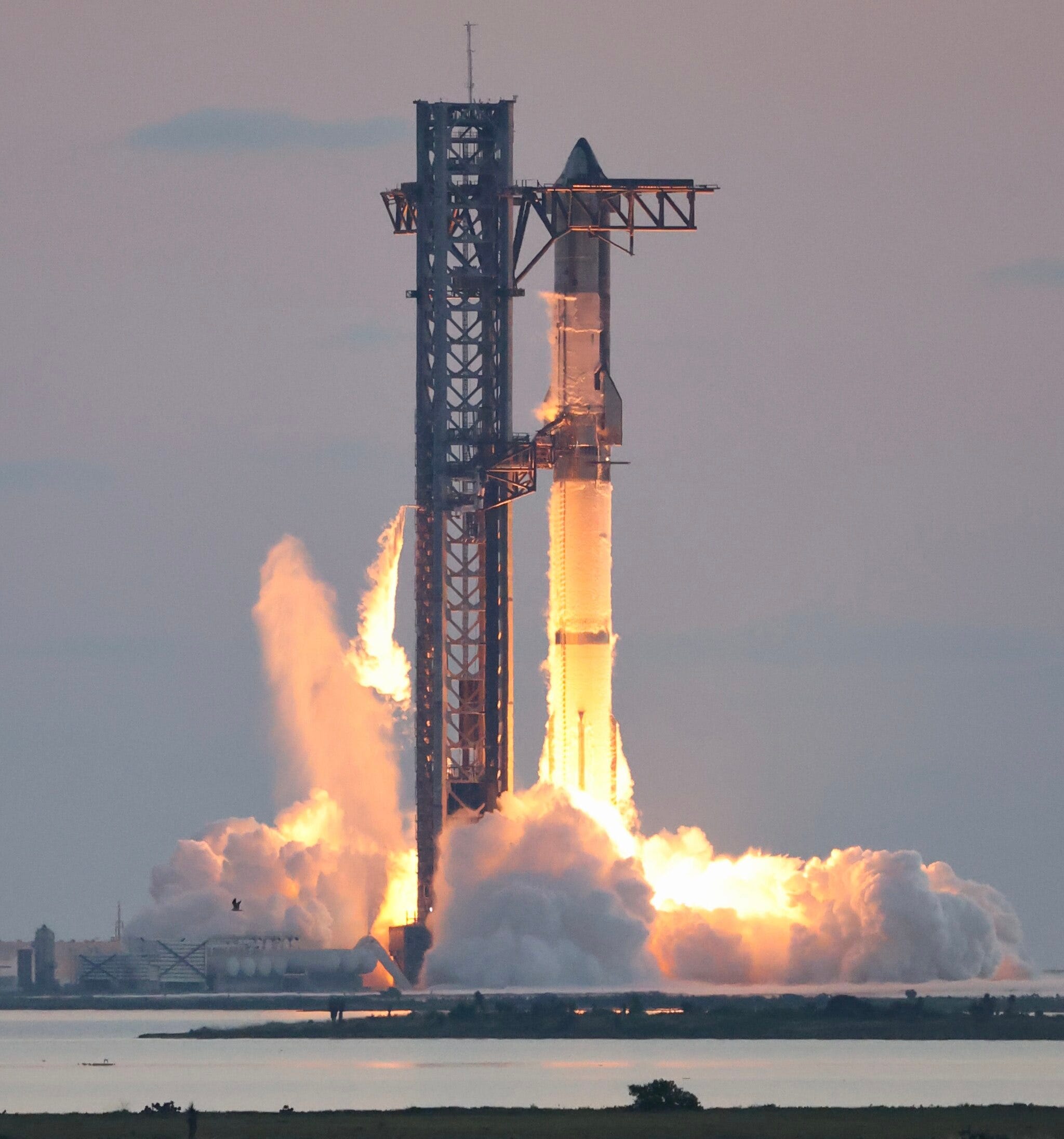
Don’t get me wrong. The Artemis program does plan to land astronauts on the moon. It’s just that they’ve subcontracted out that particular part of the program. To whom? I think you know (see the picture above). It’s SpaceX. You’ve certainly seen the vehicle that SpaceX is going to land on the moon, because it’s the Starship. Yep, the one that launches from Texas. The one where most of the launches end with an unexpected rapid disassembly (RUD)—you know, an explosion.
The Artemis II mission is a dress rehearsal for the SLS, Orion, and the live astronauts aboard. It’s like Apollo 8, the Christmas mission in 1968, where Jim Lovell, Frank Borman, and Bill Anders made a similar journey. The big difference is that the Apollo capsule had about 5.9 cubic meters of habitable space, while Orion is around 50 percent roomier, with about 9 cubic meters. But there’s an extra crew member on Orion, so it’s not necessarily less crowded. Where we get the payoff is Artemis III, when we actually land on the moon, using a variant of the Starship called the Human Landing System (HLS).
The HLS sports 600 square meters—21,000 cubic feet, about the size of a 2,300 square foot house—of pressurized habitable space. Its airlock is double the volume of the entire Apollo lunar lander. It’s about 15 stories tall, and has an elevator to bring the astronauts from the living space to the surface. Here’s the plan for Artemis III:
Starship HLS launches into low earth orbit.
Propellant tanker Starships launch loaded with fuel for the HLS, dock with HLS and transfer their fuel while in orbit.
The HLS initiates an unmanned Trans-Lunar Injection (TLS) burn to the moon, where it enters a Near-Rectilinear Halo Orbit (NRHO). It can loiter and hold this orbit for up to 100 days.
Orion arrives and docks with HLS. HLS descends to the lunar surface at the south polar region.
Astronauts explore and do their experiments, living in the HLS for up to 7 days. They use the elevator to get to and from the surface.
The HLS lifts off from the moon to rendezvous with the unmanned Orion. The crew transfers back to Orion for return to earth.
The HLS may remain in lunar orbit for later use, or be abandoned.
Simple, right? Artemis II proves everything the SLS, Orion and the astronauts need to do, so all we need is HLS. Except that SpaceX has not proven any part of the 7 steps required to execute the Artemis III mission. The company has not launched a Starship into a stable earth orbit, though just about everyone believes that will happen in 2026. SpaceX has not demonstrated an orbital fuel transfer, which nobody has ever done before. The company has not demonstrated an HLS, refueled in orbit, can execute a TLI burn, enter lunar NRHO orbit, loiter while its systems remain active, land on the moon upright (not a simple task for even an unmanned lander), deliver astronauts using a 1/6 gravity elevator, lift off from the lunar surface, and rendezvous with the Orion capsule.
The official NASA timeline puts the Artemis III launch sometime in 2027 or 2028. I think it’s laughable to think SpaceX can meet that target. I am not sure SpaceX even wants to. I think Elon Musk is focused on Mars, not the moon. Landing on the moon is simply a staging demonstration for Mars. And if the technology can be developed at taxpayer expense, why even bother going to the moon—just go to Mars and be done with it.
I do think SpaceX is committed to launching an HLS into orbit, refueling it, executing some kind of burn, and doing all the things that the Artemis program needs it to do. I just don’t think they’re particularly excited about doing it on the moon. Musk, and by extension, his minions at SpaceX, want to go for Mars. Going for Mars is a different task, a different mission, with completely different parameters, than going to the moon. To me, I think it means that HLS won’t be ready for 2027, 2028, or 2030. We’ll be lucky to get it ready by 2035, and by then, Elon will be launching unmanned habs to Mars, and the Chinese will have a permanent moon base already established.
The most important part of going to the moon is wanting to go to the moon. You know, we already know how to do it. We did it. The people who did it wrote down how to do it. They wrote down everything needed to go to the moon. Not just the technical aspects, most of which we don’t really need, because we have much better tech than NASA did in 1969. They wrote down how to manage a moon mission correctly. And we’re not doing that at all.
Youtuber and rocket engineer Destin Sandlin gave a talk to NASA managers, and told them straight. “Has anyone ever heard of this document,” Sandlin asked as “NASA SP287” appeared on the screen. “What Made Apollo a Success?” He then asked, “in your head, answer the following question, have I read NASA SP287?”
“And if you have not read it, I’m not joking about this, shame on you.”
The main point of going to the moon is wanting to design a program to go there. Not to go to Mars, or develop a space system to do this or that or other things. Going to the moon means optimizing the program to go to the moon. We’ve done it before. I don’t think the people who have been awarded the contract to do the landing on the moon have going to the moon as their primary goal. They are simply not excited about it. They are excited about Mars.
I am excited that Artemis II will take four astronauts, Wiseman, Glover, Koch, and Hansen, back to the moon for the first time in 52 years. But they won’t land on the moon. I think the next humans to step on the moon won’t be Americans. They will be Chinese. The Chinese want to go to the moon. We Americans, well, the sad thing is we just don’t want to go there again.
So Artemis II will launch, be a great success. Four astronauts will orbit the moon and return to earth. But they won’t be heroes. They’ll be remembered at NASA, but they won’t be lauded like the Apollo astronauts. For that, we need Artemis III. And I don’t see Artemis III happening. The Chinese will get there, and we will make a lot of noise, and then set our sights on Mars, where we can be first. We love our heroes, and that’s what I think will happen.
So we’re going to the moon…almost. We can still make it, if we decide we want to go. I’d be so delighted if we would make up our minds to go.
SOCIAL MEDIA ACCOUNTS: You can follow us on social media at several different locations. Official Racket News pages include:
Facebook: https://www.facebook.com/NewsRacket
Twitter/X: https://twitter.com/NewsRacket
Our personal accounts on the platform formerly known as Twitter:
David: https://x.com/captainkudzu
Steve: https://x.com/stevengberman
Jay: https://x.com/curmudgeon_NH
Tell your friends about us!
I'm an investor in two companies who are involved in our return to the Moon - Intuitive Machines and Rocket Lab - so this is exciting.
What's less exciting about it, is that the SLS is a dead-end technology-wise for sustaining a lunar presence (too slow and expensive to launch). Fortunately, the private sector - led by SpaceX (at the moment) - is beginning to fill in a LOT of the infrastructure gaps.
Destin's talk at NASA is a good one to watch, and he's quite frank about Starship too.