


I used to fly small airplanes. I do not fly any longer; not because I don’t want to, but because I have had some bouts of vertigo, and it’s just not worth the risk, even if I could convince an Air Medical Examiner to sign off on my medical certificate.
I remember what one retired Air Force officer, a colonel, told me. I’ll paraphrase: if you can’t fly at the level of proficiency required to maximize safety, don’t fly at all. This officer stopped flying. Some pilots fly on occasion, but not often enough to hone their skills. Professional pilots who crew bizjets are not among those weekend fliers. But the Learjet 60 that crashed Sunday in Palm Beach County, Florida testifies to the fact that the sky is very unforgiving.
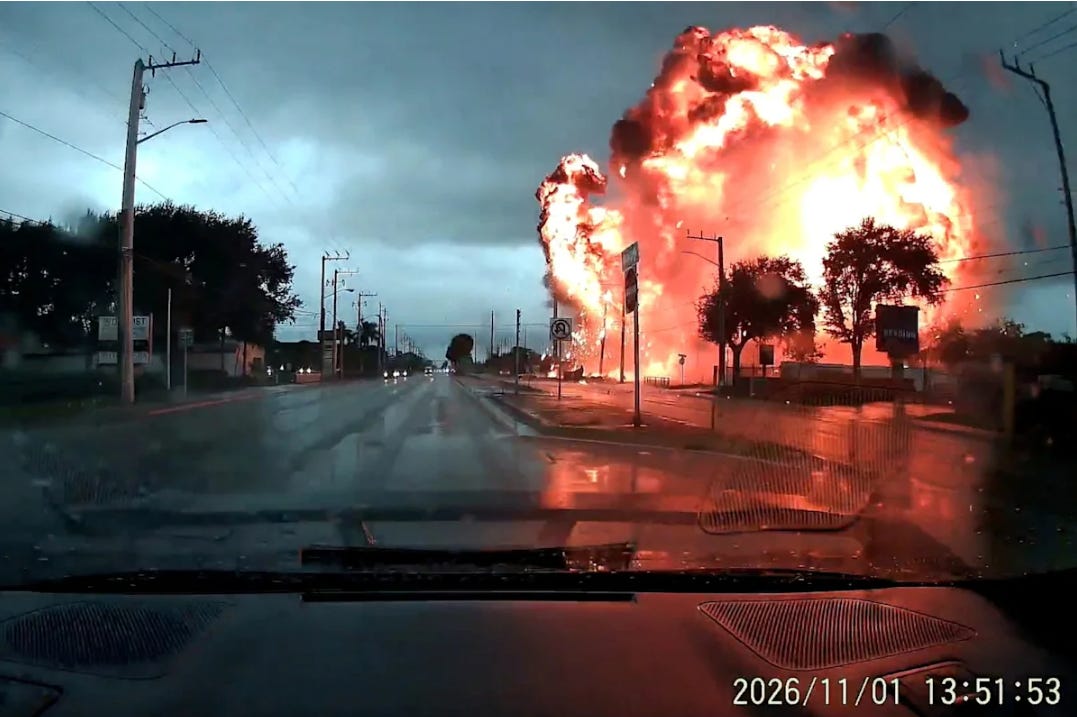
More information has been released by the NTSB, onsite gathering evidence at the crash scene. The most relevant fact is that parts of an elevator, possibly the entire assembly, has been recovered over a mile from the crash crater, which implies that a very important control surface separated from the aircraft prior to the crash. This fits with the horrible image of the Learjet hitting the ground at a very severe angle, at great speed. David Thornton observed that it appeared to be uncontrolled flight. At the point where the Mayday call was made, without critical flight controls, there would have been no chance of recovery. We don’t fully know any of this, but it would seem that the situation is coming more into focus.
Another piece of information involves the weather during the portion of the flight just before the aircraft nosed over into a dive. Meteorologist Ryan Hall examined the radar and other weather data, along with the aircraft’s position minute by minute. This revealed a terrible confluence of severe thunderstorms, a strong updraft, and icing conditions along the path of the flight. These conditions were somewhat masked from satellite and radar. Watch the video; Hall explains it much better than I ever could.
I won’t get into the details of whether the pilots could have predicted the events that led to the crash. I will say that no professional, or even private pilot, would knowingly fly into the core of a thunderstorm. Hall mentioned that there was a “SIGMET” for severe convective activity in the area of Palm Beach County at the time the Learjet flew through. Based on the actions of the pilots, based on the aircraft position and ATC conversations, it seemed they did take some action, both climbing and descending, to avoid the effects of the storm.
It’s very easy for people not in aviation to pin blame on the pilots, but things are not so cut and dried.
First of all, in south Florida, it’s common to have a SIGMET for severe convective activity over half the state, every single day. It’s also common for these events to happen quickly, and for the weather to change literally minute by minute, on a dime. Second, the pilots were professional, and the 20-year-old co-pilot working the radio was from the area, and certainly familiar with the weather. I doubt this was a clear case of “get there itis” where a pilot decided to continue through marginal conditions in spite of clear warnings.
That does happen: John F. Kennedy Jr. perished in a Piper Saratoga II, near Martha’s Vineyard. Though technically flying in VFR conditions, the twilight, haze, and ocean obscured references Kennedy, who was not IFR certified, needed to keep his aircraft properly level. He flew into a “death spiral” without realizing it. The worst part is that he had been warned against attempting the flight alone. I believe based on the initial evidence, that the Learjet crew probably didn’t commit the kind of gross error in judgement Kennedy made, though again, it’s very early in the investigation.
But the sky is unforgiving. I can tell you about a couple of instances where it happened to me, back when I was flying a lot.
One time, flying out of Cordele, Georgia, not even a 30-minute hop to Perry, Georgia, at night, I was under a clear sky with a full moon. I called for a weather briefing and was told there was a cell moving out of Montezuma, to the west, but I had plenty of time to make my short flight if I left right then. So I took off into a clear sky, following I-75 north.
The first thing I noticed was that the moon was gone, obscured by clouds. Then less than five minutes later, the interstate became “fuzzy” from the air. This means that rain had recently fallen and I was seeing the mist thrown up by cars on the road. Thirty seconds later I felt a strong gust rock my wings 20 to 30 degrees. I corrected and flew on. I would be in visual range to see the airport beacon at the Perry-Houston County airport within a minute or two. Another thirty seconds later, another gust hit, rocking me to 60 degrees. Cold sweat. I saw the beacon. The question: continue and quickly land, or turn back?
I turned back. Total time in the air was less than 35 minutes, and I was less than five minutes from the runway at PXE. The forecast said it should be clear, but the forecast was wrong, because radar and other tools weather forecasters have are not perfect. By the time I landed (and kissed the ground, really, I did) back at Cordele, the moon was out under a clear sky. Anyone can inadvertently fly into bad weather, even doing everything right. I can’t say whether I’d have made it to Perry if I continued, but I was convinced the next gust was going to flip me over, and that was enough. Another, bolder, pilot might have tried and made it.
Another time, I was flying back from the west coast of Florida, about 2/3 of the way up, back to Perry again. I knew if I left anytime after 3:00 p.m. or so, I’d probably run into some weather, because it was springtime in Florida. I tried to thread the needle as the clouds closed in, but ended up landing at a tiny strip, tying down the plane a minute before the gust front hit.
That line of storms went from Pensacola to Jacksonville, and though I tried to fly out a couple of times when it looked like a break might come, I ended up spending the night at a Knights Inn after a three mile walk from the airstrip. The weather in Florida is predictable, and unpredictable at the same time. If you fly there enough, it can become numbingly familiar, dealing with storms.
A third story. This time I was a passenger on a semi-scheduled, on-demand jet service called DayJet, that used Eclipse 500 aircraft, which seated 6, including the two crewmembers. The EA500 was a cool little jet, but it had one glaring problem (besides having no bathroom). It lacked anti-lock brakes. This became relevant when we were running late on a trip from Sanford, Florida to Macon, Georgia, and the pilots wanted to get on the ground, turned around, and off again to get to Pensacola. But there was weather. I usually took my David Clark headset as a passenger on those trips, and the crew let me plug in and listen to their conversations. This time, they were dodging some big, fast-rising thunder clouds to get into Macon downtown airport, dropping from 10,000 feet to approach altitude in a fast tight spiral.
I thought we were coming in rather high and hot, but the flying pilot decided to dump as much airspeed as possible versus going around. We floated over the runway and he put it down, standing on the brakes to stop us. Then: bang! bang! Two tires blew. The crew truck came out and got me, while the pilots had to sit by the plane waiting for a tow. Later, I got a call from DayJet operations asking if I had anything to add. I told them what I saw: pilot error, high and hot.
Could the flying pilot have decided to go around? Certainly. Could they have built in weather in their flight planning? I’m sure they did. Didn’t matter. Florida weather happens, and the sky is unforgiving.
There are few details known about the Learjet 60 crash, and it’s a terrible tragedy. But what we know so far is that apparently that bad weather, plus some other factors likely combined to disable that plane, causing an unrecoverable situation. The NTSB will do its job and determine with as great specificity as possible the causes and factors leading to this crash. But we should not jump to conclusions. It can, very easily, happen to anyone, even the best pilots.