


Jonah Goldberg was on the menu for my morning reading. He wrote about logical fallacies and the limits of being right. That’s our brains tricking us into doing the same things over and over that appeared to work before without analyzing why they worked before. There are too many examples to list, starting with people who repeatedly load money onto little cards to sit and push buttons in a casino because they are “due” to win, and proceeding to the political, economic, and military victories of our current president.
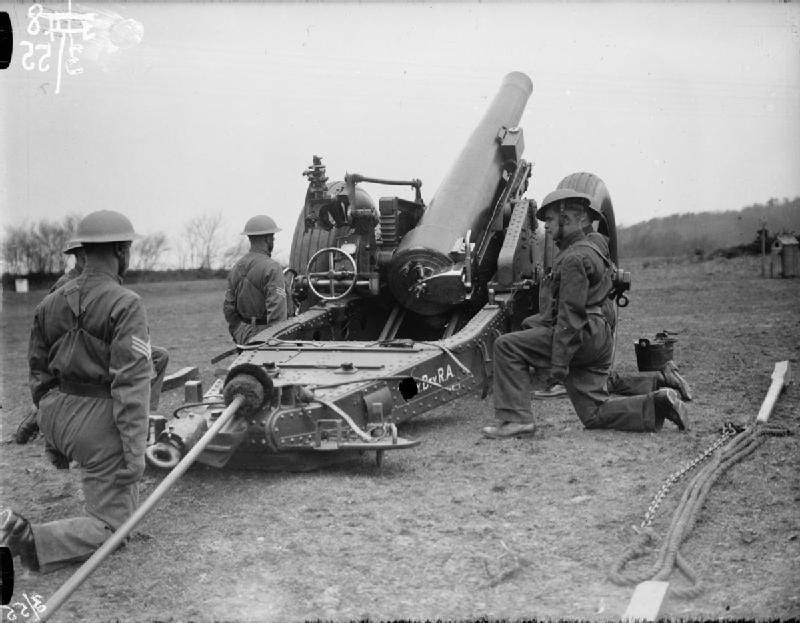
The phrase “holding the horses” has its place in a mythology regarding British artillery crews. The story goes that U.S. artillery squads were able to out-fire their British counterparts, and the British wanted to know why. As they studied their process, they noticed some of their team members would stop and step back, pause, and then the gun would fire, and they’d step forward again. When asked, the crews said “that’s how we were trained.” None of the experts could come up with the reason, until one pre-World War I veteran offered: “I know what they are doing, they are holding the horses.” Of course, British artillery had not used horses since the days before the Great War, but the procedure persisted. It turns out this is more myth than fact, but it has been retold many times.
Militaries have tremendous pride in their ability to produce integrated teams, who know to a fine degree how to operate with each other, and within themselves. This is the result of a huge amount of training, to the point where individual actions, like reloading a rifle, or firing an artillery piece, are muscle memory for those doing it. It also produces people who are deeply ingrained in a particular way of doing things, even when those things are not really the best way to fight a war today.
During World War I, the Prime Minister of France, Georges Clemenceau is given credit for saying “Generals always prepare to fight the last war, especially if they had won it.” I can easily find dozens of similar quotes from history, newspapers, and think tanks. This adage gets used so much because it’s undoubtedly true. It’s one of the oldest logical fallacies that Jonah touched on: “victory disease,” “superstitious learning,” “winner’s bias,” “selection bias,” and the “hot hand fallacy.” We do what worked before because if it worked, it must be a good idea.
I go back in my brain to “Fiddler on the Roof,” where Tevye sang in “If I Were a Rich Man.”
And it won't make one bit of difference
If I answer right or wrong
When you're rich, they think you really know
When someone’s rich, people figure they must be smart, because they made a lot of money somehow. It’s a myth and a fallacy, because many people get rich because of blind, stupid luck, graft, or inheritance—or all three. Look at Brian Epstein, who became wealthy by constantly lying and manipulating people who should have, could have, known better (and many times did know better). Any Ponzi scheme has at its core a person who knows how to sell the Tevye fallacy.
Similarly, generals and admirals and people at the top of the military food chain are typically produced by the military, and though we tend to think they know what they are doing, they are really the product of years of military training, based on the way the generals and admirals and military thinkers of years ago taught them how to think and fight. Also, of course, some attain high rank by political chicanery, sucking up to the boss, being in the right place at the right time, or being Forrest Gump—doing what you’re told and sticking around long enough.
In the American Civil War, most of the generals on both sides had attended West Point. This was evident in the early battles, where tactics intended for short-range muskets were applied to lines of troops facing an enemy using rifled barrels and Minnie balls. This resulted in much loss of life. Over those years, troops (and generals) learned to adapt, turning to trench warfare, maneuvering, and proper use of cavalry and artillery to fight. Toward the end of the war, the Gattling gun was used in Petersburg by the U.S. Army, which adopted it officially in 1866. Many European observers were watching the American Civil War and learning from it.
As a result, European armies adopted the lessons learned from America’s fight, and other wars, like the Boer War, in their military doctrine. In World War I, the machine gun killed hundreds of thousands of troops, who were massed for charges through “no man’s land” launched from elaborate systems of trenches and earthworks. Straight out of the Civil War, and a complete disaster. In World War II, the French used lessons from the Great War to build the impregnable Maginot Line, a linear, interconnected series of fortresses, capable of withstanding German artillery. Hitler merely bypassed it completely, maneuvering tanks in the Blitzkrieg attack through Belgium, and trapping the French (and British) from their rear.
This scenario replayed during the first Gulf War, when General Norman Schwarzkopf did an end-run around Saddam Hussein’s army, which was hunkered down in fixed fortifications, while B-52 bombers pinned that army in place. The result was a 100-hour “war” that was completely one-sided. I won’t get into Vietnam, where WWII tactics had much success, when the enemy was willing to come out and fight. The NVA and the Viet Cong effectively used the doctrine of asymmetric warfare, where regular troops and irregular guerrillas were integrated in order to defeat a much better equipped and larger enemy.
Today, we see the fruits of two conflicts that have been brewing for the past few years. In Ukraine, Russia’s use of short- and long-range drones, combined with missiles has made life miserable for many Ukrainians. Russia’s long-held doctrine “quantity has a quality of its own” has failed to produce spectacular results for Vladimir Putin’s “special military operation.” It has become in many respects a war of attrition, but Ukraine has turned it into a military technology and doctrine laboratory. Ukraine’s military is using Unmanned Ground Vehicles, or UGVs, by the thousands, to remediate its manpower disadvantage viz Russia. The Modern War Institute at West Point noted Ukraine’s reliance on these vehicles: “In 2025, the Ukrainian industry delivered fifteen thousand unmanned ground vehicles to frontline units, up from two thousand in 2024.”
While the U.S. has UGVs, they are expensive and complex to work with. Ukrainian company Rovertec manufactures the Zmiy demining platform for about $20,000, which is used to dismantle Russian minefields that blanket its frontier, without risking ground troops, who would be picked off by Russian drones.
Both sides are using drones, from the deadly first person drones that take out infantry in an almost preternatural way, to long-range Iranian-designed Shahed drones that can hit targets hundreds of miles away. Russia now produces its own Shaheds, along with tens of thousands of cheap lookalikes, with the same radar cross-section and heat signature, that are meant to fool and distract Ukrainian anti-aircraft and anti-missile batteries.
One innovation, that’s not particularly new, is the use of fiber optic tethered drones to defeat electronic countermeasures. The TOW missile, for example, has been around for about 50 years, and it’s an example of wired technology. Modern tethered drones are made by several manufacturers, like Linden Photonics, Hoverfly Technologies, Zenish Aerotech, Versitron, and M2 Optics. These are particularly bothersome in another theater: the Israeli conflict with Hezbollah in Lebanon. Hezbollah has begun using tethered drones against IDF troops, with some success. They are cheap, easily procured, and immune to electronic interference. They are also difficult for Israeli air defense systems to detect, locate, and engage. It puts IDF infantry in particular in a dangerous situation as they push further into southern Lebanon to root out Hezbollah.
While U.S. observers and trainers are present both in Ukraine and Israel, the lessons of those modern battles has not yet sunk in. Sure, our military can do amazing things, like we did in Caracas, but those spectacular raids are only for a very small, very elite groups of special operators. They also consume a huge amount of military planning, equipment, and troops who are there in a support role.
There’s a reason you haven’t seen this kind of raid in Iran. Sure, we can pluck a downed rear-seat aircrew member from the mountains, beating the Iranians in the race to find him. That’s something the U.S. military is very good at—the Air Force PJs are the best in the world. But taking and holding ground, even a small island in a narrow strait, is more than we can handle. Iran has more experience right now making drones that are actually used in combat than the U.S.
All our technological advantage is no good if we can’t adapt to fight today’s war, today. From what I am seeing, the U.S. is very well prepared to fight another Afghan war, or Iraq surge. (Those wars didn’t turn out the way we’d like, either.) But we are not prepared to fight in the battlegrounds of Ukraine or southern Lebanon. We are not prepared to go in on the ground to Iran, which still possesses the majority of its missile stocks, and thousands of advanced drones.
The U.S. is ready to fight the last war. Ukraine, Russia, Israel, and Hezbollah (which is the IRGC) are fighting today’s war. We should keep this in mind when dealing with the Iranians, who have a weapon much better than nuclear bombs. They control the Strait of Hormuz. Our presidents proclamations of naval blockade—an act of war that required congressional approval, by the way—are just preening. We can keep the strait closed, but only Iran can open it, which means they control it. We need it open more than they need to open it.
The U.S. finds itself between a rock and a hard place. We have the world’s biggest sticks, but haven’t learned the proper way to use them in the modern battlefield. All the F-35s in the world can’t hold a square kilometer of enemy ground, or de-mine a 28-mile wide strait through which nearly 50 percent of the world’s raw materials transits.
Like the European generals observing the American Civil War, we need to learn today’s lessons quickly, and be able to apply them at scale, because the next war is going to be nothing like any war fought before. And it’s our children who are likely to fight it.
SOCIAL MEDIA ACCOUNTS: You can follow us on social media at several different locations. Official Racket News pages include:
Facebook: https://www.facebook.com/NewsRacket
Twitter/X: https://twitter.com/NewsRacket
Threads: https://www.threads.net/@theracketnews
David: https://www.threads.net/@captainkudzu71
Steve: https://www.threads.net/@stevengberman
Our personal accounts on X, formerly known as Twitter:
David: https://twitter.com/captainkudzu
Steve: https://twitter.com/stevengberman
Jay: https://twitter.com/curmudgeon_NH
Thanks again for subscribing! Don’t forget to share us with your friends!
I first heard about the tethered fiber-optic drones after the story of a 12-year old disabling one to save his family.[1]
Wild stuff.
[1] https://www.youtube.com/watch?v=KqLGh7Tbk04