


The United States had an important moment this week. The Trump Administration announced a deal with Venezuela that would purportedly give the US access to an estimated 300 billion barrels of oil reserves, more than triple the US reserves.
There are a lot of questions about the deal. These range from whether Venezuela actually has that much oil to whether the Venezuelan oil is worth very much in terms of converting the dark goo into gasoline. In any case, Venezuela has a lot of oil, but its infrastructure is in dire need of repair and upgrade, and its oil is of the heavy, sour variety that yields less gasoline but is well-suited to Gulf Coast refineries.
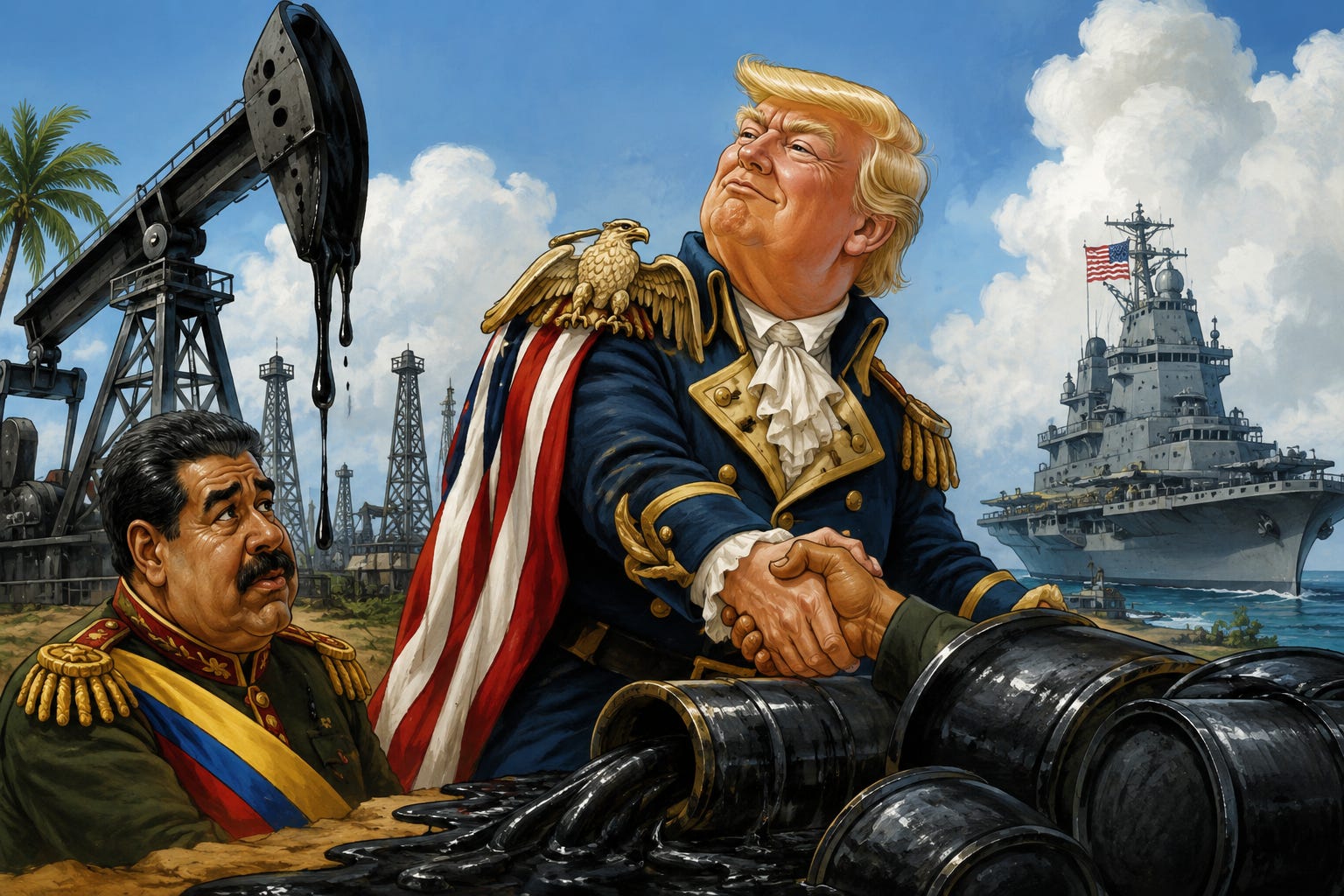
The most important question, however, is what the heck are we doing?
This all started with a daring, special operations raid last winter that captured Venezuela’s dictator-in-chief, Nicholas Maduro. Since then, we have left the regime in place, albeit with a different figurehead at the top. Delcy Rodriguez, vice president under Chavez, stepped into the top spot with American blessing and has proven to be more compliant, if no less authoritarian, than the previous dictator.
Contrary to the hopes of Venezuelans and human rights activists, our focus over the past nine months has been on assuming control of the Venezuelan oil industry rather than regime change or spreading democracy. The raid seems to have been all about the oil, rather than truth, justice, and the American way.
There’s a word for what Trump is doing in Venezuela, and that word is “imperialism,” which Merriam-Webster defines as “the policy, practice, or advocacy of extending the power and dominion of a nation especially by direct territorial acquisitions or by gaining indirect control over the political or economic life of other areas.” Military action to replace a dictator and gain control over Venezuelan oil is an almost verbatim real-life restatement of the definition.
The word “imperialism” has been overused a lot in recent decades, but at times it does apply. There were charges of imperialism in Afghanistan and Iraq, although Afghanistan had little of value and we didn’t keep Iraqi oil. But when a country is attacked and its resources taken under duress, it is one of those times when the word applies without stretching the concept.
For most countries, the allure of imperialism went out with World War II, if not the 19th century. Vladimir Putin’s Russia is one of the exceptions, and Americans should be disturbed at the fact that Trump’s foreign policy is becoming more explicitly Putinesque.
This was not without warning, however. The concept is perfectly in keeping with the theories about Trump’s geopolitical doctrine of dividing the world into spheres of influence controlled by us, Russia, and China. If these theories are correct, Taiwan should brace for the next shoe to drop.
Marco Rubio, the anti-communist son of Cuban immigrants, should be particularly ashamed. For the Secretary of State, the metamorphosis from advocate of Latin American freedom to defender of Trump’s exploitation of the Venezuelan people marks a decade-long decline from a top presidential candidate in 2016 to a MAGA yes-man.
And then there’s the fact that the deal also gives the federal government, specifically the Defense Department’s Office of Strategic Capital, a 35 percent stake in North American Blue Energy Partners (NABEP), the joint US-Venezuelan venture. So, in addition to being imperialist, the deal is also socialist, granting the government yet another ownership interest in a growing list of nationalized American companies.
Chevron has announced an investment into Venezuela, but as Republicans used to believe, government intrusion into the market may turn out to be detrimental. Aside from the legal questions, oil companies may question the wisdom and prospects of competing with a government-back entity.
It goes without saying that this is all without either congressional approval or oversight. The Senate has the constitutional duty to ratify treaties, but it’s unlikely that any treaty is forthcoming. Trump is almost always long on announcements and short on implementation.
The deal is already unpopular with the people of Venezuela. Trump avoided a prolonged war in Venezuela by replacing the head of the regime, but if it the plan doesn’t collapse under its own weight, it’s entirely possible that American soldiers will have to be deployed to protect US oil interests in the country, because ultimately imperialism is about using force to take what belongs to someone else, and often the victims don’t like that status quo.
SOCIAL MEDIA ACCOUNTS: You can follow us on social media at several different locations. Official Racket News pages include:
Facebook: https://www.facebook.com/NewsRacket
Twitter/X: https://twitter.com/NewsRacket
Threads: https://www.threads.com/@theracketnews
Blue Sky: https://bsky.app/profile/newsracket.bsky.social
Mastodon: https://bird.makeup/users/newsracket
Our personal accounts on the platform formerly known as Twitter:
David: https://x.com/captainkudzu
Steve: https://x.com/stevengberman
Jay: https://x.com/curmudgeon_NH
This article has been updated to correct the name of Venezuela’s previous dictator.
Trump captured Maduro not Chavez
Considering that US oil companies played a major role in developing the Venezuelan oil industry before Hugo Chavez nationalized the oil industry and booted the oil companies out and drove the oil industry in Venezuela into the ground, American oil company re-investment there makes sense in my mind. The Feds need to get out of private company holding business and leave business to private industry.
As for Mr. Trump he is much more akin to the Putin's, Xi's and Jung's of the world than anyone else. Taiwanese have every right to get skittish with Trump in office and the situation will be worse if Vance somehow finds a path to the presidency.