


It seems like just yesterday that the US was contemplating an invasion of Venezuela (and possibly Cuba, Greenland, and Panama). But that was weeks ago, and times change. It’s another day and a new war.
These days, the threat is from (or towards) Iran, although it isn’t clear exactly what the pretext for the strike is. Are we defending the dissident protests, which have already been crushed, or are we concerned about the Iranian nuclear program that the White House said was “obliterated” last year, calling reports to the contrary “fake news?”
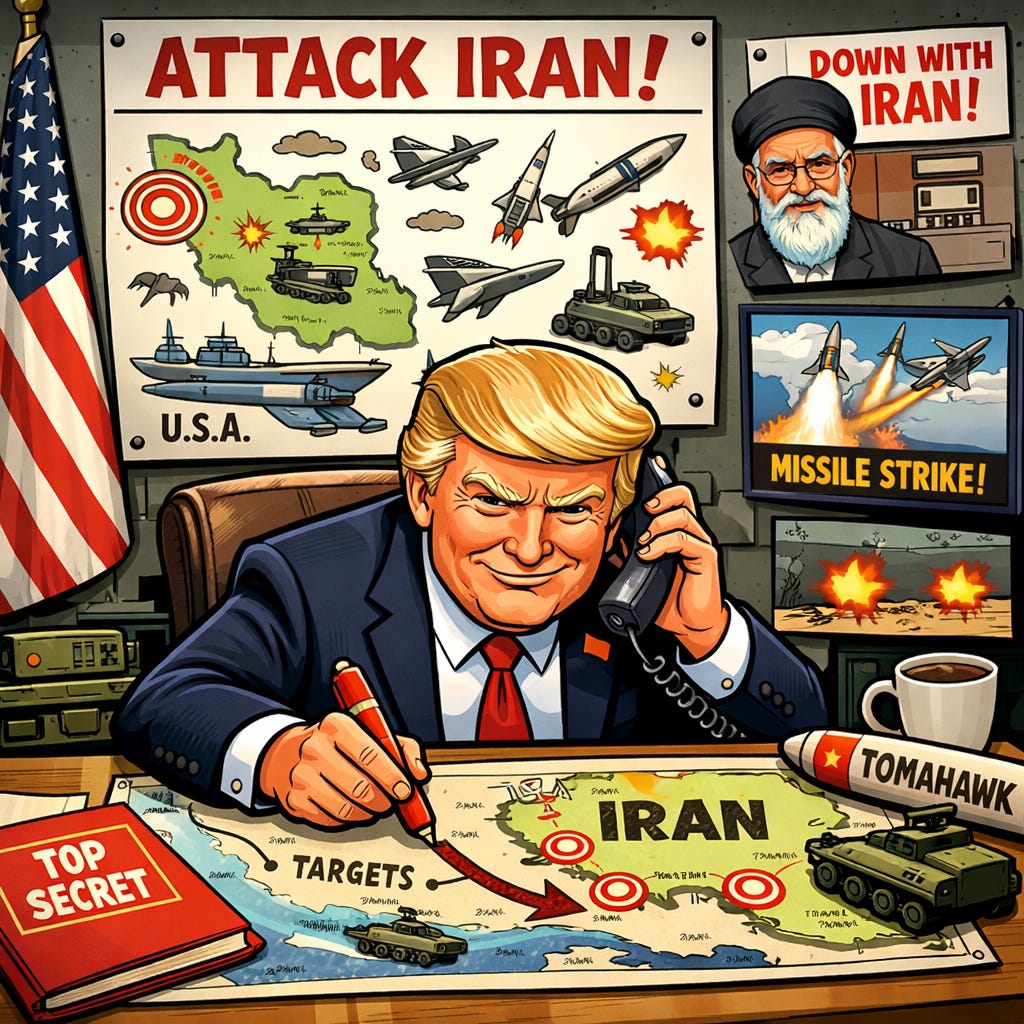
We also aren’t sure what the Trump Administration’s objective is, or if they even have one. Are we trying for regime change, or are we trying to reobliterate the nuclear weapons program that Middle East Steve Witkoff said almost a week ago was a “week away” from producing “industrial-grade bombmaking material?” Are we trying to force the regime to the negotiating table? Maybe it’s something completely different, like trying to bump up Trump’s downward-diving approval ratings or engaging in his fantasy of becoming a wartime leader.
The point is that we really don’t know, and the Administration isn’t telling us. In the State of the Union, rather than making a case for why we need to continue the massive military buildup in the Middle East and attack Iran, Trump again took credit for ending last year’s war between Israel and Iran and for destroying the nuclear program. Not much was said about current policy.
The confusion in public may reflect division within the Administration. Axios reports that the chairman of the Joint Chiefs, along with Steve Witkoff, Jared Kushner, and JD Vance, are urging caution and pushing for time to let diplomacy work. War hawks include Lindsey Graham and Israeli Prime Minister Benjamin Netanyahu, while Secretary of State Rubio is reportedly on the fence.
Per the report, General Dan Caine is concerned about the potential for entanglement in a broader war, even though a commitment of ground forces is not currently on the table, as well as the possibility of significant US casualties.
If this sounds familiar, it’s because a lot of the same arguments were made about Venezuela, but Trump did pull a fast one on the Venezuelans. Rather than regime change, Trump stopped short after a daring Special Forces raid captured Nicholas Maduro. The president essentially agreed to leave the old regime in place - minus Maduro - in exchange for payoffs in oil. The revenues from the oil were originally going to an account with no congressional authorization controlled by the US executive branch in Qatar. Now, the funds are supposedly being transferred to the US Treasury, but there is no indication that Congress has signed off on any of this, as required by the Constitution.
My theory is that Trump would like to do a Venezuela-style deal with Iran. The problem is that Iran is not Venezuela. Iran is geographically larger and has a much bigger and more modern military. Iran has also become a major supplier of drones and other weapons to Russia in the Ukraine war.
There is also a difference in mindset. Where Venezuela had an authoritarian dictatorship, the motive of the elites was to amass power and wealth. The mullahs who control Iran have a much more apocalyptic outlook that stems from their religion and hatred for Israel. The Venezuelan regime was largely focused on self-preservation; the Iranian regime might well decide to become martyrs in a war against the US, Israel, and the moderate Gulf states.
Prussian Field Marshal Helmuth von Moltke the Elder wrote, “Kein Operationsplan reicht mit einiger Sicherheit über das erste Zusammentreffen mit der feindlichen Hauptmacht hinaus.” Those of us who don’t speak German know the maxim better in its English translation: No plan survives first contact with the enemy.
Once the bullets and missiles start to fly, it is difficult to control where the conflict goes. That’s especially true if you don’t have a good plan to start with. I’m reminded of LBJ’s micromanaging of the Vietnam War, which severely hampered the US military from prosecuting the war and got a lot of American soldiers killed unnecessarily.
I could foresee a similar situation in Iran in which we start with massive airstrikes and Special Forces raids, but those may not achieve the desired result. After all, that is essentially what happened last June, and nine months later, we are back to square one.
Air power can do a lot of things, but historically, airpower alone has been unable to break the will of the enemy to fight or to topple regimes. The German blitz in 1940 didn’t break the English spirit, the Allied air campaign against Germany didn’t oust Hitler, the American bombing of North Vietnam didn’t end that war, and the Russian strikes against Ukraine have not proven decisive. The one case where airpower unequivocally ended a war was forcing the Japanese to surrender in WWII, and that took not one but two atomic bombs.
So, it’s likely that whatever Trump’s goal is, he won’t achieve it with a limited air war alone. Once we are involved, the pressure will be on to show something for the effort. We may eventually find ourselves sending in American soldiers to take Iranian territory or overthrow the regime.
It’s also possible that Iran could lash out at the US and its Persian Gulf allies with drones, missiles, or suicide attacks. In the past, the US has proven adept at intercepting Iranian cruise missiles and drones, but that depends greatly on having assets in the right position to stop them. We helped protect Israel from a wave of drones and cruise missiles in 2024, but we couldn’t do much when Iran attacked a US airbase in Iraq in 2020.
There is also the possibility of undercover terrorist cells, but personally, I think if the Iranians had such units in the US, they probably would have used them when we bombed Iran last year. If there weren’t terrorist moles in place last June, they probably haven’t built a network in the last eight months, but no one really knows.
We are approaching a point where there are three main options. First, Trump could back down and incur a loss of face. Second, he could aim lower and achieve a deal with Iran that would probably be worse than the deal Obama made, a deal that Trump canceled in his first term, even though indications were that Iran was abiding by the deal. Finally, we could open the Pandora’s box of war and hope for the best.
Ironically, Trump’s own actions in his first term are almost certainly making it harder for him to deal with Iran now. Trump has bargained in bad faith with numerous countries at this point, in addition to canceling the original Iran deal. The Iranians aren’t idiots. They know that he can’t be trusted to keep his word.
But again, this is all speculation, because the Administration isn’t telling We The People anything of substance. Donald Trump is not working to build support for his Iran agenda with either the American public, Congress, or our allies (the ones we have left anyway).
Whatever Trump does, it seems likely that he will go it alone, both in terms of the lack of international support and the lack of a national consensus. Honestly, I think Putin did more to try to win support for his invasion of Ukraine than Trump has done on Iran.
Going it alone will make it really easy to assess the blame when the president’s Iran policy blows up in all our faces. I can only hope that the detonation will not be a nuclear one.
SOCIAL MEDIA ACCOUNTS: You can follow us on social media at several different locations. Official Racket News pages include:
Facebook: https://www.facebook.com/NewsRacket
Twitter/X: https://twitter.com/NewsRacket
Threads: https://www.threads.com/@theracketnews
Mastodon: https://bird.makeup/users/newsracket
Our personal accounts on the platform formerly known as Twitter:
David: https://x.com/captainkudzu
Steve: https://x.com/stevengberman
Jay: https://x.com/curmudgeon_NH
The only upside I can see to a war with Iran is it cutting off their Shahed drones from the Ukrainian front. It'll be interesting to see how Putin might get involved to keep those UAVs available.
Taco