


It has been four days since the US captured Nicholas Maduro in a daring overnight raid. Since then, the situation has not changed. Venezuela’s socialist regime is still in power, with Delcy Rodriguez, the country’s vice president and a staunch leftist, in power and demanding the return of Maduro. As of this writing, there have been no more known American attacks.
The war has become a rhetorical battle of words, with the Trump Administration attempting to justify its actions. These defenses involve several arguments. First, the Administration cites the indictment against Maduro for his alleged involvement in drug trafficking as well as his status as an authoritarian ruler. Second, Trump’s defenders point to the 1989 invasion of Panama as a precedent. Finally, digging deep into American history, the Monroe Doctrine has emerged as a justification due to Venezuela’s relations with China, Iran, and Russia.
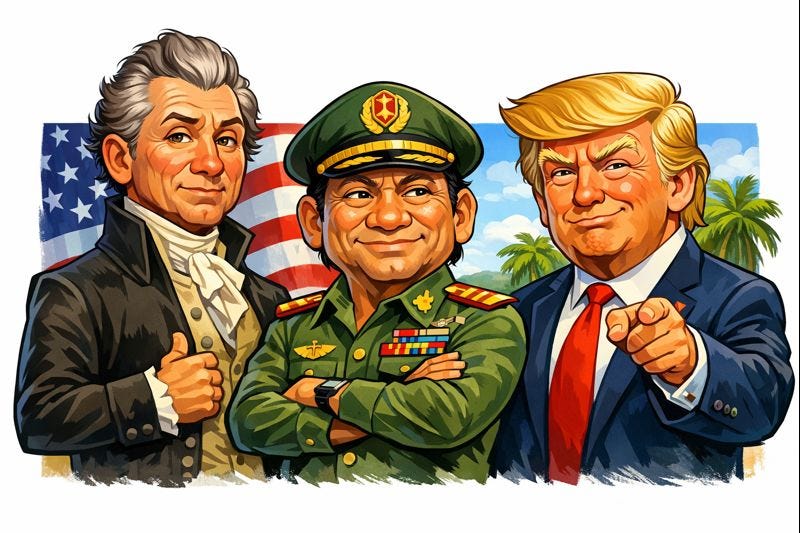
First, let’s look at the Monroe Doctrine. Dating back to President James Monroe in 1823, the Monroe Doctrine, as originally articulated, held that the US would not tolerate European colonization or puppet monarchs in the Western Hemisphere. Theodore Roosevelt expanded the Doctrine to justify the US invasion and occupation of several Latin American countries, such as Haiti and Nicaragua, as well as the Dominican city of Santo Domingo. It should be noted that this “gunboat diplomacy” did not endear the United States to our Latin American neighbors, but there is precedent for using the Monroe Doctrine as an excuse for meddling in the internal affairs of our neighbors with our military.
That does not, however, mean such interference is legally justified or even a good idea. The Monroe Doctrine is a policy, not a law, and its implementation has often not went well. The US Marines ran Haiti for 20 years in an occupation that must be ultimately judged unsuccessful, while the occupation of Nicaragua, also for about 20 years, is viewed in hindsight as a sop to US corporate interests, part of the so-called “Banana Wars.”
The risk in Trump’s heavy-handed use of the Monroe Doctrine is that his bullying may push our Latin American neighbors into the arms of China. Trump is acting more like a rogue head of state than Maduro, threatening Colombia, Cuba, Greenland, Iran, and even Mexico since the attack on Saturday. Paired with his tariff wars on trading partners, Trump’s actions may well push former allies into China’s orbit for both security and economic reasons.
At least overtly, the Monroe Doctrine has been largely set aside since the Bay of Pigs, the disastrous US-backed invasion of Cuba in 1961. The US has aided other anti-communist insurgencies and supported friendly governments, even authoritarian ones, but US military interventions have become rare (with the exception of some peacekeeping deployments to Haiti).
The US invasion of Panama was an exception to that rule. In 1989, President George H.W. Bush ordered the invasion of Panama to depose dictator Manuel Noriega. This operation has been used to justify Trump’s attack on Venezuela, but there are important differences.
The biggest difference was the threat to US personnel and interests in the country. The indictment against Noriega was not the casus belli. Indeed, if an indictment is all that is required to launch a war without congressional approval, no country in the world is safe. One of the few times that the Justice Department has failed to win an indictment was against the DC sandwich thrower, although it also nearly failed to indict James Comey. It would probably be easy to indict Chinese President Xi on charges of fentanyl trafficking, as an astute reader pointed out. Will Trump try to have the Delta Force spirit Xi out of Beijing? Probably not.
Unlike Venezuela, the US military had thousands of troops in Panama guarding the Canal Zone. These Americans were legitimately threatened by the Noriega regime. Prior to the invasion, there had been attacks on US personnel, including at least one that resulted in a death, and the Panamanian government had declared war on the US.
Despite the urgency of the situation, the Bush Administration provided the required notification of the operation to Congress before the attack began. In return, Congress responded with broad bipartisan support.
With regard to motive, the US did not engage in a long occupation of Panama after the invasion. Operation Just Cause ended on January 31, 1990, with sovereignty returned to democratically elected representatives of the Panamanian people.
None of that is true with respect to Venezuela.
In Venezuela, there is no imminent threat to Americans or US forces. The Administration is reduced to arguing that the exportation of illegal drugs represents an imminent threat. This defies both the law and the common definition of the word “imminent.”
Even though there was no rush to attack Venezuela, evidence is mounting that the Trump Administration not only failed to consult with Congress as the law requires, but it actively lied to the legislative body about its plans. Not only did the Administration apparently not even tell its allies in Congress about the impending attack, Democrats argue that Trump officials intentionally misled Congress, telling them that ground operations and regime change would not happen. Ironically, Trump has been telling the press that he would attack Venezuelan land targets for weeks, if not months.
Secretary of State Marco Rubio argues that the raid was a “law enforcement operation” rather than a military one, but the facts belie this claim. The operation was mounted by military units rather than law enforcement and was outside US jurisdiction.
Rubio’s claim is also undercut by a third difference between Panama and Venezuela. Donald Trump is overtly claiming that the US intends to control Venezuela and exploit its natural resources. The US president has pointedly rejected backing Maria Machado, the opposition leader whom Venezuelans selected to be their leader, instead saying, “We will run the country until such time as we can do a safe, proper, and judicious transition.”
Other members of the Administration have played down the notion that the US will control Venezuela, but Trump has consistently maintained that it will. Even Rubio, who initially rejected the idea, now says, Trump “always retains the optionality” to occupy the country.
Of course, much of this is academic because the US does not control Venezuela at all at this point. The Saturday raid by special operations forces was daring and impressively executed, but it did not topple the regime. It was a tactical success, but so far it has been a strategic failure. I have to wonder whether there was a strategic plan at all beyond hoping that the regime would crumble once Maduro was out of the country.
At this point, it seems as though Trump has two options, neither of them good. The US can escalate attacks on Venezuela in hopes of destabilizing the regime and encouraging the people to revolt, or it can declare victory with Maduro in custody and quietly move along. The first option would likely eventually lead to a full-scale US invasion and occupation, while the second would involve loss of face for Donald Trump. Guess which is more likely.
Already, Trump’s action has provoked widespread condemnation from both allies and adversaries alike. Israel’s Benjamin Netanyahu is one of the few voices of support, which may not be of much help to Trump.
Ukraine’s Volodymyr Zelinsky had the mic-drop response, saying, “If you can do that with dictators, then the US knows what to do next.” Unfortunately, Vladimir Putin is on the short list of world figures not threatened by Donald Trump.
As with the international reaction, the attack was also unpopular domestically. Early polling from both YouGov and Reuters/Ipsos found that only about a third supported Trump’s actions. Considering that Trump is coming off the high of a mind-numbingly well-executed mission and that there are still a large number of Americans undecided on the issue, polling is likely to get worse. Poll numbers are likely to sink quickly as it becomes apparent that there is no quick path to victory.
When all is said and done, Donald Trump can almost certainly get away with Maduro’s capture. The brief raid can fall through the cracks in the War Powers Resolution that calls for consultation before hostilities when possible and/or notification of Congress within 48 hours. Maduro’s crimes, along with American history, can be twisted to justify the attack if you squint just right and don’t look too closely at the big picture in a sort of “bad man stays in jail” legal theory of international law. (I’ll add that closing the loopholes in the War Powers Resolution needs to be added to the long list of post-Trump reforms to executive powers that Congress should address.)
But what Trump cannot do without Congress is prosecute a long-term war and occupation of Venezuela. The War Powers Resolution aside, Congress controls the purse strings of government, and the body is unlikely to give Trump a blank check for an unpopular and imperialistic war. That will be especially true after Democrats take control of at least one house in the elections ten months from now, but Trump’s adversarial relationship with Congress on the issue, even with his own party, makes it questionable whether he could fund the war before the next Congress takes over.
In short, Maduro’s capture is somewhat justifiable and may turn out to be a good thing, depending on what happens next, but it also comes with numerous downsides. These include the fact that the US is increasingly becoming an international pariah with fewer and fewer allies and the likelihood that we will become embroiled in a protracted occupation and guerrilla war.
On the other hand, there is no legitimate justification for an open-ended occupation and the exploitation of Venezuelan oil. This would be the textbook definition of imperialism, and while Americans might not have looked askance at the US government occupying entire countries for economic reasons in the early 1900s, voters are unlikely to be so passive these days.
That is especially true if Trump unilaterally has the US military attack other countries without provocation. And the odds are good that he will.
I’m sorry, I don’t have a punchline for the joke in the title. Maybe readers can suggest one.
WALZING OUT Minnesota governor and former vice presidential candidate, Tim Walz, has announced that he will not seek a third term. Walz is embroiled in a scandal involving fraudulent daycares run by Somali immigrants. While I’m still developing an opinion on exactly how extensive the real fraud is, I commend Walz for knowing when to bow out rather than hanging on past his sell-by date. More politicians should learn from Walz in this respect at least.
FIVE YEARS SINCE JANUARY 6 INSURRECTION This is still relevant because one of the reasons given for deposing Maduro was his failure to accept election results and hand over power peacefully. Irony is dead.
SOCIAL MEDIA ACCOUNTS: You can follow us on social media at several different locations. Official Racket News pages include:
Facebook: https://www.facebook.com/NewsRacket
Twitter/X: https://twitter.com/NewsRacket
Threads: https://www.threads.com/@theracketnews
Mastodon: https://bird.makeup/users/newsracket
Our personal accounts on the platform formerly known as Twitter:
David: https://x.com/captainkudzu
Steve: https://x.com/stevengberman
Jay: https://x.com/curmudgeon_NH
Tell your friends about us!
You could always wrap the headline into the “walk into a bar” joke :). Agree there are many questions on how to move forward here and many hurdles to extract ourselves from this situation with success. Of course Trump alway does even the ‘right’ things in a wrong way. The ends always justify the means for him. That is how demagoguery works. Monroe Doctrine is a sound policy and serves us well in the right situation (Cuban Missle Crisis). But Trump speaks loudly and beats all with a stick when it serves him. We will see.
Here's a punchline: They decide to blame it on the Jews.