


I am not sure how to begin this. But I guess I’ll start with the church, and by the church I mean the original, organized Church of the sixth century. I was going to begin with the overused TikTok meme about how often men think about the Roman Empire, which is a lot. The influence of the glory of Rome on our culture is more than just a meme: go see the Memorial Amphitheater at the Tomb of the Unknown Soldier at Arlington National Cemetery. It’s Rome, complete with a throne. Most of our government structures are modeled after Roman buildings. We’re obsessed with Roman things, so I’ll begin there.
Not Rome at its height, but after the Roman Empire split, when the Byzantine Emperor Justinian ruled what was also called the Eastern Roman Empire, and spent his reign trying to reify the old empire, by conquest. Justinian was raised a Latin-speaker, and thought it would be a good idea to take all the Empire’s laws and codify them in writing, so naturally he had it done in Latin.
In the 4th century, the Catholic Church had officially switched from Greek, the lingua franca of the Mediterranean and the Levant, to Latin, which became the default choice for all canon, scholarship, theology, administration, and church law. I had a hard time believing that until 2026, the Catholic Church still demanded official documents be published in Latin. Justinian’s use of Latin for secular law caused English Common Law to also use Latin, which is why law schools still teach it and lawyers use it.
Until fairly recently, for someone to be considered “educated” or “literate,” it was assumed they learned Latin. The oldest school in America, Boston Latin School, was founded in 1635, to teach—you guessed it—Latin, because that was the language of theology. They also taught Greek, in order that the Scriptures could be read in their original text.

There’s a whole rabbit-hole I am not going down about how the church used Latin to keep its authority, because the common people could not comprehend the Scriptures, which were restricted to the educated, meaning the wealthy and privileged. There’s a lot of church history that’s about people and not Scripture or theology, worthy of study, which I’m not here to write about right now. But if you want to see what happened to people who violated the Latin law, start with William Tyndale.
Latin is useful to convey meaning to certain legal terms, and the one I want to focus on is Jus Soli. That means “right of the soil” versus Jus Sanguinis, which means “right of blood.” It’s easy to understand Jus Sanguinis. You were born from two parents, and your right of succession, the right to their property when they die, derives from a bloodline. In the 4th and 6th century, these rights were understood, though for people who were not citizens or nobility, there was no property, because slaves and peasants had none. The concept of adoption was also understood, especially in regards to the Roman line of succession. The concept of “nationality” in terms of belonging to a nation rather than being a subject of a lord or king, is a rather new idea.
Inheritance and citizenship through bloodline is the most ancient idea, since people formed tribes, which became villages, which became cities, then nations. Outsiders are from other tribes, and they are frequently enemies, or at least competitors for resources, wealth, and power. Jus Sanguinis is the natural state of mankind. We know our family and our relatives, and we know the land we are from because it’s where we were raised; the ancients knew their land was theirs because it was theirs by blood.
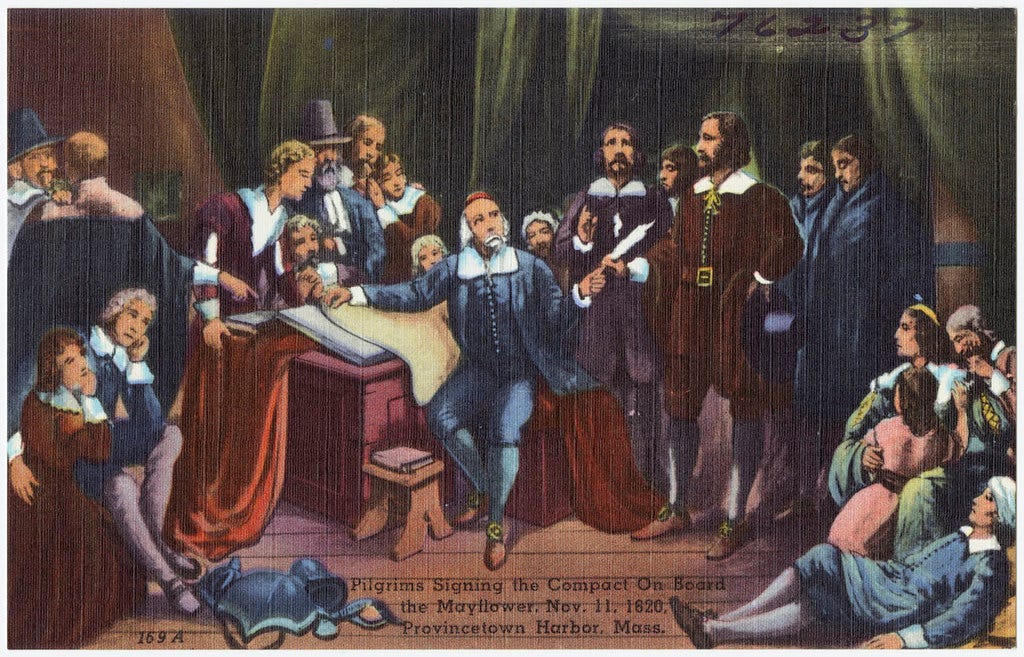
The legal idea for Jus Soli is much, much newer. In fact, at the time the Pilgrims signed the Mayflower Compact in Provincetown harbor in 1620, Jus Soli was not widely acceptd. The first European Americans understood they were subjects of the Crown of England. The Native Americans who were on this land before that had a concept of Jus Sanguinis but it did not apply to land, which was considered tribal property only in the sense of resources, though they well understood bloodline authority and power succession.
From the time the U.S. became a nation, not everyone who resided here was considered a citizen, nor did anyone who was born on these shores have any rights conveyed by their birth. Slaves had no rights, no property, and no bloodline succession except more slavery. It was not until the 14th Amendment granted equal rights to all born here or under our jurisdiction.
The language reads:
All persons born or naturalized in the United States, and subject to the jurisdiction thereof, are citizens of the United States and of the State wherein they reside.
The 13th Amendment abolished slavery, giving former slaves the same status as those who were born free. Slaves were always considered “persons” for the purpose of counting, and the 14th Amendment made them full citizens with the same rights as anyone born or naturalized here. The idea of Jus Soli was fully implemented in U.S. law in 1868. Before that, it was part of English common law, but not guaranteed. Before the U.S., Mexico, Argentina, Uruguay, Venezuela, Colombia, Peru, and Ecuador adopted Jus Soli citizenship. Uruguay has continuously recognized birthright citizenship since 1830; Argentina suspended that right during the 1976-1983 military dictatorship.
Not all dictatorships and totalitarian governments have abandoned Jus Soli, notably Cuba, which offers unrestricted birthright citizenship. The Soviet Union had conditional birthright citizenship, but emphasizing bloodline citizenship over the right of the soil. North Korea allows birthright citizenship (not that anyone who could choose would want it) if one is born to a mixed or North Korean parent, or unknown parents, living in that country. Fascist regimes like Spain under Generalissimo Francisco Franco, Italy under Mussolini, and of course, the Nazis, heavily favored bloodline citizenship, or outright banned Jus Soli for those who did not possess the proper bloodline. It’s hard to maintain a nationalist state while allowing a pluralistic and diverse population.
The United States is first and foremost among nations as the beacon of Jus Soli. Former U.K. Prime Minister Boris Johnson was a U.S. citizen, born in New York City in 1964; he only formally renounced his citizenship in 2016 while serving as Foreign Secretary. The first two presidents of Liberia, a nation founded as a colony for former slaves in the U.S., were American citizens. The president of Ecuador during World War II and the years afterward, Galo Plaza Lasso, was a U.S. citizen.
King Bhumibol, Rama IX, who ruled Thailand from 1950 until his death in 2016, was born in 1927 in Cambridge, Massachusetts. It’s a complicated case—technically, Bhumibol qualified for U.S. citizenship, because he was not the heir apparent to the throne of Thailand. It was only through an accidental series of events: the abdication of King Prajadhipok (Rama VII) and the assassination of his older brother, King Ananda Mahidol, that Bhumibol ascended to the throne. As a foreign sovereign and son of a prince, Bhumibol never claimed U.S. citizenship; however, had he declined the throne, he almost certainly could have been a citizen here.
Joseph Stalin’s granddaughter, Olga Peters, is an American citizen, the daughter of Svetlana Alliluyeva, who defected to the U.S. then married the son-in-law of famed architect Frank Lloyd Wright. Alliluyeva died in Madison, Wisconsin in 2011 at 85 years old.
In the world, it is truly uncommon for a nation to offer unlimited and unrestricted birthright citizenship. The United States is the one place where people born under totalitarian states can become free citizens, and their children are guaranteed full citizenship.
I could spent a lot of time getting into President Donald Trump’s presence at the Supreme Court while the Justices heard oral arguments (weak ones) of why the current administration believes unrestricted Jus Soli should be ended. I believe (and I’m not a lawyer, but I could make a long list of those who agree with me who are lawyers) there’s more than sufficient precedent in law and practice in America to outright reject these arguments. In fact, it’s a good thing to have this decided and litigated by the nation’s highest court. Proclamations and executive orders signed by the president can be interpreted and followed by executive branch officials, citing the president’s authority alone. But when the Supreme Court explicitly rejects those orders and their basis in law, then there can be no further question.
Americans are special because we don’t base our citizenship on bloodline, but only on the fact that we were born free, or that we, or our forebears, escaped serfdom, slavery, and the boot of statist dictators to be free here. It is the most cherished right of those who come to the U.S. for a better life, that their children will inherit that freedom, and not be subject to some other test, bloodline, or rejection based on their ancestry.
I wasn’t sure how to begin this, but I am sure how I must finish.
I would be deficient in this subject if I failed to mention that it’s going to be Easter Sunday, and on that day, Christians celebrate the resurrection of Jesus Christ, who offered his life as a sacrifice for the sins of the world, and through the power of God returned to life as the Second Adam, and firstborn of the New Covenant, and the hope of all who believe in Him.
The church has spent nearly two thousand years arguing over doctrine, canon, and theology. Emperor Justinian rejected the Council of Chalcedon, which concluded that the nature of Jesus Christ is “the same perfect in godhead, the same perfect in manhood, truly God and truly man, the same of a reasonable soul and body…” Justinian held that there are two natures of Christ, one as man and one as God. Modern church orthodoxy has largely rejected Justinian’s view as heresy. If Jesus Christ was a man and died, then came to life as God, we cannot be saved, since we ourselves are not God. But I’m not here to argue theology.
The point of bringing up the Resurrection is that being part of the Kingdom of God is not inherited by bloodline. Salvation is not Just Sanguinis. Our blood has no bearing on our relationship with God or the condition of our souls. By Christian belief, there is only one blood which cancels the sin of Adam and Eve, the first sinners. It is the blood of Christ, the one perfect sacrifice, who as God came to earth as a man, to offer himself for the salvation of the world.
We are citizens of heaven by the same legal idea that the United States codified in 1868. We are citizens by Jus Soli, because our birthright is based on the soil, that we are all human, and we all fall short of the glory of God and His holy standard. We are all like sheep who have gone astray. None of us is righteous. We arose from the soil and our physical bodies return to it. The Hebrew word “adamah” literally means ground or soil, and that is how the name “Adam” is rendered. Our sin nature is one of Jus Soli.
But there is another doctrine in Latin, Sola Fide, meaning “faith alone.” Our sin nature is Jus Soli, but our birthright to be free is by believing through faith. And believing does not mean we are convinced by the facts, or overwhelmed by the historical and physical evidence of Christ’s life and resurrection. Those places exist and can be visited. The place where Jesus was crucified, buried in a rich man’s tomb, guarded by Roman soldiers, where the large stone was rolled away and an angel sat atop it, where Christ himself walked, the place where he cooked breakfast for His disciples, where He ascended to heaven, these are all places that can be visited and seen with our eyes.
But we cannot see the Savior, because He is not here. He sent the Holy Spirit to gift us the faith to believe without seeing. The Holy Spirit empowered the Apostles to write the New Testament under the inspiration of God. The Holy Spirit imbued the early church fathers with power to preach the Gospel and suffer horrible death as martyrs. While the church argued over doctrine and translated the Gospels into Latin, and fought to preserve its worldly power, martyrs continued to rise up by the power of the Holy Spirit.
Today, martyrs still rise up. The fastest growing Christian church in the world is in Iran. More new Christians are expressing their faith in the Lord in China than there are churchgoing believers in the U.S. In both of those nations, expressing faith in Christ is punishable, sometimes by death or life in prison. Thousands of Palestinians have seen the risen Christ in dreams, and secretly gather in small groups to praise “Allah” but not the “Allah” of Islam, they are praising Yeshua, the risen one, God almighty.
Americans are arguing over removing birthright citizenship and going back to bloodline tests. Around the world, those who accept faith in Christ are walking in their true, uncommon birthright.
In John Bunyan’s “The Pilgrim’s Progress,” the concept of “turning around” means returning to the world, to the City of Destruction. So often the path to freedom, to the uncommon birthright, leads opposite the direction we believe to be right, but know that we ought to turn again, away from that path. Even in church, it’s easy to focus on who is right, and who is wrong, on who is a “better” Christian. But faith only points in one direction, through the cross, to the grave, from the grave to the sky.
Our uncommon birthright is that we are eligible for citizenship in the only place that matters, where every tribe, tongue, nation, race, and all manner of diverse humanity is welcome. It is the birthright of receiving faith in the one who is risen.
I am glad that I was born into such an uncommon faith, and my only desire is that anyone who wishes can join me in it. Happy Easter.