


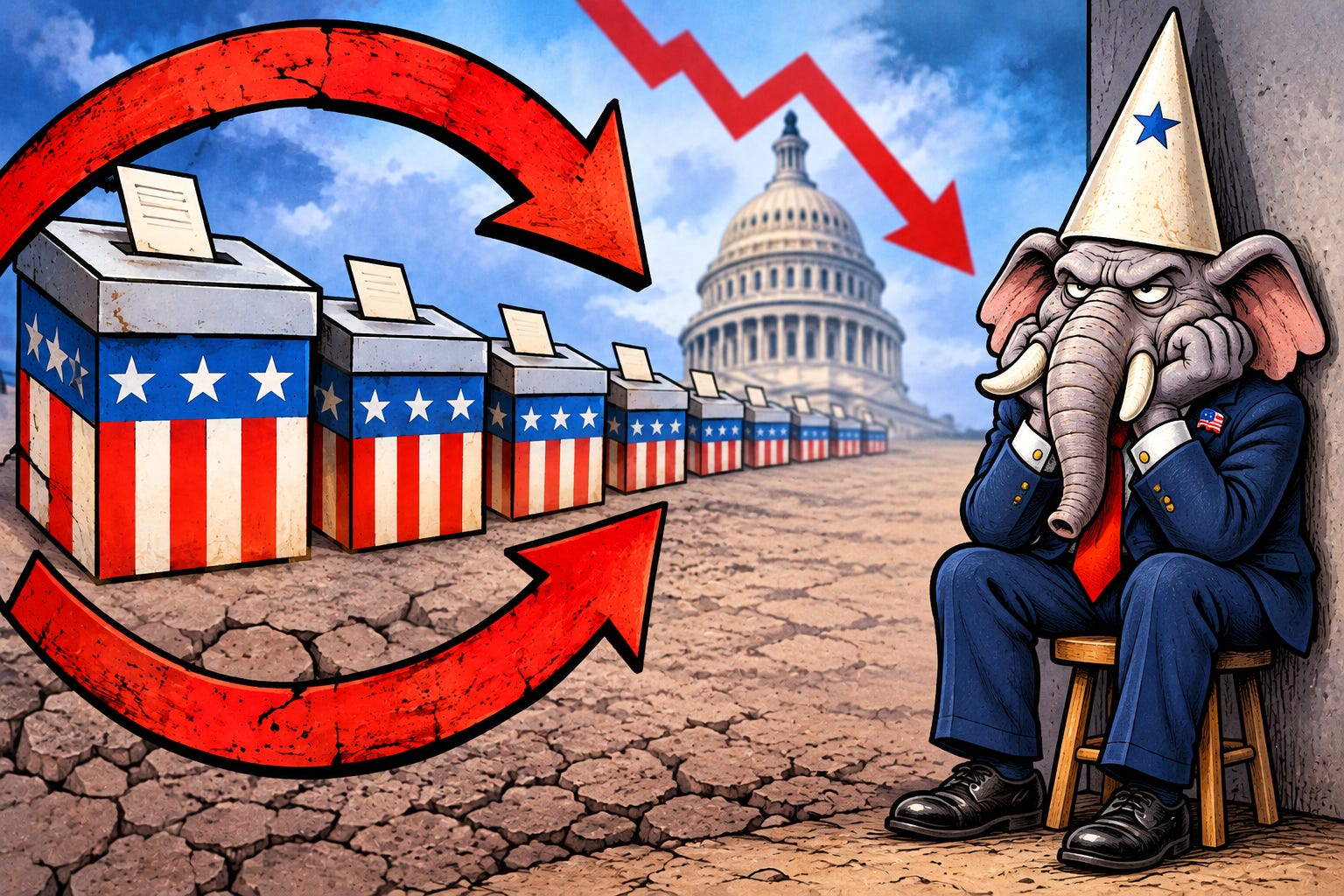
It’s just over a week past the 2026 midterms, and the Republican strategy for the next two years is becoming apparent. If anyone's wondering, that strategy can be summed up as “more of the same.”
The first clue came with Trump’s appointment of Stephen Miller as White House Chief of Staff immediately after the election. Fox News reports that one of Miller’s first acts was to issue a memo giving the president more direct control over cabinet positions, “making it a more effective instrument for the President, whereas previously it was too constrained.”
I haven’t seen any polling of voters that indicated the federal government being too constrained was a major issue that hurt Republicans. It seems to have been more the opposite.
A second indication that Republicans were doubling down was the selection of Jim Jordan as the incoming minority leader in the House. Jordan is a Freedom Caucus member and one of Trump’s most outspoken and combative supporters, indicating that House Republicans don’t intend to put much distance between their caucus and the president.
The flip side, however, is that John Thune will remain the top Republican in the Senate, much to the consternation of many MAGA supporters. About a third of Republican senators dissented against the choice, although the South Dakota Republican is generally respected, except by MAGA. But even if he is from the traditional wing of the GOP, Thune plans to push hard on Republican priorities in the lame-duck session.
These priorities include a slew of partisan bills such as the SAVE Act, a defense authorization bill, judicial confirmations, and a budget reconciliation, as well as a bipartisan permitting reform bill. Republicans never had the votes for the SAVE Act, and it’s unlikely that they have picked up additional support for the measure after their drubbing last week. Some outgoing Republicans are even becoming roadblocks to the expedited confirmations.
And then there’s Iran. As our friend, Stan Mitchell, pointed out on his podcast, there are signs that Trump might be about to renew the war on Iran, and the Administration has historically launched attacks after the close of markets on Friday. It’s very possible that we could see a resumption of hostilities over the weekend. Trump now says the US doesn’t need to make a deal to end the war, and he shifted Vice President Vance from his role as a peace negotiator to that of looking for corruption in Democrat-led cities.
If Trump does launch a new wave of attacks, he has about two months to do what he could not do over the previous 10. When the new Congress convenes in January, it will almost certainly have the votes to approve a War Powers Resolution. Although such a bill would still be subject to veto, it would be politically embarrassing to the Administration.
The new Democratic majority could also use its control of the federal purse strings to end appropriations for the war. Such an attempt would spark a major confrontation between Congress and the Executive Branch, and the outcome would depend largely on who was more stubborn in a shutdown fight.
Yet another indication that the Administration doesn’t take the midterm results seriously is that it is denying them. In a flashback to 2020, Trump and other prominent MAGA Republicans are posting claims that the election was stolen. So far, no lawsuits seeking to overturn results have been filed, and all of the losers seem to have conceded, but failing to acknowledge that voters rejected Republicans in large numbers is a tell that ruling Republicans don’t intend to address the root causes of the midterm disaster.
That failure to confront problems and make corrections does not bode well for 2028. If voters didn’t like what Republicans were selling in 2026, there seems to be little reason that they’ll like another warmed-over, minority version of it two years from now.
More bluntly, the MAGA GOP’s record of nominating horrible candidates, together with national Trump fatigue after four years of chaos, incompetence, and radicalism, makes it already doubtful that Republicans can win back their majorities and likely that Democrats can expand their hold on Congress. The 2028 Senate map includes several Republican seats in states where Democrats recently made gains, including Alaska, both Carolinas, Georgia, Iowa, Kansas, and Wisconsin, as well as others where they came close, such as Florida and Louisiana.
MAGA’s continued domination of the Republican Party will make it difficult for quality candidates to win the nomination in battleground states. For example, outgoing Governor Brian Kemp of Georgia is a likely Senate candidate, but Kemp, a popular figure, might face political headwinds against a MAGA candidate in the mold of Ken Paxton or Mike Collins. The same problem will apply to Republican presidential candidates, who must win over the Trump base and then face a general election electorate that is no fan of the president.
Ironically, even though Republicans don’t seem willing to give ground after the midterms, Donald Trump does. The president has indicated that he is open to making a deal with Democrats on immigration, saying that his own policy has been “too tough.”
The terms of such a deal remain to be seen, and it may never get that far. Those old enough to remember 2016 may recall that Trump considered a softer immigration policy 10 years ago and then abandoned the idea. I’m old enough to recall multiple attempts at immigration reform, and it’s almost always the Republican base that kills any deal. Core GOP voters are so indoctrinated against “amnesty,” which in context means any solution to the problem of illegal immigration that doesn’t include mass deportations, that they view any deal which includes lesser penalties as treasonous and a threat to the country.
Trump’s openness to an immigration deal may not last until next week, much less next year, but even with Democratic majorities, a workable deal would be a difficult reach. If Trump is serious, elevating Stephen Miller, a probable white nationalist, is an odd choice. In any case, the four Republican senators needed to overcome a filibuster may be difficult to find, even if the lame-duck Trump backs the deal.
It remains to be seen whether Democrats have learned anything since they lost power two years ago. Democrats won’t have the opportunity to affirmatively pass much legislation with Trump still in the White House. The next two years will be more about investigations and providing a check to Donald Trump.
One Democrat has at least learned a new tactic. Senator-elect Abdul El-Sayed has said that he would be willing to work with the president to pass a TrumpCare bill for universal healthcare. Playing to Trump’s desire for approval and a lasting legacy might be the key to moving the ball forward, rather than just running out the clock.
Things will be different in new Democratic state governments. Democrats will have the chance to show whether they can exercise power in a reasonable and practical manner in these laboratories of democracy. If Democrats prove that they can govern effectively, even in formerly red states, they can grow a new generation of potential candidates for federal offices. On the other hand, if Democrats go off the rails, their 2026 gains may prove to be ephemeral. These new blue gains make states purple, not reliably blue.
Again, ironically, the fact that Democrats are sharing power in a number of states may help them to succeed. For example, in Georgia, Republicans maintained control of the Senate and noted in an after-action report that Republicans can “stop any bill, but cannot lose a single vote.” The need for Republican votes will force compromise and moderate the Democratic agenda. Divided government is good.
Democrats should have no illusions that the midterms were an endorsement of radical progressive politics. The election was a rejection of Trumpism, not an embrace of the left. There is a growing body of evidence that Republicans stayed home in 2026. Democrats need to convert those disillusioned voters, not wake them up.
Newly elected Democrats should realize that voters just clicked on the free trial of their leadership. If the people aren’t happy with what they see over the next few years, it will be easy to cancel the subscription.
HEGSETH AWARDS HIS CRITIC Defense Secretary Pete Hegseth, who may have been saved from impeachment by an auto accident, awarded the Joint Service Commendation Medal to the soldier who disciplined his party at the Tomb of the Unknown Soldier on Veterans Day. This was a good way to defuse the scandal and shows that Hegseth may be more conciliatory following his close call.
SOCIAL MEDIA ACCOUNTS: You can follow us on social media at several different locations. Official Racket News pages include:
Facebook: https://www.facebook.com/NewsRacket
Twitter/X: https://twitter.com/NewsRacket
Threads: https://www.threads.com/@theracketnews
Blue Sky: https://bsky.app/profile/newsracket.bsky.social
Mastodon: https://bird.makeup/users/newsracket
Our personal accounts on the platform formerly known as Twitter:
David: https://x.com/captainkudzu
Steve: https://x.com/stevengberman
Jay: https://x.com/curmudgeon_NH
That’s a great deal of writing to simply say that you hate Trump.
Evidently you didn't learn anything from the election either. The GOP wasn't rejected on account of immigration enforcement, which is the one issue they beat the Democrats on. It was on account of the four items listed by J.D. Vance in his post-election tweet, summed up by the war and its economic consequences and the fact that people are sick of the Israeli dominance of foreign policy. Yet all the Democrats talk about, it seems, is another round of Stalin-esque show trials, and they have said NOT A WORD about that last issue. Not a winning strategy, especially when you consider that they haven't got the votes to override a Trump veto. By the way, while Democrat candidates did well, a number of conservative ballot initiatives won, suggesting that the Dem-Socialist-trans-woke nonsense remains very unpopular.