


Before the Iran war took all the oxygen out of the political room, the big issue being pushed was the SAVE Act. Republicans and the president were mounting a full-court press to pass legislation that they claim would prevent illegal immigrants from voting in American elections. The issue returned over the weekend with a Truth Social post from Donald Trump, who said that he would not sign any other bills until the SAVE Act was passed. That’s probably not the threat that he thinks it is, since bills left unsigned become law after 10 days unless Congress adjourns first.
But anyway, a big question is why Republicans are pushing this bill so hard. Federal law already mandates that only citizens can vote in federal elections, and virtually all states require proof of identification and/or citizenship either at registration or at the polls. It is a myth that random people can just walk up and vote in American elections with no proof of eligibility anywhere in the country.

There is also no outbreak of undocumented voters. While it does happen on rare occasions that are loudly trumpeted by SAVE Act proponents and immigration fearmongers, illegal voting by noncitizens is statistically rare. The Bipartisan Policy Center reports that analysis of voter rolls shows that only 0.04 percent of voter verification cases were returned as noncitizens, and many of those never actually voted.
The hype does not match the facts. As with the fearmongering about vaccines, rare cases are sensationalized and made to seem normal, because we humans do a lousy job of assessing risk. If we see a story on the news, we assume it represents a serious and common threat, not realizing that it represents a one-in-a-million (or longer) chance. This inability to deal with numbers is why we avoid vaccines and buy lottery tickets, drive our cars fast and smoke cigarettes, and engage in many other risky behaviors while obsessing over long-shot threats like terrorist attacks, mass shootings, and illegal immigrant crime.
So, going back to the original question, why are Republicans pushing the SAVE Act so hard when there is no crisis of voting by illegal (or legal) immigrants? It makes very little sense to pass a new law that doesn’t do anything new to solve a problem.
Part of the strategy is almost certainly fearmongering about immigrants to shore up the GOP’s nativist base. With Trump failing on all other fronts (gas and groceries are up, the economy is slowing, and “no more forever wars” is history), the war on immigration is about all he has left to motivate the MAGA base to get to the polls.
But the SAVE Act is not just immigration fearmongering. The SAVE Act does more than just mandate voter IDs, and Americans should know about the shadowy side of the bill.
First, per the National Conference of State Legislatures, the SAVE Act (view the current text of the bill here) mandates that states collect identification and citizenship data from voters and establish maintenace procedures for voter rolls. The bill would also mandate photo IDs and documents that show citizenship. A University of Maryland study recently found that these requirements could disenfranchise as many as 21 million voters.
“But you have to show ID for almost everything else,” is a common objection.
That may be true, but voting is different, and the reqirements under the SAVE Act are different from what we are used to. Voting is a constitutional right, where getting on an airplane and cashing a check are not. Further, under the SAVE Act, you don’t just need an ID, you need a photo ID plus something that shows citizenship. (Because the bill is still being changed, exact text changes, but this has been a requirement.) Most Americans don’t have any such ID.
Most Americans have a Real ID driver’s license at this point, but the Real ID star signifies both citizenship and legal resident status. Since the Real ID does not differentiate between the two and legal residents can’t vote, a Real ID would not be sufficient proof to vote under the SAVE Act. ICE has also detained American citizens with Real ID licenses, claiming that the documents were fake, so poll workers might make the same objection.
If you don’t have an enhanced driver’s license, issued only by Michigan, Minnesota, New York, Vermont, and Washington, you’ll need your photo ID plus something like a birth certificate to prove citizenship. Conversely, you could use your US passport, but only about half of Americans have a passport.
If you are a woman who changed her name after getting married, you may have bigger problems. Married women often don’t have birth certificates that match their current IDs. These women might have to provide a marriage license or court decree showing their name change in addition to all the other paperwork required.
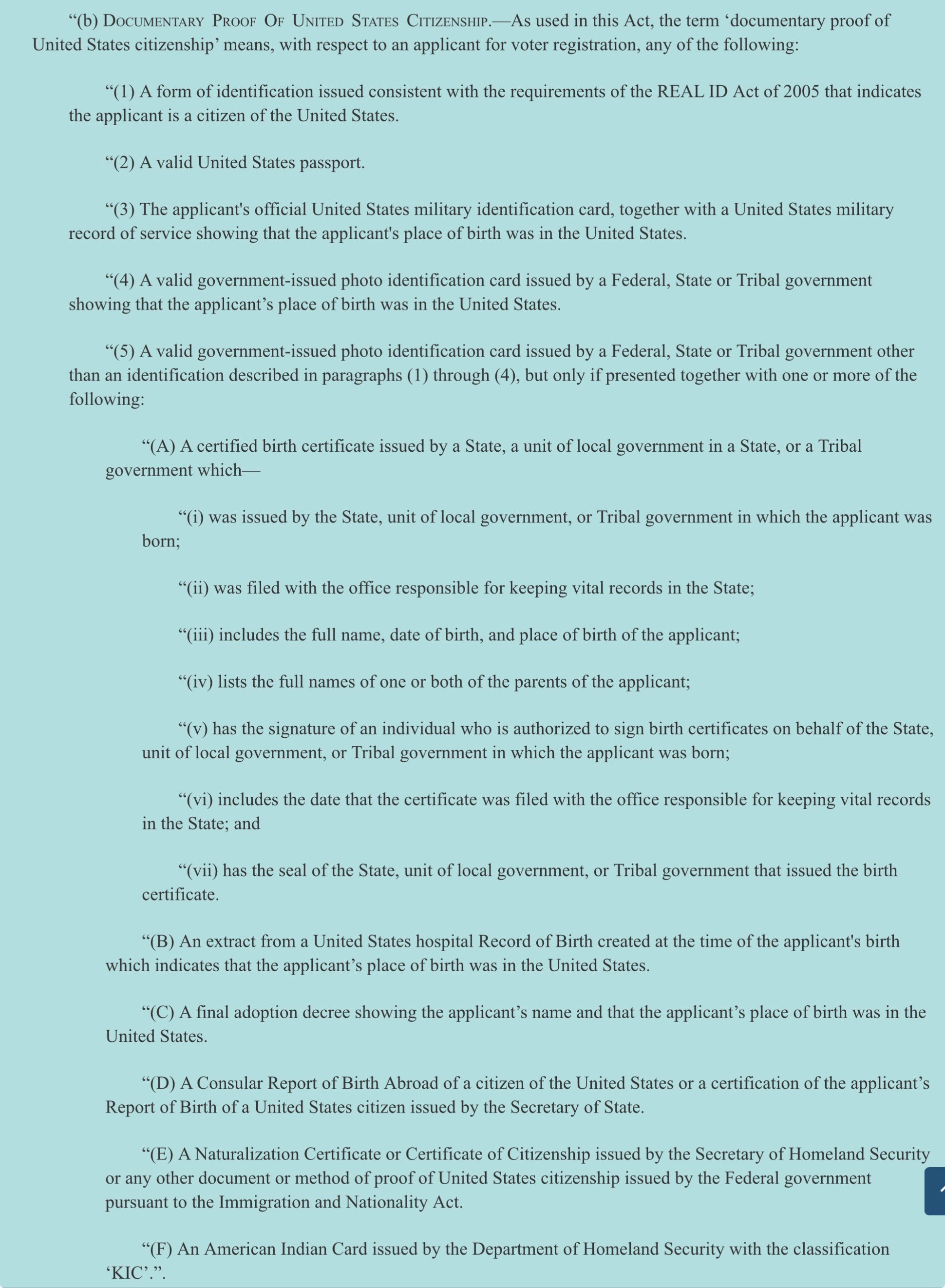
This is a lot of paperwork for a right that people have been exercising for years, and two other points make it worse. The bill does not provide a grace period before it goes into effect and it does not fund any of the changes that it mandates. So, if the SAVE Act passed today, it would go into effect for this election, leaving voters to scramble to find the required documentation. The closer we get to the election, the more likely that courts would find that the law violates the Purcell Principle, a legal doctrine that frowns upon last-minute changes to election law.
The SAVE Act also comes with legal consequences for election officials, who can be held criminally and civilly liable if they mistakenly register an applicant without proof of citizenship. This could be an incentive to turn away legitimate voters.
Courts might also frown upon the fact that voters would be suddenly required to pay for new IDs and documents to vote. The 24th Amendment abolished poll taxes or any other tax that might be required to vote. Some Democrats have equated voter ID laws with poll taxes, but several states provide free IDs as a workaround. The SAVE Act makes no such provision.
In addition to all this, the bill requires that state voter rolls be run through the federal Systematic Alien Verification of Eligibility system to screen for noncitizens. This system is used by the federal government and some states to verify immigration status for public benefits. DHS claims 99 percent accuracy, but a one percent failure rate with 174 million voters would yield a far greater problem of disenfranchisement than we currently face with voting by ineligible immigrants. It’s 1.74 million unhappy voters, if you can’t do the math.
Turning over personal voter data to the federal government is controversial as well. This is especially true in an age where Donald Trump’s DOJ comes after citizens for political reasons, Elon Musk’s DOGE rifles through federal databases for reasons unknown, and the DHS uses personal data from other agencies, like the IRS, to persecute immigrants. The DOJ has already launched several initiatives to force states to turn over voter data, and federal agents allegedly showed up to harass immigration observers at home in Minnesota.
The SAVE Act also makes it harder to vote absentee by requiring a copy of the voter’s ID to both request and submit an absentee ballot. Aside from the problem of how people who can’t go to the polls could get copies of their IDs (probably by giving them to someone else to copy), submitting two copies seems like overkill. Most people would probably make two copies rather than making one copy at each stage of the process.
Having said all this, I’m not opposed to voter IDs or requiring proof of citizenship, but the SAVE Act seems poorly thought out and poorly written. It poses a significant burden on a large share of Americans and doesn’t give them much time to deal with the new requirements. It also doesn’t fund its mandates. A better solution would be to require new voters to show proof of citizenship and fund free compliant IDs and voter rolls.
There are a number of reasons why Donald Trump and the Republicans want to pass the SAVE Act. Most of them have nothing to do with ineligible voters. The SAVE Act seems to be more about suppressing voter turnout in a series of elections that it looks increasingly like Republicans will lose. It also represents federal encroachment into an area that the Constitution reserves for the states. Whether the SAVE Act is a sinister plot or just a poorly written piece of legislation, the effects will be the same.
It should always be a red flag when either party tries to pass a law to make something illegal that is already against the law. That’s especially true when there is no loophole creating a crisis. At such times, it’s prudent to ask questions about what is really in the bill.
And that’s good advice in general. Bad stuff is often hidden in bills with innocuous sounding names like the Anti-Puppy Kicking Act of 2026. Because you wouldn’t want it if they called it the Federal Power Grab Act, and besides, why do you hate puppies and want it to be legal to kick them?
SOCIAL MEDIA ACCOUNTS: You can follow us on social media at several different locations. Official Racket News pages include:
Facebook: https://www.facebook.com/NewsRacket
Twitter/X: https://twitter.com/NewsRacket
Threads: https://www.threads.com/@theracketnews
Mastodon: https://bird.makeup/users/newsracket
Our personal accounts on the platform formerly known as Twitter:
David: https://x.com/captainkudzu
Steve: https://x.com/stevengberman
Jay: https://x.com/curmudgeon_NH
The SAVE Act would invalidate Georgia's Motor Voter law, and I'm sure other states have similar programs. This would severely impact ballot access, and would result in immediate lawsuits and undoubtedly be tied up in the courts for years. Republicans know this and therefore are willing to vote for it since the actual consequences are unlikely to show up soon. How cynical.
Now on the other side of the issue, there are places that allow non-citizens to vote in local elections: California, Maryland, and Vermont, along with D.C. NYC tried but it got yanked by the courts.
The issue is not one of ID or provisional voting, which would constitute ballot fraud if proven that non-citizens were registered to vote and did in fact vote. There's very few instances of that (like 0.001%), not enough to sway an election unless it was literally one vote. And if it was one vote, that's why we allow recounts and audits. And these illegal voters do get caught and face heavy sentences (especially in federal cases). There is a STRONG disincentive for foreign nationals to try it. the risk/reward is simply too high.
Enemy states are much better off spending money to promote the idea that illegal voting is commonplace to sow chaos in our elections (which they do).
Well, the internet and AI can easily help anyone figure out what to do to obtain the proper identification. I lost my birth certificate in a move and it wasn’t hard to apply for a new copy. Im not a boomer but a Gen X’er. If anyone needs it, it’s not that hard to ask for help or use the internet to figure out how to get the proper identification. I call BS on the availability and time frame.