


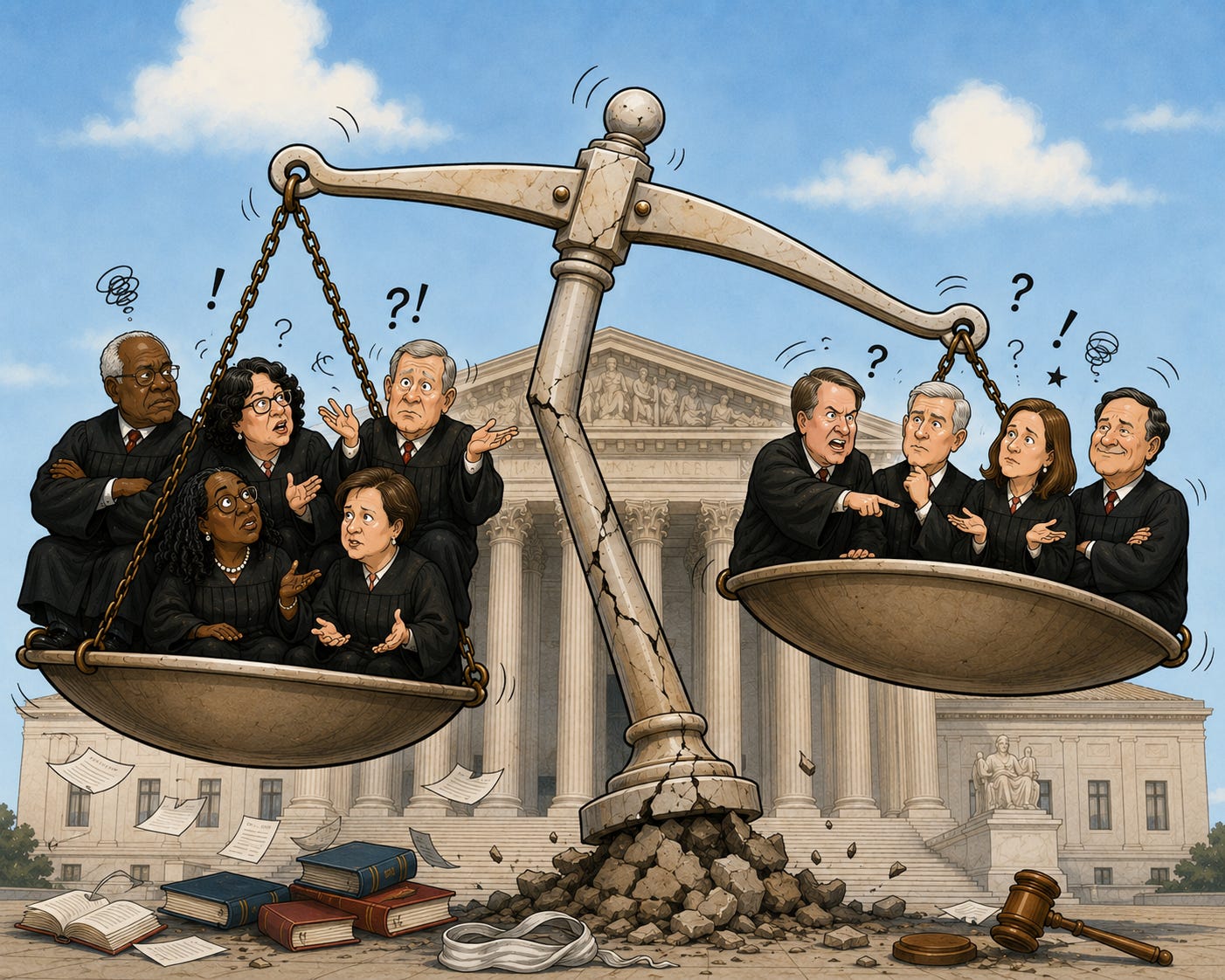
The Supreme Court released a full broadside of decisions on Monday. There was something to please and anger everyone. There were decisions that were a blow to the Trump Administration and decisions that made Trump crow about the “Greatest Increase in Presidential Power in the last 100 years” [random capitalizations are his] on Truth Social. Yes, there’s something for everyone, but I think that both sides are likely to concentrate on the cases they lost.
For the record, I haven’t read the full decision in any of these cases and don’t plan to. I’m in the middle of a large library book, “Guadalcanal” by Richard Frank (the definitive account of the WWII battle; it says so on the cover), and I do this for free, so no, I’m not reading all these decisions, but I will explain them, aided heavily by other reports, particularly from SCOTUS Blog.
Let’s start with Chatrie v. United States, in which the Court held that geofence warrants are legally considered searches and are subject to Fourth Amendment protections. Justice Kagan, joined by Chief Justice John Roberts and Justices Sotomayor, Kavanaugh, and Jackson, held that cellphone location data is subject to an “expectation of privacy… that society is prepared to recognize as reasonable.” This is a victory for civil libertarians.
In a ruling that has triggered meltdowns, pearl-clutching, and rending of garments among the MAGA set, the Court also held that states could choose to receive mail ballots after Election Day. Single-day elections and mail ballots have been a MAGA bogeyman since 2020, but the Court affirmed the constitutionality of America’s federalist system as it applies to state authority to run and regulate their own elections.
Watson v. Republican National Committee involved a challenge to a Mississippi law that allows mail ballots to be counted if they are received within five days of Election Day. It’s important to note that the ballots have to be postmarked by Election Day, not after, as some scaremongers are claiming. The ruling was 5-4, with Justice Barrett writing for a majority that included Chief Justice Roberts, Sotomayor, Kagan, and Jackson.
I’m a little surprised at how this one turned out, but as Barrett explains, “the election-day statutes require the electorate’s choice to be made on election day. That occurs so long as election day is the deadline for individuals to vote—as it is in Mississippi. But the election-day statutes do not set a deadline for ballot receipt, so they do not prevent Mississippi from counting ballots postmarked before election day yet received afterward.”
In my opinion, this was the right call. Once a mail ballot is placed into the care of the Post Office, the voter has no control over whether it is delivered quickly or not. It seems reasonable to allow some extra time for mail ballots to arrive after Election Day; otherwise, ballots mailed on Election Day would not be counted because same-day mail delivery is not a possibility.
As always, my advice to voters is to drop your ballot off in person if you can’t vote in person. (I typically vote early in person, and I highly recommend that strategy if your state allows it.) If you absolutely must mail your ballot, I strongly recommend that you do so well before your state’s deadline. Requesting a return receipt might not be a bad idea either, unless your state has a way to check whether the ballot has been received, like the Georgia MyVoter page.
Finally, there was a split decision on the ability of the president to fire members of independent agencies. In a 6-3 decision, the Court overturned Humphrey’s Executor, a 90-year-old precedent, and allowed the president to fire Rebecca Slaughter from the Federal Trade Commission. In the same breath, the Court denied the president the right to fire Lisa Cook from the Federal Reserve in a 5-4 decision.
In Trump v. Slaughter, Roberts, supported by Alito, Gorsuch, Kavanaugh, Barrett, and Thomas, held that “the President must have the assistance of officers he can trust. Although it is up to the Senate to decide whether to confirm those with whom the President would prefer to work, neither Congress nor the courts may saddle him with those with whom he cannot work. Subordinates who exercise the President’s power are subject to removal by him. Then, and only then, can they remain accountable to the President, and the President to the people.”
On the other hand, Roberts also wrote for the majority in Trump v. Cook, where he was joined by Sotomayor, Kavanaugh, Kagan, and Jackson. In that decision, Roberts wrote that allowing the president to fire Cook “would in effect transform the Federal Reserve’s for-cause protection into at-will employment—an interpretive leap out of step with the statute Congress enacted and our Nation’s tradition of central banking protected from political interference.”
It’s two Chief Justice Roberts’s in one! What are we doing here, guys?
If you’re wondering why Roberts and Kavanaugh would vote one way in one case and flip their votes in another, you’re not alone. Much of the legal and political world is wondering the same thing.
The core issue in both cases was the president’s authority over independent agencies established by Congress. In the statutes creating the agencies, Congress stipulated that members could only be removed for cause. In Slaughter, the Court seemed to reject that stipulation while it preserved it in Cook. This sends a very mixed message to Congress and lower courts.
The ruling in Cook raises the possibility that a president could make a pretextual case for firing a Fed governor and says that the bar for dismissal is not “very low” as the government claimed, but “not only the fact of independence but also the appearance of independence is key to the Federal Reserve’s design,” which in turn “counsels a substantial threshold for ‘cause.’”
Cook had been temporarily reinstated by a lower court, and this week’s ruling was based on the appeal of that temporary stay. The Court did not dismiss Trump’s attempt to fire Cook, but it did say that to remove her, the government must show that it would likely win on the merits of the case. Cook now gets to fight her dismissal in federal court while she continues to sit on the board of the Fed.
But what about Slaughter? The statute mandates that FTC commissioners could only be removed for “inefficiency, neglect of duty, or malfeasance in office,” yet Slaughter was fired without any indication of cause. Is Roberts’ ruling not making FTC employment “at will” without even a pretextual claim?
If there is any material difference between the two cases, except that the Fed controls the money supply and monkeying with the dollar could cause a global depression, most of us can’t see it. The twin decisions are almost schizophrenic.
Hopefully, future cases will lean more in the direction of Cook than Slaughter, but the cases underscore the need to elect honorable, trustworthy people to the presidency. If Slaughter is the ruling precedent, there is nothing to stop a president from firing bureaucrats of all agencies and restocking the pond with his cronies. Agencies like the Federal Trade Commission and the Federal Election Commission are supposed to have balanced partisan membership, but under Slaughter, that may be out the window as well.
Slaughter is another example of the “one-way ratchet” in which Congress delegates some authority to the president, and then courts strike down congressional limitations on the president’s use of that authority. The result is a large transfer of power to the executive that Congress almost never gets back.
I’m not sure what a good solution is here, because Congress does not have the expertise, the time, or the brainpower to make federal regulations on all the minutiae of modern life. Congressional geriatrics are not the best people to regulate cutting-edge issues like artificial intelligence. We need independent agencies to fill the gaps. Perhaps those agencies could be placed under congressional, rather than presidential, supervision, but would the courts allow that?
If you want to worry about anything in Monday’s decisions, worry about all the power that the Roberts Court is handing to the president as it strips away congressional guardrails. The extremes of unitary executive theory are bad no matter who is president, but they are especially bad considering the current president.
Again, the bottom line is that we need to stop electing incompetent and power-hungry presidents. We need trustworthy and able administrators, but we also need to enact reforms that make it easier for Congress to hold bad presidents accountable. We also need the courts to preserve congressional authority.
Add that to the list of much-needed post-Trump reforms. Is anyone writing this down?
SOCIAL MEDIA ACCOUNTS: You can follow us on social media at several different locations. Official Racket News pages include:
Facebook: https://www.facebook.com/NewsRacket
Twitter/X: https://twitter.com/NewsRacket
Threads: https://www.threads.com/@theracketnews
Mastodon: https://bird.makeup/users/newsracket
Our personal accounts on the platform formerly known as Twitter:
David: https://x.com/captainkudzu
Steve: https://x.com/stevengberman
Jay: https://x.com/curmudgeon_NH
Can someone schedule a wellness check for Curtis?
"In a sharp rebuke to President Trump, the Supreme Court ruled Tuesday that the Constitution guarantees automatic birthright citizenship to virtually all children born in the United States."
"Chief Justice John Roberts wrote the court's 6-3 opinion."
"The decision firmly rejected the executive order that Trump issued on the first day of his second term. It sought to bar citizenship for babies born in the U.S. to parents who either entered the country illegally or who are living and working here legally with temporary visas. The executive order never went into effect because every lower court judge who reviewed it concluded, in the words of one judge, that it was 'blatantly unconstitutional.'"
https://www.npr.org/2026/06/30/nx-s1-5839358/birthright-citizenship-decision-scotus-trump
"If you’re wondering why Roberts and Kavanaugh would vote one way in one case and flip their votes in another, you’re not alone. Much of the legal and political world is wondering the same thing."
They probably have friends and family members with retirement accounts (no cushy pensions) and would prefer to not give the President the power to nuke the economy by playing stupid games with the Fed. (Lest they have to support their destitute friends and family on those judicial pensions.)