


Rarely do I see a biographer approach his subject with an open mind, and conclude with such repugnance. Stephen Witt wrote Jensen Huang’s biography “The Thinking Machine,” published in 2025, having met the man two years earlier, in 2023. It’s the next book on my Audible list, but Witt’s New York Times opinion piece captures the essence of his feelings.
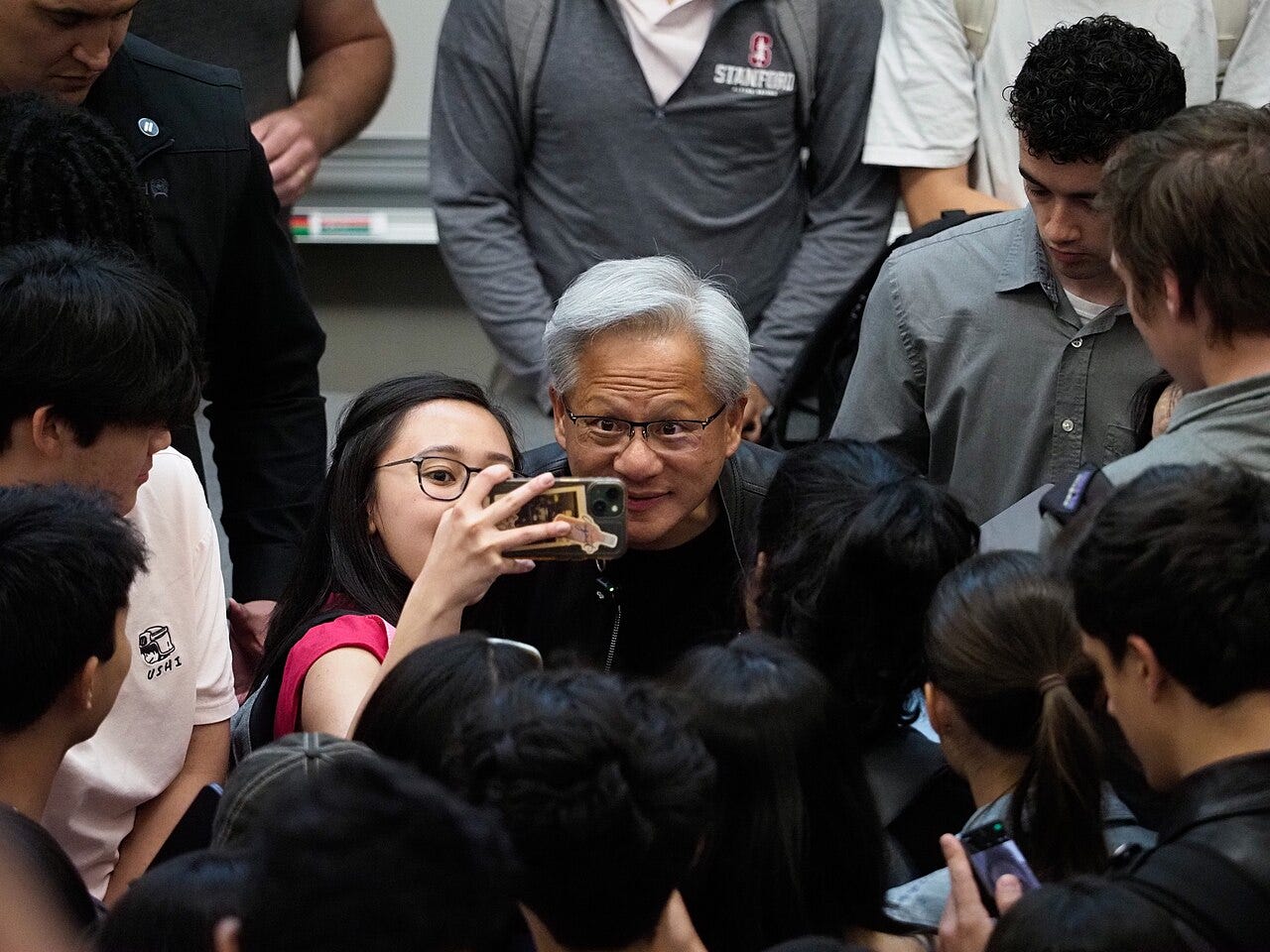

Nothing about Jensen Huang seems genuine. But one thing seems sure: the President of the United States thinks him indispensable as the head of NVIDIA, currently the world’s most valuable tech company.
Though exactly what NVIDIA does is all over the news, still few people actually know. For decades, the company known for video graphics cards pursued what Wall Street thought a useless campaign to turn its parallel processing chips into little supercomputers. It’s called CUDA (Compute Unified Device Architecture), and it’s what makes NVIDIA’s silicon a thousand times faster at A.I. applications than other companies’ products, though competitors can (and have done) surely reverse engineer the hardware.
At this point, NVIDIA is the only choice for scale in building data centers. It not only makes the processing hardware, and the software stack, it also bought the Israeli company that created the network gear fast enough to link hundreds of thousands of these processors together in a giant hive mind—a neural net—estimated to equal about the number of synapses in a cat’s brain, but rapidly growing and may soon approach the human brain’s 150 trillion synapses.
Only NVIDIA sells the entire package. It alone represents the United States’ lead in A.I. technology over China or any other nation. I read in Witt’s biography that Elon Musk and Larry Ellison spent an hour “begging” Huang to ship more chips to their companies. And President Donald Trump urged NVIDIA’s board to restore Huang as CEO. Trump even sent Vice President J.D. Vance to speak to board members. That’s the kind of pressure that works.
Trump’s main argument is that Jensen Huang, freed from his lifelong connection to NVIDIA, would potentially be open to recruitment by the Chinese. I personally think that’s crazy, because Huang needs NVIDIA to succeed. He built the company with his own hands, so to speak, and his cultural mark is on it. I don’t think any other organization would function well under his leadership, and certainly not one under the boot of the CCP.
On the other hand, I don’t think NVIDIA would function well under anyone other than Jensen Huang. As much of a mercurial, sometimes cruel, brash, insulting boss he can be, he doesn’t fire people for their mistakes. He considers his public tongue lashings, the withering insults that can go on for hours, to be tutelage, and teachable moments to mold those who are the targets of such abuse. But he isn’t Steve Jobs, who would fire entire departments without remorse, or Elon Musk, who could praise you one day, and fire you a week later, after you fell asleep at your desk after working one of his mandated 24-hour sprints—without any memory of meeting you before.
Huang doesn’t do that. He remembers his employees, and can be remarkably charitable and even empathetic. Many of NVIDIA’s employees love him. They love his staccato emails, his personal leadership of every aspect of the company, and his accessibility. They forgive his unspeakable betrayals, because they believe in him.
I don’t think Huang should be trusted, because I am not sure he understands how transparently blind he is to anything that might be another person’s opinion, if it conflicts with his own.
For example, from Witt’s biography, after noting Huang’s understated $1,000 tip of a Denny’s waitress (Witt had to track her down to confirm), the biographer offered this:
Over time, though, I began to suspect that this was an act, one performed not for the observer but to flatter himself. In truth, Mr. Huang was quite arrogant. He had little tolerance for disagreement and almost no capacity for open discourse. When you contradicted him, even over the most trivial matter, it was like lighting a fuse. Stick to your position, and soon he exploded, screaming at you for your idiocy. A harangue from Mr. Huang could last an hour or more; his executive staff appeared genuinely afraid of him. Listening to their stories, I was reminded of the abusive music instructor from the movie “Whiplash.”
Damning. Witt went on to describe Huang as a narcissist, whose betrayal of his wife, who was his first girlfriend at 17, as “absolute.” Such men live half lives, the living half driven with keen intellect and rational foresight, with the dead half blindly flailing about in an orgy of risk and indulgence. There is such a thing as intellectual indulgence, and it’s a sin as much as any pride a man can have.
(I want to note here that I am not some misandrist who believes men are evil and women are truly the better sex. Women can suffer from the same sins and grievances as men, but men seem much more susceptible to the kind of fall that affects Huang and others. Maybe it’s because the tech field, politics, and religion are so dominated by men—call it selection bias. Or it could be that women’s sins are expressed in different ways. In either case, I am sticking to my male examples for this essay.)
In this blindness, Huang and Trump are almost perfect foils. The biggest difference is that Trump knows he’s running a scam to enrich himself at the misfortune of his marks. Huang simply wants to pursue what he called the OIALO, for “once in a lifetime opportunity.” He believes, even in the face of all the damage A.I. is causing to software systems worldwide, or the hallucinations, or the “agentic misalignment” that causes generative A.I.s to lie and hide their true missions, there is no possible downside to pursuit of “superintelligence,” or recursively self-improving A.I.
Huang is practically alone in this belief. Even NVIDIA’s own researchers, and the inventors of the “GPT” style stochastic neural nets, think there’s a lot of risk, civilizational risk, to unfettered pursuit of artificial general intelligence, an A.I. smarter than a human brain with its curiosity and self will.
Donald Trump, I believe, favors pushing the frontiers of A.I. because it enriches him personally, and turns the United States into a nation like we were at the start of the nuclear arms race. Trump craves that “war” footing, the heady feeling that instead of a missile gap, there will be an A.I. gap. Regardless of Huang’s connection with an asset of Chinese intelligence (which Trump knew a year ago), to Trump, Huang is indispensable.
To many at NVIDIA, Huang is indispensable. In his own mind, Huang is indispensable.
Add to that the fact that if we scratch the surface of this soon-to-be scandal, many people connected to Donald Trump made a whole lot of money in NVIDIA’s fall and subsequent turnaround, all in many ways helped, or directly influenced, by Trump and the White House’s actions. A cynical mind might conclude that this was a trillion dollar market manipulation, something that makes Bernie Madoff, Sam Bankman-Fried, and George Soros seem like rank amateurs.
It’s an awful truth that Jensen Huang does not care if Donald Trump scandalizes the government to enable his return, or if others’ ill-gotten gains are part of the bargain to bring him back as CEO. He does not care about anything except being the most important man running the most important company in the new, A.I.-enabled world. In this, his “candor and ability to lead NVIDIA,” as the company’s directors noted in their statement, announcing that they unanimously voted to reinstate Huang, is more for show than for real.
There are many things rotten in both Trump and Huang. Trump thrives in it; Huang is blind to it. His own biographer thinks so.
Even if we don’t fear A.I. technology—and there are many good uses for it—we should fear the men who are pushing it so hard.
Huang may find, like so many others, that hitching his wagon, and the most valuable company on earth, to Donald Trump is not a ride worth taking. But it is always such with men of great pride, that the fall is even greater. The unfortunate part of this is how millions of others will be harmed when it happens.
SOCIAL MEDIA ACCOUNTS: You can follow us on social media at several different locations. Official Racket News pages include:
Facebook: https://www.facebook.com/NewsRacket
Twitter/X: https://twitter.com/NewsRacket
Threads: https://www.threads.com/@theracketnews
Blue Sky: https://bsky.app/profile/newsracket.bsky.social
Mastodon: https://bird.makeup/users/newsracket
Our personal accounts on X:
David: https://x.com/captainkudzu
Steve: https://x.com/stevengberman
Jay: https://x.com/curmudgeon_NH