


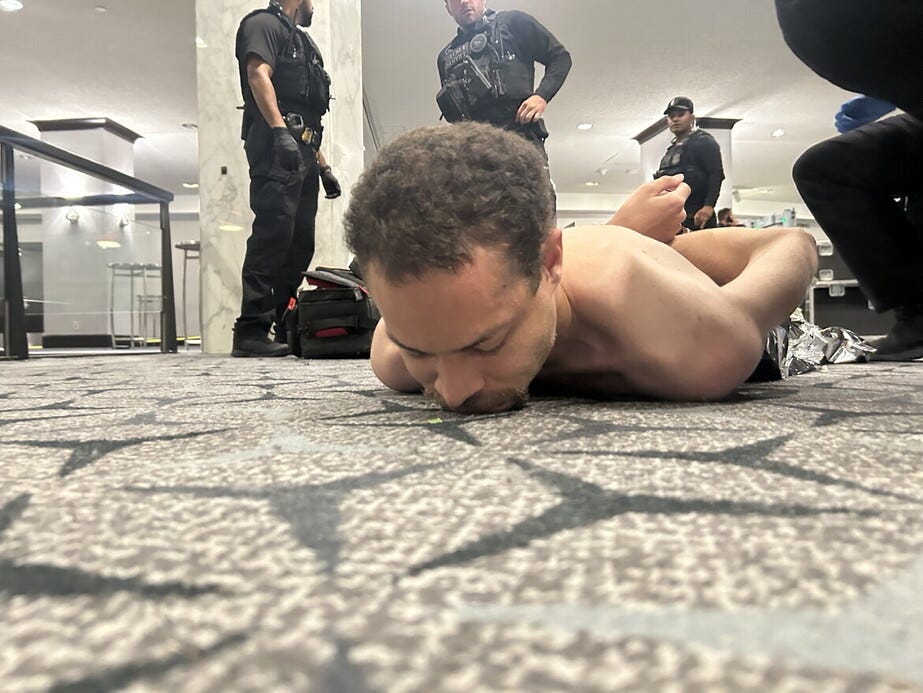
A gunman tried to breach security at the Washington Hilton, one of the most familiar venues where U.S. presidents speak, and therefore one of the places the Secret Service is most familiar. Cole Tomas Allen, 31, is charged with using a firearm in an act of violence, and assault on a federal officer; he reportedly shot an agent, who was saved by a Kevlar vest. Hot takes abound, led by President Donald Trump.
The venue here is no stranger to assassination attempts. In 1981, John Hinckley, Jr. shot President Ronald Reagan as the president exited the building, heading for his limousine. Donald Trump is no stranger to assassination attempt, either. We remember the summer of 2024, when 20-year-old Thomas Crooks fired a shot that nearly killed Trump, but only grazed his ear (one of Crooks’ shots did kill firefighter Corey Comperatore). Later that summer, Comperatore’s firefighter gear hung on stage at Trump’s nomination speech—his family grieved while the man’s death was used as political grist. I have no idea if a man seated on the platform at a Trump rally would want to be remembered in this way, or if anyone would choose that memorial. I wouldn’t.
Some say that if the White House Correspondents Dinner was held in the massive ballroom under construction (again halted by a federal judge) to replace the demolished East Wing of the White House, such security breaches would be a thing of the past. Trump himself wrote on Truth Social (I have no link, the site is crashed right now, so I am paraphrasing) that security measures “never seen before” would be the norm at the ballroom. This is sad. The White House is the “people’s house,” a term coined by President John Quincy Adams in the 1820s. This gained popularity as an argument to justify using government money to build it.
First Lady Jacqueline Kennedy founded the White House Historical Association, said “The White House belongs to the American people.” I don’t think either John Quincy Adams or Jacqueline Kennedy meant having security “never seen before” as the end goal of their vision. It is certainly clear that Donald Trump believes that the White House is the President’s House, not the people’s.
Further separating the public from its political leaders is not the real danger stemming from near-security breaches and regular assassination attempts on political figures. Other presidents have been assassinated, of course. Teddy Roosevelt took a bullet to the chest while reading a speech in his failed Bull Moose Party run at the White House. He continued the speech after being shot, famously declaring “I have just been shot; but it takes more than that to kill a Bull Moose.” It was Teddy’s long speech, in his coat, that he claims saved his life by slowing the bullet and preventing it from piercing his heart.
Each assassination attempt has resulted in more security; ironically it was President Abraham Lincoln who signed the act creating the Secret Service on April 14, 1865, the day he was assassinated. The act took effect in July. The organization was founded to combat financial crimes, but in 1901, after the assassination of President William McKinley, it took on the role of protecting the president full-time. A congressional report revealed that Donald Trump’s campaign had repeatedly requested more personnel and resources to protect the candidate in 2024, which were denied before the Butler, Pennsylvania assassination attempt.
Protecting the president, presidential candidates, and government officials is, and should be, a priority for our nation. There is no shortage of disaffected kooks capable of violence against our political leaders, never mind the rest of us. The cost of this, besides taxpayer dollars, is further separation of the public from those who represent us, and those who are chosen to govern.
But as I wrote, that’s not the danger we face.
This nation’s governmental system was founded on a document created by the Constitutional Convention of 1787. Fifty-five delegates debated, voted, and struggled behind closed doors for 116 days, until the final document was produced and signed by 39 of them. Delegate George Mason (namesake the the university named for him) famously declined to sign, saying he would rather “chop off his right hand” than affix his name to the document. It’s not that Mason hated liberty, or the carefully crafted design of the constitution; it’s that he wanted the Bill of Rights to be included in the final draft, instead of left to the states to ratify after the fact, and that he believed the method of selecting a president, and the powers of the presidency, would lead to despotism.
Inherent in the constitution is a foundational belief in many of the precepts held by John Locke, such as “natural rights” to life, liberty and property; that government is a social contract between the governed and the system of governing; that government should be in tension with itself to prevent one faction or body from having absolute power over the people; that the people have a right to rebel against a government that violates the social contract.
The reason our government was crafted the way it is, is because the founders followed these precepts. They created a government where legislators had the power to make laws, but not the power to enforce them; where judges had the power to strike down laws, but not without a case before them duly brought by someone injured by the law; where the executive branch was sworn to uphold laws that Congress passed, but could do so with the greatest degree of freedom and discretion. Congress was explicitly divided into two houses, one that represents the people, and one that represents the states, and given different powers of oversight, though both must agree to any law before it goes to the president.
These things are known and taught in every government and civics classroom, including lessons that must be learned by every naturalized citizen, who must pass a test to gain their citizenship.
There are many leaders in our government and political space who believe that our government is ineffective, and inefficient at attaining the end goals of protecting life, liberty, and property. It was designed to be inefficient, as its purpose is to arrive at the best (or least worst) solution to complicated problems, having the greatest good (or least harm) to the most residents of our nation. And our nation is large and diverse. The founders future-proofed our government by parceling out powers, dividing and limiting the federal government, while reserving all other powers to the states, and the people (Tenth Amendment).
With the exception of the United Kingdom, which has no written constitution, the United States is the oldest surviving democracy among nations with large populations and ethnic diversity. Our constitution has survived 128 years longer than Mexico’s, 161 years longer than India’s, and 169 years longer than France’s. Other countries, such as China, Japan, and Germany, have long-lasting government systems (though Germany is a lesson in the dangers of populism), but these are either totalitarian in nature, based on racial dominance, or both.
Our government was designed specifically to govern a rabble, who cannot agree on anything, never mind major issues, and has the right to be armed for the specific purpose of defending itself from excessive government incursions. It was designed to create a pen for our passions, so that they do not run red with blood in any direction. Only slavery has breached the constraints of this iron prison of federalism and republicanism, and that issue was known (and consistently avoided) by the founders. The delegates to the constitutional convention refused to even mention slavery in the final document. Tortured language was used to infer it, but never directly. It was known that one day things would resolve, but breaking the union and a bloody was was hoped to be avoided—it could not be avoided.
Right now, the danger of these assassination attempts and the political violence encouraged by both parties in our factional system, is that we would forget and dismantle the iron prison of federalism and republicanism. With a congress that refuses to legislate or exercise oversight, an executive that believes it has the right to govern without limits, a federal system that subverts the rights of states to self-government, and a progressive cabal who would like to totally dismantle the electoral college, which was the shim to keep us from electing demagogues, because the electoral college has elected demagogues to the office, our system of government is broken.
It is broken but at least it can be fixed, because the elements to fix it are inherent in the constitution, and the institutions to fix it still exist in their more-or-less original form. However, if the Supreme Court, or the Senate, or the electoral college, or the states, allow our political groups and leaders to dismantle any element of our system, the entire system could fail, and fail spectacularly. The balance, or rather, the tension, that keeps the balance, cannot endure if the systems that create that tension are removed.
Those who tinker and toy with it do so at our peril. There is no issue so important that it requires our government to be dismantled or deformed to the point of failure. There is no issue so important that it requires political violence to solve; we took care of slavery 150 years ago.
The danger we face is not from would-be assassins, or even the massive security culture to protect against them. It is in the loss of inherent rights and foundations of our constitution. The people have the last say, and our votes and selections in elections matter. That is how we defend against the danger; we elect people fit for the task. That is the duty of the electorate. If we abandon the social contract that Locke elucidated, we abandon our government to the passions of demagogues, sycophants, and corrupt criminals.
Elect better people and let the constitution keep the iron prison intact.
"... and a progressive cabal who would like to totally dismantle the electoral college, which was the shim to keep us from electing demagogues, because the electoral college has elected demagogues to the office..."
If I have code in a software that is not working (or working to sabotage other code), I either fix it or remove it. I used to be a big fan of the electoral college, but it failed us catastrophically this past presidential election.
"However, if the Supreme Court, or the Senate, or the electoral college, or the states, allow our political groups and leaders to dismantle any element of our system, the entire system could fail, and fail spectacularly."
John Roberts' immunity ruling was a big step towards failure as he surrendered the Court's role in holding the Executive accountable for actions that enriched the President and effectively neutered Congress's ability to constrain the chief executive. (What force have any laws when those that break them on behalf of the President may be pardoned[1]?)
I fear that the critical mass of voters needed to elect "better" leaders doesn't exist anymore and we're scheduled for bread and circuses until the tent collapses around our ears.
[1] https://www.wsj.com/politics/policy/trump-promises-mass-pardons-to-staff-before-leaving-office-d7274d32
A banger of a column Steve, one of your best ever.