


There’s an old saying: “once is happenstance; twice is coincidence; the third time is enemy action.”
I looked it up: Ian Fleming, the creator of James Bond, wrote that line in the book “Goldfinger.” This piece is not one of those encouraging back-slapping things, so I’ll treat you to my favorite line from the movie version—the “enemy action” line is not in the script. As Bond is strapped to a metal table, Goldfinger activates a powerful laser, which cuts through the table, moving inevitably toward Bond’s crotch. “Do you expect me to talk?” Bond asks. “No, Mister Bond. I expect you to die!” And with that, we will continue.
There’s another saying that applies today: news travels fast, and if you pause, you’ll be overcome by events. Okay, I don’t think anyone famous said that. I said it, and right when I was finishing this piece, the Optimizely hack hit CNN, Fox News, BBC, Salesforce, and GitLab. What is Optimizely? It’s an invisible marketing platform that subtly (or not so subtly) alters a public website to fit the viewer’s “preferences” using AI. Basically, it’s a click-generator and ad presentment platform that shows you what you like, so you’ll be more likely to click it, buy it, or visit more. In other words, a manipulation engine. It’s invisible, because you don’t know it’s working in the background, tracking you.
Except when it has been hacked and some nefarious group has inserted a script to steal your credit card information, or your credentials. Then you notice. Now I’ll return to the main topic here, but this ties in pretty well.
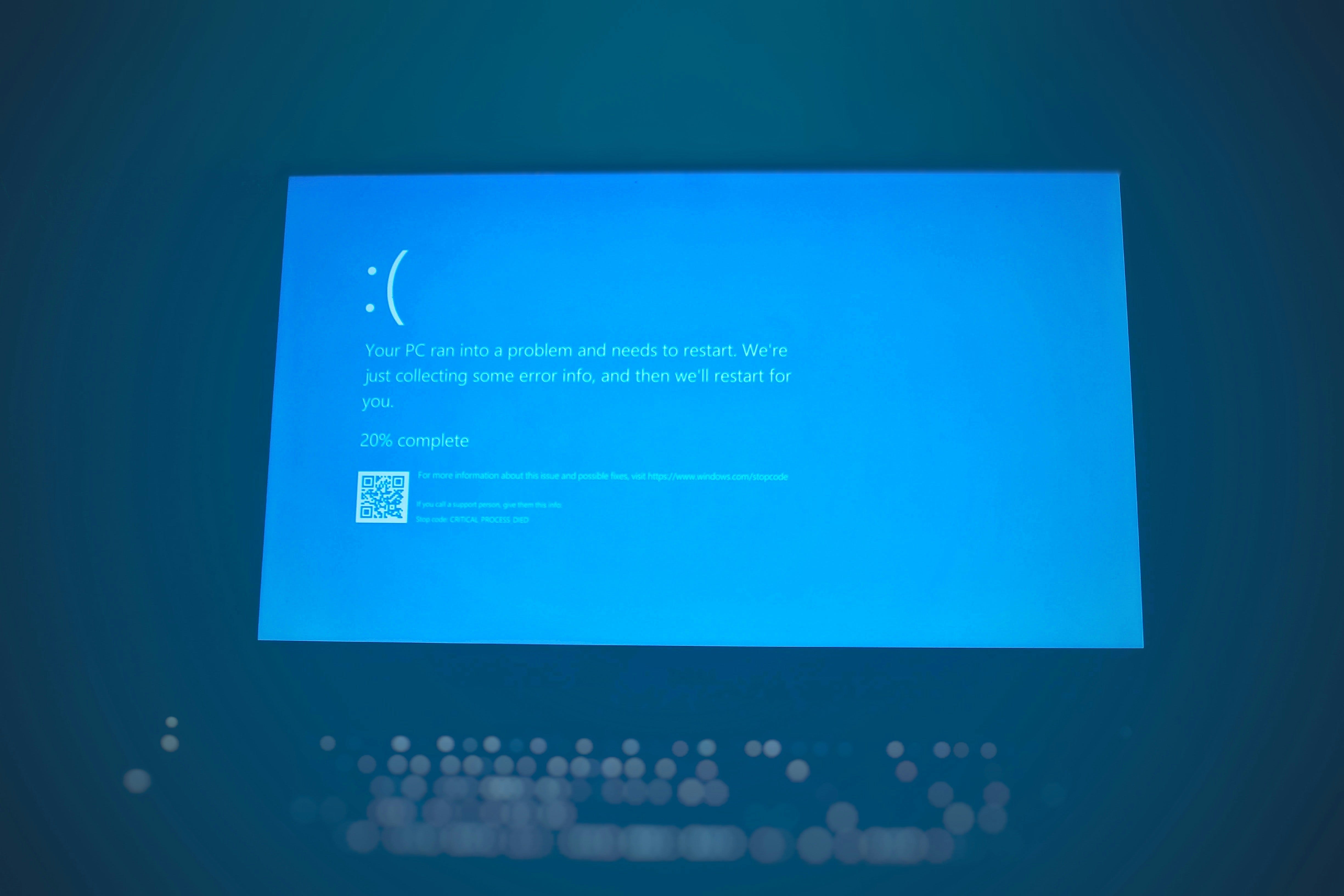
The last week was a difficult one for software, users of software, and recipients of goods and services dependent on software. If you have flown somewhere on an airline, I do not envy you. If you have money in JP Morgan Chase Bank and had trouble with transactions, I am sorry for you. If your company uses Microsoft Office 365, and the email infrastructure attached to it, I feel your pain. Goldfinger logic would place these events squarely in the category of enemy action. If all our software, which is supposed to be five-nines (99.999%) reliable, is failing in quick succession, surely someone is behind it.
But this time, maybe counterintuitively, it’s not the case. Yes, the European refrigerator failures earlier in the month were indeed the result of hackers. And since the summer, cyber attacks on U.S. water systems have caused minor problems—some evidence traces that back to Iran-aligned hackers. But the trifecta of an FAA communications blowout, Microsoft’s email woes, and Chase’s overload do not appear to be the result of enemy action. Unless the enemy happens to be software itself, that is.
I’m not going to lie. I was going to write about Jensen Huang and his enormous cult, in which he himself is the chief priest and shot-caller. I still have that piece on the warmer, and will continue to polish it. When it’s time, I’ll post that one. But related to the chip industry is what chips are used for, and that’s to run software code, which, when compiled down from complex programming languages, is really just instructions from a chip’s instruction set. Computers are really good at doing what you tell them to do, not what you want them to do. In its most pure form, the failures of the past week are of that kind, and in one case, the expected result.
Let’s look at the FAA and its Air Traffic Control system. This system was built on 1950s technology, which was then adapted to 1980s infrastructure. It has not been remade in decades. I mean, just a few weeks ago, the agency announced it was phasing out the use of floppy disks. If it was not such a serious problem affecting so many, this would be cause for laughter. I haven’t used a floppy disk (not even the 3.5 inch variety) in years. I don’t even possess anything with a floppy drive, though there’s plenty of museum pieces that do. The ATC system is just that, a museum piece, but a fairly reliable one. The problems begin when you try to graft that museum piece into the modern world’s network architecture.
In other words: it works if you don’t touch it.
The Juniper router that longtime FAA contractor L3Harris installed caused a huge network broadcast storm. Hewlett Packard, which owns Juniper, said in a statement: “Based on what we know today, the device functioned as it was configured to by the installer. It did not fail or act improperly.” In other words, this problem was predictable—if not inevitable—and should have been planned for. I am absolutely certain that some L3Harris network engineers informed the FAA of this fact, and I’m absolutely certain that some Pollyanna optimist manager shu-shu’d it away and told everyone to hope for the best.
My brother Jay and I are both veterans of many software projects, meaning we’ve seen these things happen, and we have rolled our eyes when they did. Jay shared a time when he had a deep discussion with a vendor over the meaning of “factory reset,” or reset to “factory settings,” leading to an admission that indeed, the device in question does not really reset itself back to those settings. It’s important to know such things when one is installing a piece of gear that needs to be in a known state, in a working system that is not supposed to have downtime. I’m sure something was overlooked in the ATC project. Some small detail that nobody thought to ask, or someone asked and the answer was buried.
I shared a time when I was brought in to informally consult with a college student project to gather some data on a European Space Agency launch. The kids, and their professor, worked hard to configure their sensors and communications systems to gather whatever it was they were collecting, and send it to a ground station. ESA, for whatever reason, insisted on HP gear. The students tested their components, and the entire system end-to-end. They handed over their project gear to ESA, which carefully packaged it in the rocket.
One night around two in the morning, I received a call from a distressed professor. He said the rocket launched and they received their data, but it was garbage. After some questioning, I concluded that at some point, the HP gear and its serial communications chip, called a UART, was reset to factory settings. But the ground station for the project remained configured the way it was tested. The factory settings for the UART was 9600 baud, and the ground station was set for 118200. Nobody had considered the bedrock of system engineering: determine the failsafe condition, and stick to it. I understand, they are students—but I had to deliver the bad news, after asking if there was any raw data buffer or signal archive to replay (there wasn’t), that their experiment ended in a stream of garbage.
These are all part and parcel of communications and network engineering, which is really a branch of software engineering. And these systems, like the ATC communications network, though carefully crafted and assembled, are indeed very fragile when you mess with them, without attention to minute details and the consequences of small errors.
I think that the global web of software, online software-as-a-service (SaaS), and everything-as-a-service, from security, to networks, to cloud data, to databases, to ordering, payments, billing an fulfillment, has become so complex and interconnected, that no one organization can untangle it. And that’s dangerous as hell (forgive the strong language).
The tiniest flaw in some module of what we call “mobile code” can be exploited to maximum effect, because AI agents are crawling everywhere, looking for holes. “Mobile code” refers to software that is loaded to your browser, called by the main page that’s being displayed, so it sits resident on your computer, running scripts, executing commands, and generally relying on the trusted status of the site that called it with proper credentials.
But when mobile code is infected because it has a vulnerability, especially a “zero day” unknown vulnerability, much damage can be done. And since these “as-a-service” mobile code bases are used across many, many sites, and millions and millions of computers, the effect of a small exploit can be unusually large.
That’s not all. It’s not only mobile code and vulnerabilities and exploits. It’s the global supply chain of dependencies in software. Nobody writes custom code anymore than runs directly on a CPU, unless you’re NASA or JPL or CERN and creating a one-off, one-of-a-kind program. Even giants like Apple, Samsung, and Alphabet rely on software libraries, some of which have been around for decades, because they rely on the tried-and-true Unix universe of utilities and standards.
It’s like Men in Black out there. You don’t know and you don’t want to know, because people are herd animals, and we panic. For example, the XZ Utils Backdoor issue that nearly compromised the entire Internet in 2024. Open source projects maintained for years by volunteers are used by large professional software organizations, and therefore ubiquitous services like OpenSSH (secure shell, a way for computers to cooperate using crypographic protection of data) can be weeks, or days, away from catastrophe. This one was narrowly avoided because a single Microsoft engineer noticed a 500 millisecond delay in SSH connections, associated with a spike in CPU usage. It was a backdoor that could have exposed millions of servers to unlimited hacking.
Sometimes, through no fault of hackers, bugs just show up because they are deeply buried, and software release cycles have become “continuous delivery” pipelines where changes are implemented without the stringent integration testing of the old days, when “waterfall” releases were pushed out all at once. Don’t get me wrong, there are still big releases, like Apple’s annual iOS updates, but there are also tiny releases, patches and other fixes that constantly update websites, mobile code, browsers, and your computer’s operating system.
No organization can afford to do full regression testing on every deployment, or revalidate all the dependencies, because it’s just too complex.
So we just trust that the companies that make the software and hardware we rely on to make our software work are doing the right thing. And that they mean what they say when they publish specifications. And that our engineers are asking hard questions like “what does ‘factory reset’ really mean?”
Like a snowball running downhill, it’s increasingly clear that the rise of AI, which can find problems light years faster than humans, is leading companies to get out over their skis (another industry term for when a company accepts a huge risk by exceeding its ability to manage complex systems), and when a certain number and combination of these companies are out over their skis together, you get things like the Microsoft 365, JP Morgan Chase, or FAA problems that affect everyone.
The problem is that nobody seems willing to pull back. Maybe when they see the human herd panic that the world is ending and the sky is falling, they’ll get the message. Or more likely, they’ll get the message when their stock crashes.
Our electronic infrastructure is so tied in with the global economy that the two can’t be separated. When NVIDIA is more valuable than every food producer in North America, combined—actually, in the world, combined—we have a gigantic problem. The failure of one company, and a panic like the world has never seen since the Great Depression, can set of a chain of events that makes food unaffordable. It’s not that we don’t have food, it’s that panic has disrupted everyone’s ability to earn money to pay for it.
Yes, there’s a case that bad people with mad computer skills are out there trying to sink the western world. They are out there. But Microsoft, and a whole host of advanced companies are on the ball, and keep very close tabs on cyber attacks. Our blind spot are the billions of combinations of dependencies and trusted libraries that we simply ignore.
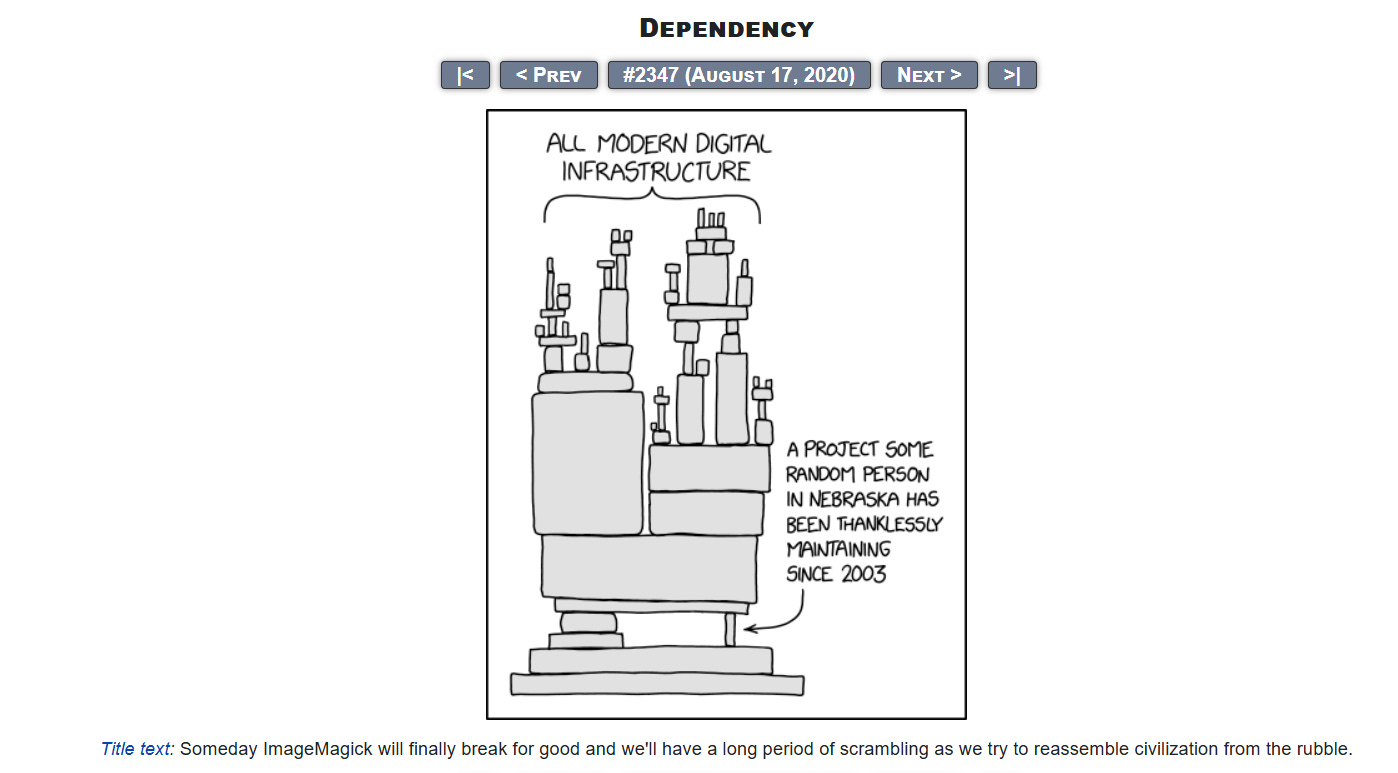
The folks at the tech satire site xkcd.com got it right. We are always on the precipice of failure, but never seem to fall all the way. It’s dangerous to think we never will.
SOCIAL MEDIA ACCOUNTS: You can follow us on social media at several different locations. Official Racket News pages include:
Facebook: https://www.facebook.com/NewsRacket
Twitter/X: https://twitter.com/NewsRacket
Threads: https://www.threads.com/@theracketnews
Blue Sky: https://bsky.app/profile/newsracket.bsky.social
Mastodon: https://bird.makeup/users/newsracket
Our personal accounts on X:
David: https://x.com/captainkudzu
Steve: https://x.com/stevengberman
Jay: https://x.com/curmudgeon_NH