


There are 42 days to the midterm elections. Six weeks. Get your voting shoes ready.
Both sides have described the election as a Flight 93 election at times, but I think there’s a better analogy. To find it, we have to look back a bit further than September 11.
At this point, it seems as though the big Republican closing argument is going to be that, sure, gas prices are high, but the Democrats are communists.
Admittedly, there is some truth to this. Graham Platner was a self-described communist, and in one of the rarest of all things, he was a communist with a Nazi tattoo. (Nick Fuentes might be another.) On the other hand, Graham Platner was shown the door a few months ago in one of the smartest moves the Democratic Party has made in recent years.
There are a few Democratic candidates who claim to be socialist, as well as some others, like Abdul El-Sayed, who don’t adopt the label but share many of the policies. It’s true that socialists are not communists, but it’s also true that the dividing line is pretty gray and blurred. “Socialism” can represent anything from the democratic socialism of the wealthy Nordic countries to the hardcore leninism of the Soviet Union (the Union of Soviet Socialist Republics) and the Cuban and North Korean regimes.
There’s a lot of ground in between those two extremes, and Democrats who take the socialist label tend to skew toward the Scandinavian end. As I pointed out with Platner, however, there are exceptions.
On the other side of the political aisle, Democrats have accused Republicans of being fascists. That’s not a totally new thing, but as I pointed out a while back, Trumpism fits the generally-accepted definition of fascism that includes characteristics such as extreme nationalism, a (would-be) dictator with a cult-like following, and no firm principles other than whatever is best for the tribe. Fascism, of course, was also called national socialism.
An interesting quirk of politics and history is that national socialism isn’t really socialism. The word “socialism” in Hitler’s National Socialist party was a bait and switch, intended to capitalize on socialism’s popularity in 1920’s Germany in an attempt to appeal to the working class as well as middle-class Germans. The two ideologies overlapped in many ways, such as being anti-capitalist and authoritarian, but the Nazis were anti-socialist and anti-liberal.
In the wake of last week’s hullabaloo about Bo French’s racist tweet about college football crowds, Erick Erickson posted an expose’ about the white supremacist infiltration of Republican and Christian Nationalist groups, which traced the ideology of some prominent right-wing activists to Carl Schmitt, a veritable WWII German Nazi. The replies to Erick’s posts on the subject are revealing.
In a way, this year’s election is a matchup of Democratic Socialism versus National Socialism. You know what else had that sort of ideological faceoff? The Spanish Civil War.
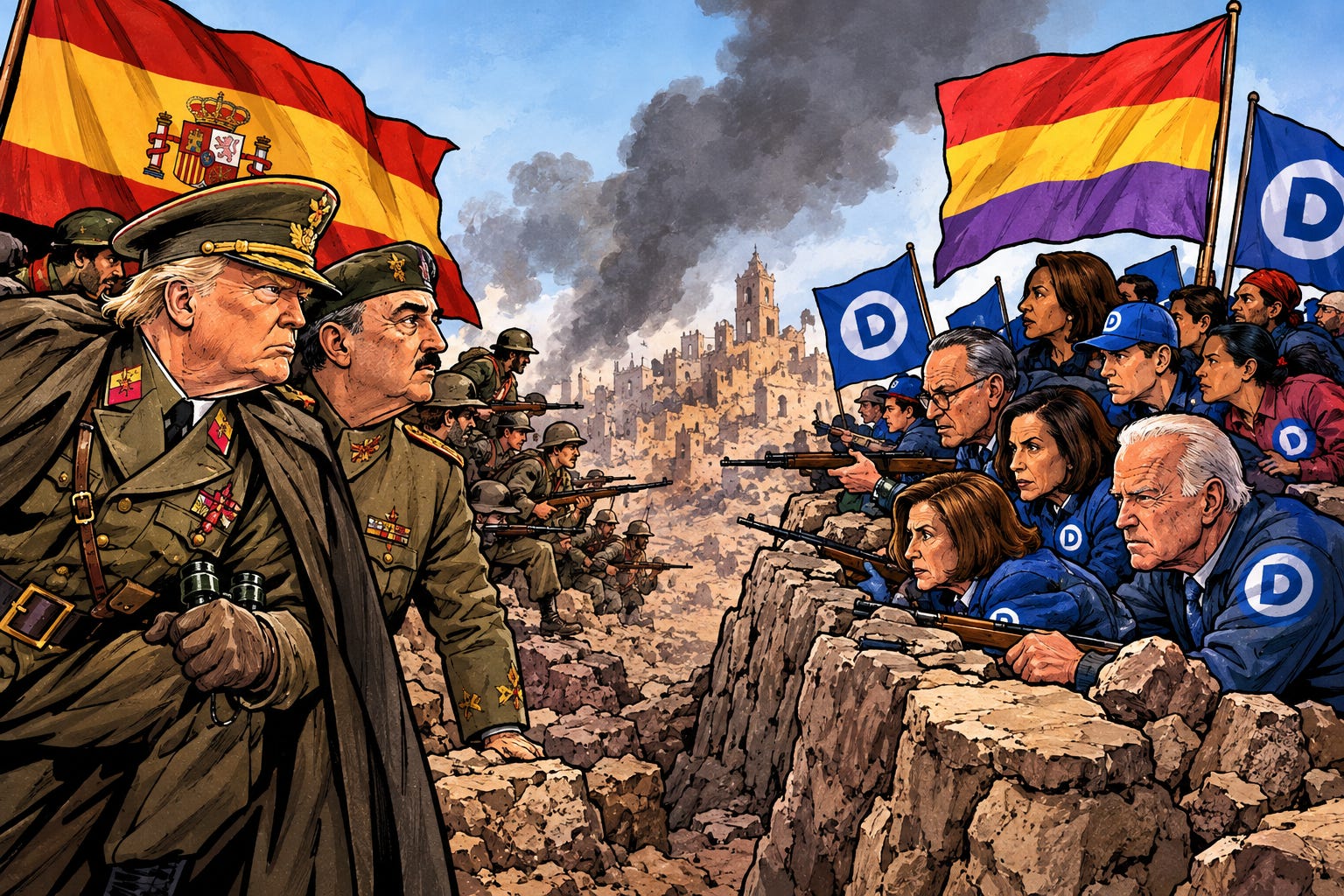
The Spanish Civil War gets short shrift in the American version of world history, but if you’re a World War II buff, you’ve probably at least heard of it. The conflict began in 1936 with a military revolt against Spain’s Republican government. The causes of the war aren’t as relevant to the story here as its conduct. The Nationalists, led by Francisco Franco (if you’re a Saturday Night Live buff, you may remember the old Weekend Update joke, “Generalissimo Francisco Franco is still dead”), fought the Republicans, and each side had its surrogates. (If you want an more backstory on the conflict, I recommend episodes 109 and 110 of the “WWII: Both Sides of the Wire” podcast.)
Once the war started, Nazi Germany used the conflict as a field test for the weapons and tactics that it would use in Europe a few years later. German soldiers and pilots, the Condor Legion, served tours in Spain to get combat experience and “advise” Nationalist troops. On the Republican side, the Soviet Union counterbalanced the fascist aid to the Nationalists.
In many ways, the Spanish Civil War was a cause celebre of the 1930s in much the same way that the Russo-Ukraine War has rallied the world’s support in our own time. Pablo Picasso’s masterpiece, “Guernica,” memorialized the loss of life on the Spanish town of Guernica by a German air raid, and Ernest Hemingway, a war correspondent who covered the conflict, detailed his experiences in “For Whom the Bell Tolls.” The United States was officially neutral, but American volunteers formed the Abraham Lincoln Brigade to fight against the Nationalists. Some of these volunteers were communists or socialists, while others just hated fascism.
As Hemingway wrote:
"Are you a communist?"
"No I am an anti-fascist"
"For a long time?"
"Since I have understood fascism."
It may be hard for those who know me know to believe it, but I was once an avid reader of “Soldier of Fortune” magazine (“the journal of professional adventurers”). In addition to covering the conficts of the 1980s, SOF also ran articles about military history and I distinctly remember one letter to the editor about about an article on Spanish Civil War. I can quote the closing lines from memory that succinctly described the war: “The Spanish Civil war was communism versus fascism. Both suck.”
Indeed.
The point here is that when faced with two unpleasant choices, sometimes you still have to choose. The lesser evil is also the greater good to an optimist. (Thanks to Micheal Medved for that insight.) Let’s not bother talking about third parties that have no chance. Sometimes being an adult means making difficult choices.
In 2026, we have a Spanish Civil War sort of choice. I’m not very excited about some of the people on the Democratic side, and I’m not excited about a lot of the Democratic platform.
However, I do understand that the greater danger is the wanna-be dictator and the personality cult who are actually in power and already doing tremendous damage. MAGA fascism is also a greater threat than Democratic socialism because the Republican Party is far more infected with radicalism than the Democrats are. Polling shows that Republicans are still 79 percent MAGA while 55 percent of Democrats viewed socialism favorably in recent polling. Neither stat is anything to brag about.
Like Ernest Hemingway, being an anti-fascist in 2026 may put us temporarily on the same side as some socialists and even some communists. That doesn’t make us communists or socialists; it just means that we see fascism as a more imminent and dangerous threat.
Sinclair Lewis did not say, “When fascism comes to America it will be wrapped in the flag and carrying a cross,” but the sentiment has proven correct and here we are. It’s up to the American people to correct the course of the country. Like the Spanish Civil War, it can be difficult and unpleasant choice, but there is definitely a right choice.
I’ll close with another Hemingway quote that seems eerily on target these days: “There are many who do not know they are fascists, but will find it out when the time comes.”
SOCIAL MEDIA ACCOUNTS: You can follow us on social media at several different locations. Official Racket News pages include:
Facebook: https://www.facebook.com/NewsRacket
Twitter/X: https://twitter.com/NewsRacket
Threads: https://www.threads.com/@theracketnews
Blue Sky: https://bsky.app/profile/newsracket.bsky.social
Mastodon: https://bird.makeup/users/newsracket
Our personal accounts on the platform formerly known as Twitter:
David: https://x.com/captainkudzu
Steve: https://x.com/stevengberman
Jay: https://x.com/curmudgeon_NH
David, I like the comparison of current politics here are similar to the Spanish Civil War. While I agree with much of what you say, I think at the time of the Spanish Civil War the Nazis were a known commodity and the free world understood that something needed to be done to stop the spread of fascism, so Americans voluntarily joined the International Brigade in order to do so. At that time, the threat of communism and what communism in the Russia style actual stood for was not understood to the same extent and there were many communist sympathizers. Once these idealists got to Spain and joined the ranks of the International Brigade, much disillusionment with the communists set in, particularly with the way the Russians conducted themselves by dominating the forces. It was only after WW II and the USSR's dominance of Eastern Europe did the free world really come to understand what the communists were all about. So much like Spain in 1936, Trump is a known (and despicable) commodity. The DSA members may or may not be similar to the USSR or CCP. The extent of their beliefs is an unknown but many of them appear to be as much a racist as the neo-fascists are in the GOP and the track record of many of the main stream Democrats is not that of a shining example to lead our country into the future.
Again, great article. It provides much food for thought.