


This is one of those pieces you’ll read and say “that’s obvious.” But sometimes we need to be reminded of obvious things. My old pastor, when he taught from the Bible, always reminded us that when a verse begins with the word “therefore,” we must find out what it’s there for; in other words, whatever follows that word precedes from the things written before it. Beginning with “therefore” puts the conclusion before the cause or premise. In debate and rhetoric this is called “begging the question.” In everyday life, it’s called self-deception.
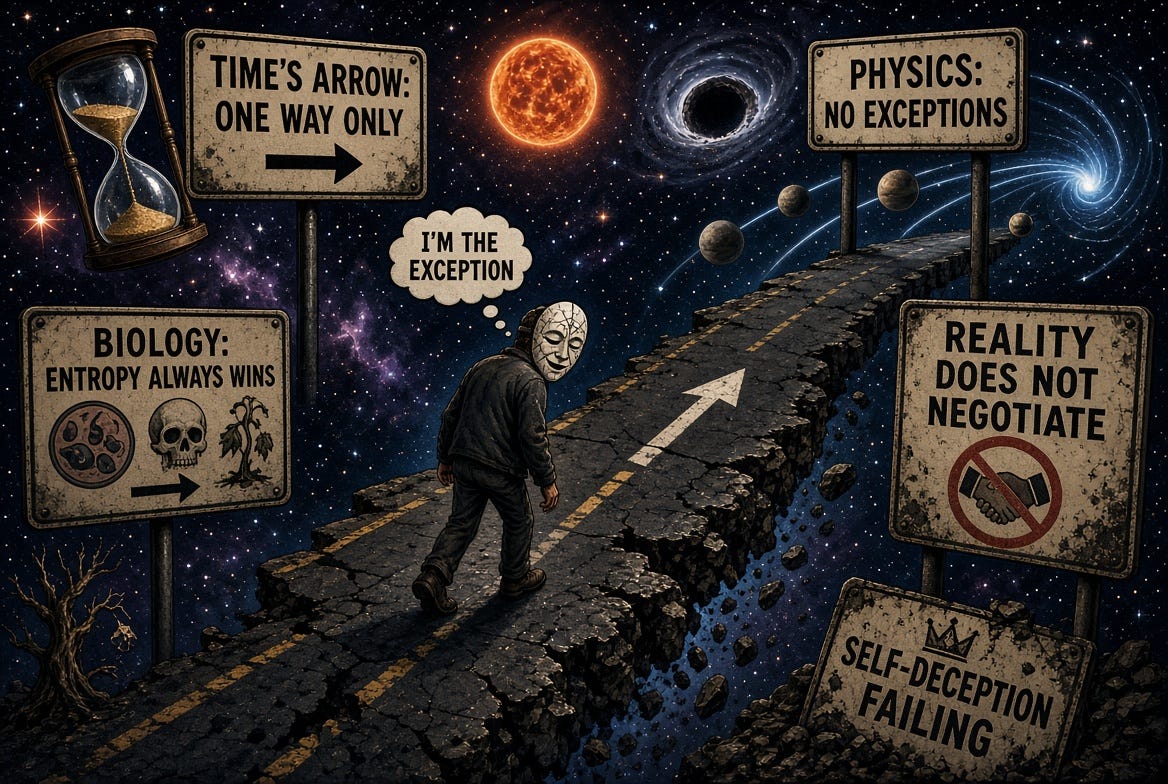
Human beings are vastly capable of self-deception. Not only that: we are capable of holding mutually exclusive deceptions in our minds as true at the same time. We can simultaneously believe that others cannot reason as well as we can, and therefore, we should be in charge, to do the things that, obviously, must be done. This mindset has governed the United States political environment for at least 20 years. I think the last president who didn’t fully subscribe to it was George H.W. Bush.
There was a time in politics where the siren song of ambition was blunted by the call of duty. Even Richard Nixon—of whom I will not say nice things in some lame attempt to resurrect honor in him—had the wits to realize when his duty included resigning and accepting disgrace. Those days of corruption blunted by duty are long gone. Today’s congress would not dare to impeach Nixon (ask me how I know).
Nowadays every political argument begins with “therefore,” skipping the essential arguments and premises that must be made to support the conclusion. Frequently, the entire argument is “therefore, I must be in charge.” This is nothing but raw ambition and will to power, and it governs a giant slice of the political environment in America.
The late Andrew Breitbart always said that politics is downstream from culture. In large part, I believe that’s true, but I also believe it’s more a waterwheel driving a pump analogy. Some volume of the political stream gets pumped back up into the culture reservoir, to be released back downstream. So when the culture begins fracturing through social media, the breakdown of national shared experiences, and competing epistemologies, then politics follows, but the breaking of politics into competing and equally deceived parties feeds back into the culture that produced it. As I’ve observed many times before, when it’s a race to the political bottom, there is no bottom. We just keep descending.
This is nothing new. After around 250 to 300 years of the Roman Republic, that body descended into civil war and Caesars. And for about 100 years, the Caesars got worse and worse, until Nero the psychopath brought it to its nadir. Societies can rebound from a nadir—look at postwar Japan and Germany—but it takes external conditions and a group of people who value critical thinking and truth over indulgence to get there. Of course, Rome fell, because there can only be so many “good Caesars” until one decides to be stupid and break the mold (they got Commodus as a reward).
For some more contemporary examples, we can look at why Germany and Japan recovered. The Marshall Plan was designed to prevent the communists from taking over. It was not the only plan considered: Gen. George S. Patton, and to no small extent, Winston Churchill, favored a military solution to keeping communism out of Western Europe. But the Marshall Plan leveraged a truth—that capitalism and free markets, coupled with generous infusions of capital, aid, and resources, would accomplish the same goal without bloodshed and result in stable democracies. France may have forgotten that lesson.
In Japan, Gen. Douglas MacArthur, an expert in the Far East and its culture, kept the trappings of Japanese society, but allowed it to transform into a thriving democracy and capitalist economy. He didn’t do it with the Marshall Plan, but with the same principles, with himself as the supreme ruler. The Japanese still venerate MacArthur.
In contrast, George W. Bush went for self-deception. We began a war in Iraq and believed we could simply remove the dictator, plant the “seeds” of democracy, and hand the reigns over to the Iraqis. Everyone who has studied history knew that the effort would take a MacArthur, or a Marshall Plan, along with 20-plus years of intensive ruling the place ourselves (along with our coalition partners) to even begin making the turn. Instead, we spend 20 years fighting a losing battle, and now it’s likely that war will be lost completely in the next decade, with Iraq siding with our enemies.
I won’t say much about Afghanistan, other than nobody has been able to tame it. The place is simply resistant to any kind of base cultural change. The Soviet Union tried for nine years and gave up. During that time, the U.S. armed and supported the Mujahadeen (literal translation from Arabic: someone who engages in jihad) to oppose the Soviets. That group became the Taliban, who then declared jihad against us, and we fought them, while those old Soviets from 1979 laughed. We left in defeat and abject humiliation. Some places are simply too difficult to govern from the outside, unless the colonialists decide to commit a century and a half million men to do it. (It’s been done, look at India and the Raj.)
We can also look at science and economics, which are very much linked. Global warming is real and happening before our eyes. Humanity’s effect on the planet does contribute to it. But too many climate activists begin their arguments with “therefore” and usually followed by their own quest for power to shape the world’s economy to their liking, in the name of saving the planet. The truth is much muddier. We truly don’t know a whole lot about how our planet handles climate. We don’t know if under the crust of this planet there’s a single ocean or seven oceans subducted above the mantle. We don’t know the full ability of the planet’s systems: atmosphere, magnetosphere, oceans, crust, mantle, and volcanic activity, to normalize (“heal”) or to make this place uninhabitable. We do know that a single event can wipe out most life, and that doesn’t include extinction-level asteroids or other externals. It’s foolish delusion to believe that our activity is all that’s necessary to set the climate right. It could be changing despite our efforts to eliminate greenhouse gasses produced by human activity.
The same goes for viruses and other microscopic killers. Of course, we can design such things in the lab and either on purpose or by accident release them into the world. But removing all biological threats is not a reason to hand political control over to people frequently acting in their own best interests. Nor is it a reason to be so skeptical of established and tested science, like herd immunity, that we reintroduce killers like measles and polio.
All these examples are the negative space illuminating some truths. Some things can’t be fooled. I want to highlight three examples, though there are certainly more.
Biology can’t be fooled. People are born—those able to reproduce, that is—male or female. Gametes are part of our design. Yes, there are other “genders” like hermaphrodites, but they are sterile. The human genome can only be passed on by sexual reproduction, meaning one set of male and one set of female chromosomes. Closing? Yes, it can be done, but the clone will never be perfect, and it still needs a womb to grow into a baby. It’s nonsense to say that a man can express himself as a “her” and experience everything it is to be female, or the other way around. The closest anyone can get is a crude masquerade or a surgical monstrosity. I’m sorry if that offends some people, but biology cannot be fooled. “Becoming” a different sex doesn’t change basic genetics functional anatomy. It would be easier to construct a full set of DNA from our knowledge of the human genome than it is to attempt to change a fully formed human from one thing to another. It’s biological alchemy and will have the same results as alchemists throughout history.
Alchemy brings me to the second truth: physics cannot be fooled. At the scale of human perception, quantum effects like superimposition cancel out. The universe we witness is one of classical, Newtonian physics. Push us out a window and we fall until we strike something to break our fall—and depending on the height, break us too. We can construct new elements, most completely unstable, and some poisonous like plutonium, but we cannot turn lead into gold. Perhaps at some quantum level, or at energy levels approaching the accretion disc of a black hole, such things are possible, but not in any practical sense that we can experience or benefit from other than basic research. But so many people begin their arguments with “therefore” as if these physics problems are simply engineering challenges.
Elon Musk wants to inhabit Mars and terraform the place. Physics dictates the difficulty of this. Mars is in the “Goldilocks” belt around our star, and could, theoretically, be inhabitable. But long, long ago, that planet lost its atmosphere to space. Putting it back and making it stick is so beyond our technological development as to be magic. We may as well pursue alchemy.
All of us share the third truth. We cannot beat time’s arrow. Biology and physics find their nexus in time. Entropy rules us; we cannot live forever. Our bodies degrade; our faculties fail; our time on this earth is limited. We all must die. In 100 years, unless we leave some indelible mark on history, we will be forgotten. Other than a digital trail, some public records, and perhaps a tombstone, the human race will move on without us, and even the memory of us will fade. Every American learns about Abraham Lincoln, but no one alive has a memory of him. Living memory dies. We cannot go back in time. Even thought experiments of “who would you meet?” or “who would you eliminate?” going back in time are futile self-deceptions.
We look to a future we’d like to live in, but that future will not include us. Those who dream of such futures and claim some ownership of authority to build them are deluded. Building the future is an act of service to people who aren’t yet alive, and won’t know or remember us. The world we create will be lived in by our children, but really it will be lived in by people far beyond our grandchildren when our memory has faded. Greatness is fleeting.
Pursuit of greatness frequently begins with ambition, with the “therefore” because someone is well known, famous, or rich, that they deserve to rule. It is playing god.
The Christian apostle Paul wrote in his epistle to the Galatians:
1Brothers, if anyone is caught in any transgression, you who are spiritual should restore him in a spirit of gentleness. Keep watch on yourself, lest you too be tempted. 2 Bear one another’s burdens, and so fulfill the law of Christ. 3 For if anyone thinks he is something, when he is nothing, he deceives himself. 4 But let each one test his own work, and then his reason to boast will be in himself alone and not in his neighbor. 5 For each will have to bear his own load.
6 Let the one who is taught the word share all good things with the one who teaches. 7 Do not be deceived: God is not mocked, for whatever one sows, that will he also reap. 8 For the one who sows to his own flesh will from the flesh reap corruption, but the one who sows to the Spirit will from the Spirit reap eternal life. 9 And let us not grow weary of doing good, for in due season we will reap, if we do not give up. 10 So then, as we have opportunity, let us do good to everyone, and especially to those who are of the household of faith.
(Galatians 6:1-10.)
Living for one’s own greatness is mocking God, for nobody lives forever. Flesh fails and is corrupted. Building the future is serving others we do not and will never know, obeying time’s arrow; it is doing good.
Christians believe that after this life, through the work of the cross, we can inherit eternal life with God. Not here on this planet, in these bodies, but in a perfect creation, with a perfect God. This universe is rational—it if was not, we would not be able to function. The creator of this universe is infinitely rational, and in Him there is no lie, otherwise gravity might fail, or light may not travel at a predictable, constant speed in every medium. “Science” is completely based on the study and acts of discovery in a rational universe. It is an act of service to discover things that may never benefit anyone alive at the time of discovery. It is building the future.
We stand at a time when few are thinking about the future as a servant. Most take up issues that either benefit themselves, or make arguments beginning with “therefore,” begging the question of who should rule everyone to shake a future in their eyes.
The biggest delusion is that we can shape our own future. Just like entropy cannot be mocked or reversed, God cannot be overruled. His future will happen just as He planned it, whether we deceive ourselves or not.
One day, we will come to our last moment on earth. At that point, all of life arrives at one point of decision. Will our memory be committed to a world without us, where we will be forgotten, or will we live in eternity with God through Christ? For those who choose the world, their fate is already decided. Open a Bible, start with the book of Matthew, and find the answer.
I want to encourage everyone that it is possible to live without delusion. That doesn’t mean we have all the answers (I don’t), but it does mean we can have peace with knowing all we need to know, and not knowing the rest. Paul wrote at the end of Phillipians chapter 3:
17 Brothers, join in imitating me, and keep your eyes on those who walk according to the example you have in us. 18 For many, of whom I have often told you and now tell you even with tears, walk as enemies of the cross of Christ. 19 Their end is destruction, their god is their belly, and they glory in their shame, with minds set on earthly things. 20 But our citizenship is in heaven, and from it we await a Savior, the Lord Jesus Christ, 21 who will transform our lowly body to be like his glorious body, by the power that enables him even to subject all things to himself.
And then he continued at the start of chapter 4 (chapters are our constructions, not how Paul wrote the epistle).
Therefore, my brothers, whom I love and long for, my joy and crown, stand firm thus in the Lord, my beloved.
Those who stand firm in the Lord have built their future, and also the futures of everyone who lives after them. Time’s arrow cannot be fooled, but we can serve the future with the greatest “therefore” we can muster. Don’t fool yourself. Serve God and stand firm.
Nice piece.
I’m not religious in the least. So for me it’s more the Twain/Hitchens concept that I didn’t exist for nearly an eternity before me, and I won’t exist for an eternity after me, and I’m here for a tiny speck in time, and that is all.
But I agree with your other core truths.
I don't have time to respond now, other than this: You know i read JVL from the Bulwark, he might be my favorite of all time. He makes me think, makes me look in the mirror, makes me ask questions i might not have asked had he not written the column i just read.
The highest compliment i can give you Steve is you just did the same with this piece.
Kudos.