


The US and Israel have long been friends and allies. The US was the first country to recognize Israel when it became an independent state in 1948, and the US resupply of Israel when it was attacked by a coalition of Arab forces in 1973 may have made the difference between Israel’s victory and annihilation. Through three quarters of a century, US public opinion has largely been on Israel’s side.
Until now.
Several polls from this year, including Pew in April and Gallup in February, show that American backing of the Jewish state has softened in recent years and now lags behind American sympathy for the Palestinians. I think there are a multitude of reasons for this shift, including growing anti-semitism on both the left and right, but much of it can be traced to Israel’s response to the October 7 attacks generally and the leadership of Benjamin Netanyahu in particular.
October 7 undoubtedly looms large in recent Israeli actions. The barbaric sneak attack by Hamas was akin to Pearl Harbor or September 11 in American history, but on a much larger relative scale. The 1,200 fatalities on October 7 make it the third most deadly terrorist attack in history, but it ranks first on a per capita basis, with about 1.07 fatalities per 10,000 Israelis (not all of whom are Jewish). Put another way, that represents about 0.01 percent of Israel’s population at the time, roughly equivalent to a death toll of 35,000 Americans from a single event.
There was never any chance that Israel would not respond strongly. We spent two decades fighting a war on terror after a much smaller proportional loss.
It may be that a strong Israeli response was exactly what Hamas (and its Iranian masters) intended. One of my longtime theories is that October 7 was a calculated attempt to kill not only thousands of people, but also an imminent peace deal between Israel and Saudi Arabia. Newly unearthed Hamas documents seem to confirm this theory.
Like Osama bin Laden with George Bush, Iran and Hamas may have underestimated the strength of the Israeli response. It’s also possible that Iran was willing to sacrifice Hamas and the people of Gaza for their overarching strategic goals.
Whatever the truth, the tragedy of October 7 was followed by an even greater tragedy in Gaza. It is difficult to determine the true extent of the civilian deaths in Gaza due to Hamas’s nature as a paramilitary organization that blends in with the populace and uses innocent people as human shields, but it is without question horrific. As of May 2025, Israeli military figures estimated 53,000 dead in Gaza, of which only 17 percent were Hamas fighters.
The very nature of the war against Hamas meant that a lot of noncombatants would be killed. Hamas has a long history of hiding its military operations in hospitals, schools, and even United Nations facilities, but Israeli strategy has also led to unnecessary loss of life.
David French, formerly a US Army lawyer, pointed out in 2024 that Israel was making the same mistake that the US made in Iraq (and in Vietnam, for that matter) by clearing areas of Gaza and then withdrawing. Hamas then recaptured the territory, and Israel had to go back and clear them out again. Having to fight repeatedly for the same urban territory rather than using a clear-and-hold strategy means that a lot more innocent people get killed. Occupation is politically unpopular, but it is probably better for the people of Gaza than endless, repetitive war. (As a footnote, Israel occupied Gaza between the Six-Day War of 1967 and 2005 when it unilaterally withdrew. The withdrawal set the stage for two decades of low-intensity conflict with Hamas before October 7.)
Israel has also historically had very strict rules of engagement to minimize civilian casualties, but those rules were loosened after October 7, though the IDF says it still adheres to the Laws of Armed Conflict, something that Hamas does not do. The changes led to attacking targets that were previously off-limits, and predictably, caused more civilian deaths.
Further, like the four horsemen of the apocalypse, other causes of death followed the fighting in Gaza. Famine and disease added to the death toll, while the difficulty in getting food and humanitarian aid into the area, sometimes due to Israeli blockades, contributed as well.
Israel’s decline in popularity correlates very closely with its aggressive response in Gaza and mounting civilian deaths, but Israel’s problems don’t stop there. Benjamin Netanyahu’s role in drawing the US into its unpopular and unsuccessful war with Iran has almost certainly added to Israel’s PR problems.
Many believe that Trump did Netanyahu’s bidding in attacking Iran, but that now seems overly simplistic. Netanyahu, working with the Iran hawks in the US government, definitely seems to have driven Trump’s decision to involve the US, but Trump’s break with Netanyahu to pursue peace at any price is evidence that Israel does not pull the strings on US foreign policy. Indeed, Trump seems to have frozen Netanyahu out of the peace process.
At the same time that the US and Israel were attacking Iran, Israel launched an invasion of Lebanon in April. Despite the peace deal with Iran, Israel has continued to attack targets in Lebanon and apparently plans a long-term occupation of the southern parts of that country, possibly out of the realization of the failed Gaza strategy. The fighting in Lebanon was likely intended to neuter Hezbollah while Iran had its hands full, but it hasn’t made Israel look any better to the world.
Israeli foreign policy post-October 7 is reminiscent of the scene in “The Godfather” where Michael Corleone takes control of the family business and exacts revenge on the heads of the other crime families, even though he had previously aspired to go completely legit. What is happening now is both a settling of old scores by Capo Netanyahu and an attempt to render the opposition incapable of threatening Israel in the near future.
That isn’t how things are done in the civilized parts of the world, where uncivilized and murderous terrorist groups don’t sit within missile range right across the border, though. It arguably breaks quite a few international laws to carry out this policy, not unlike our own unprovoked attacks on Venezuela and Caribbean fishing boats, which the US government now admits may have killed victims of human trafficking rather than drug smugglers. We’re still attacking boats, by the way.
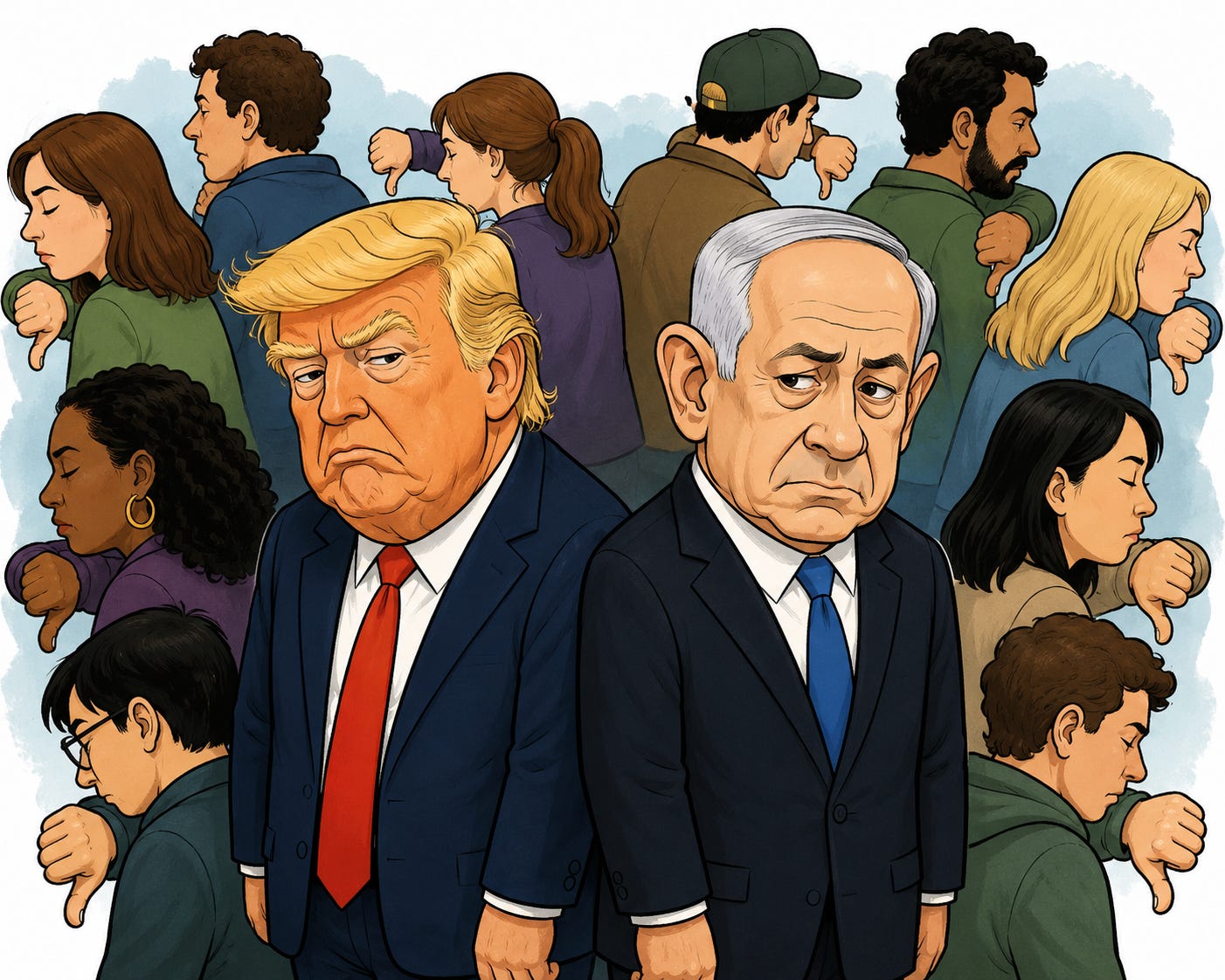
In the grand scheme of things, I think Israel is becoming more unpopular because Benjamin Netanyahu is at the helm, and like Donald Trump, Netanyahu does bad things. In fact, the two seem to share a lot in common, including a disdain for democracy and a disregard for the law.
Many may not remember, but before the Gaza war started, Netanyahu was in the midst of his own power grab. Back in 2023, Netanyahu’s right-wing Likud party forced a bill through the Knesset, the Israeli parliament, that would have stripped the Supreme Court of the ability to overturn acts of government. The law drew widespread protests before being narrowly struck down by the Supreme Court.
Even before that, Israelis protested Netanyahu’s corruption. He faced trial on three criminal counts, a situation that is still ongoing, even as the war(s) continue, and he has been indicted by the International Criminal Court for war crimes, for which he will probably never be tried. With all of his scandals, Netanyahu’s trust (approval) rating is at near-Trumpian levels (meaning “not good” for those of you from Rio Lindo).
Republicans in Congress seem tone deaf to the mounting opposition to Netanyahu and Israel. A component of the National Defense Authorization Act (NDAA) would more closely link US and Israeli military research and development. Further, the upcoming Intelligence Authorization Act of 2027 would mandate increased intelligence sharing with Israel in a sweetheart deal that would limit presidential discretion not to share data, a detail unique to Israel. This special treatment at a time when most Americans have serious concerns about Israel provides fodder for conspiracy theorists and may further erode trust between the two countries.
Both Trump and Netanyahu share blame for Israel’s increasing unpopularity due to their government corruption and their trigger-happy foreign policies. Further, there is often a slippery slope between criticism of Israel and more general anti-semitism. The Venn diagram between the two contains a lot of overlap, and there are indications that anti-semitism is rising on both sides of the political spectrum.
I’d like to see the US and Israel maintain a special relationship, but also stay at arm’s length. While our national interests often coincide, they often differ as well. Most of all, I’d like to see both countries reject militaristic nationalism, authoritarianism, and corruption. At the moment, Trump and Netanyahu seem to present similar threats to both nations.
I’m reminded of someone who observed a while back that the Bible makes it clear that God loves Israel and the Jews, but it also makes it clear that God does not approve of everything that Israel does. There is no reason that our individual view of Israel should be any different. We don’t do our friends any favors when we rationalize and excuse bad and self-destructive behavior.
PEACH STATE FALLOUT Among the fallout from Georgia’s primary runoff on Tuesday was the decision by state Republicans to step away from their plans for mid-decade redistricting. It isn’t clear whether the redistricting plan is dead or whether it might reemerge in a lame duck session or in the next General Assembly. I would not be surprised if a redistricting plan is passed if Republicans win the state offices in November or if a lame duck session limits state executive powers if Democrats pull off a victory. For details on the redistricting retreat, listen to this episode of Politically Georgia by the AJC.
SOCIAL MEDIA ACCOUNTS: You can follow us on social media at several different locations. Official Racket News pages include:
Facebook: https://www.facebook.com/NewsRacket
Twitter/X: https://twitter.com/NewsRacket
Threads: https://www.threads.com/@theracketnews
Mastodon: https://bird.makeup/users/newsracket
Our personal accounts on the platform formerly known as Twitter:
David: https://x.com/captainkudzu
Steve: https://x.com/stevengberman
Jay: https://x.com/curmudgeon_NH
The deal is already on the rocks. Regardless of Netanyahu's unpopularity among Israelis, just about all Israelis support continuing the war in Lebanon against Hezbollah. Seeing daily incoming rockets, hearing the air raid sirens (they also use a sophisticated mobile app), and watching drones pick off IDF troops and civilians will do that to a nation. Israel will not stop fighting in Lebanon. They do need to tighten up their ROE, and stop relying on their own AI so much for rapid response.
https://www.nytimes.com/2026/06/18/world/europe/iran-united-states-deal-israel.html
ETTD...on steroids.
"Rio Lindo," best laugh of the day. Hard to believe i called his show and argued with him.