


On January 3, 1990, the president of a sovereign foreign nation, under indictment in the U.S. on drug trafficking charges, who claimed his position on the basis of a nullified, stolen election, surrendered to the U.S. military and was brought to America for trial. Thirty-five years later, to the day, Nicolás Maduro surrendered to the U.S. military under strangely similar circumstances. I’m not the only one who has noticed this coincidence. I’m not even sure it was pure happenstance, though Gen. Dan “Raizin’” Caine was still an ROTC cadet at the time of Operation Just Cause; he was not commissioned until October, 1990.
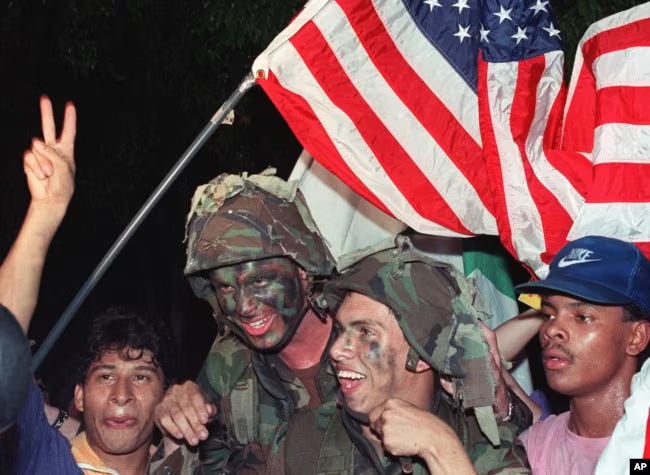
Of course, Venezuela is not Panama, where the U.S. had about 12,000 troops already stationed at the time Gen. Manuel Noriega was captured. In 1990, the U.S. did more than just go after the leader—we took control of the entire country, including airfields, Panamanian Defense Forces (PDF) headquarters, communications, and operations. Panama had major strategic value to the United States, as it still does, due to the Panama Canal.
Operation Just Cause began in December, 1989, ordered by President George H.W. Bush. The U.N. General Assembly quickly passed a resolution condemning the invasion as a “flagrant violation of international law,” namely Article 2(4) of the U.N. charter. Critics held that there is no recognized right for any nation to impose democracy on another by regime change because an election has been nullified. California Democrat Rep. Ron Dellums argued that Bush exceeded his authority under the War Powers Resolution by using the military to perform a law enforcement function. These arguments were never fully resolved, from a legal or academic perspective, but they were resolved by public acclamation. Noriega was a hated criminal, by most Panamanians, as well as most Americans. Also, the public unveiling of the F117 Nighthawk “Stealth Fighter” during Just Cause, and its coolness factor was just too strong.
The same gaggle of internationalists, America critics, socialists, and opponents of U.S. power have come out in condemnation of Operation Absolute Resolve, which so far has been limited to the capture of Maduro. Contrary to claims by President Donald Trump, the U.S. is not “running” Venezuela. In fact, Venezuela’s Vice President Delcy Rodriguez was sworn in as interim leader; she and her government staff claim to still recognize Maduro as president. In order to remove the current government, it appears the U.S. has more to do than simply arrest Mr. Maduro. For his part, Trump threatened Rodriguez, telling The Atlantic, “if she doesn’t do what’s right,” she may pay a bigger price than Maduro. I don’t know what that would be—her murder?
Let’s face it: most Venezuelans hate Maduro. Their unrestricted joy at his capture is all over the Internet, if not well cited in the mainstream media, who prefer to focus on analysts willing to lend credence to the arguments of illegality and motivations of Trump’s ordered action. I think it’s possible to divide out these things and get a better picture.
First, the legality. No federal judge ever ordered Manuel Noriega released. In a seven month trial, Noriega’s lawyers argued that their client deserved prisoner of war status, which Judge William M. Hoeveler first denied, but eventually granted in 1992. The prosecution, however, continued, and Noriega was convicted of drug trafficking, and after 17 years of confinement in a Miami federal prison, was extradited to France to face charges of money laundering. France refused to grant Noriega POW status, which would have afforded him better treatment in confinement under the Geneva Convention. In 2011, a French court allowed Noriega to be extradited to his native Panama, where he had been tried in absentia for murder in 1995. He remained in Panamanian custody until his death on May 29, 2017, at the age of 83.
Second, what to do with a dictator? History is rich in stories. As I’ve said before, most dictators die in bed, many in their homelands. Antonio López de Santa Anna, general, three time president of various Mexican governments, butcher of the Alamo, was captured by Sam Houston’s forces in the Battle of San Jacinto, on April 21, 1836. After he was forced to sign the Treaties of Velasco, Santa Anna negotiated safe passage from Texas to Veracruz, however, the new government in Mexico City repudiated both the general and the treaty. Not knowing what to do with the man, Texas made him Washington’s problem (Texas was not a state at the time).
President Andrew Jackson put Santa Anna on the U.S.S. Pioneer and returned him to his home in Veracruz in 1838. After serving two more terms as president, Santa Anna was exiled to Cuba, and also lived in the U.S., Colombia, and Saint Thomas. He finally returned to Mexico in 1874, where he lived for two years in Mexico City before dying at 82 in 1876, and was buried with full military honors.
Noriega was a corrupt leader and a criminal. So is Maduro. Nobody will miss Maduro rotting away in prison, just as they didn’t miss Noriega. The legality is a secondary issue here, as history shows public opinion is going to win out. Perhaps Maduro will gain POW status, but he is not a military man like Noriega (who was a general in the PDF).
Third, what of public opinion? Are Venezuelans better off? The general feeling right now is that things could hardly get worse. Hyperinflation, strongman tactics, and rampant corruption all plagued Venezuela, which was once a very rich nation. However, if the next leaders are just as corrupt, committed to tyrannical rule, and besotted by corruption, what has been gained?
On the first two points, I think it’s arguable that Trump has ordered a limited military operation, which historically and in context, has legal precedent on its side. The same arguments that supported the Noriega capture and trial apply to Maduro’s. Just Cause and Absolute Resolve are similar in those respects, if not in scope. But in outcome and motivation, I think there’s potentially a world of difference.
You can look, but it’s unlikely that you’ll find a more morally centered, rational, and empathetic man in the White House than George H.W. Bush. He is the man who ordered a halt to the first Gulf War after 100 hours of battle. He was encouraged by many to let Gen. Norman Schwarzkopf continue on to Baghdad and depose Saddam Hussein. But he stopped the war with the exit of Iraqi troops from Kuwait and the liberation of the oil fields (which the Iraqis set on fire and it took years to get back under normal operations).
Bush was not motivated by corruption. He honestly believed that Noriega was a threat to the operation of the Panama Canal and the safety of U.S. personnel. He also knew that Noriega was a strongman, a corrupt leader, and a drug trafficker. Cocaine was the main player in the drug war in Bush’s day. Noriega was not offered any deal or pardon. He was locked up for life (sentenced to 40 years, effectively life).
Panamanians were happy to be free of the PDF, and Noriega. Venezuelans are happy, for now, to be rid of Maduro, but that’s where the comparison ends.
The fourth point is motivation. Here there’s a problem with the Maduro operation. I suppose you can choose to ignore it, since the other areas very well may paint President Trump in a positive light. You can also claim that Bush’s action in Kuwait was about oil—and you’d be right. Kuwait has remained a friend of the U.S. since the Gulf War, and relations with Saudi Arabia have survived even the horrors of 9/11 due to our protection from Iraqi aggression in those days. Sometimes crass interests like oil and money are actually aligned with the lofty principles of American national security.
Of course America’s interests in Venezuela includes oil. As one Venezuelan noted in a viral clip, do you think the Chinese and Russians were interested in their recipe for Arepas? Everyone is interested in Venezuela’s oil; they have the largest proven untapped oil reserves on earth: 300 billion barrels. There’s also the country’s rare earth minerals, iron ore, bauxite, nickel, copper, zinc, and gold. It’s said that Venezuela is possibly the richest victim of government mismanagement in the world. That’s a big claim, but one that attracts the attention of every nation vying for global power.
I wouldn’t fault any U.S. president for keeping Venezuela firmly within the Monroe Doctrine, and out of the influence sphere of the Russians, Iranians, or particularly the Chinese, who have made great strides gaining a foothold in South America. One take I read (I don’t have the link) is that one reason for the timing of the Maduro capture is to keep Venezuela from offering safe harbor to Iran’s leaders and the ayatollahs. I find that to be somewhat specious, but it’s not completely ridiculous. I mean, it’s far more likely that Moscow would be a better fit for that, considering who Putin is currently protecting (Bashar al Assad). In any case, it’s not far-fetched to claim that capturing Maduro helps U.S. national security.
But I don’t get that vibe from the Trump administration. Yes, Trump says it, sort of. But his actions belie a different reason. Just over a month ago, the president pardoned former Honduran President Juan Orlando Hernandez, who was serving a 45-year sentence for “cocaine importation and related weapons offenses.” The charges Hernandez was convicted of mirror the charges Maduro is indicted for. Those charges do not include anything remotely related to fentanyl, despite what Trump publicly claims.
Hernandez was pardoned after fixer and political sewer lord Roger Stone requested it. Some are currently questioning that pardon and the message it sends to Maduro. It’s the message that bothers me. Look at it this way. There’s one person who has plenipotentiary authority to order Maduro’s release on his own word. That’s Donald J. Trump. For Maduro, it’s a 45-year prison sentence, or it’s becoming warm close personal friends with Donald Trump or one of his consigliere. This is the language South American drug lords understand: plata o plomo, silver or lead, money or a bullet.
Trump’s message, by his actions, is “for my friends, everything; for my enemies, the law.” This is well understood by South American strongmen, being the words attributed to either Peruvian President Óscar R. Benavides or Brazilian President Getúlio Vargas. In the more familiar vernacular of American mobsters, the message Trump is sending is more like “now you work for me.” Hernandez was jailed, and now he’s free because Trump said it was so. Maduro defied the long arm of American power, and now he’s been hauled in to settle accounts.
America wants a piece of Venezuela’s action, and maybe that aligns with our actual national security. After all, we were frozen out of their oil industry, though it is a matter of money now, not national sovereignty. Venezuela’s oil does, and always has, belonged to Venezuela. America (Trump) just seeks a more, shall we say, active, say in how that wealth is distributed. Maduro, and his socialist predecessor, Hugo Chávez, tried to keep filthy multinational corporate hands out of the nation’s oil, and in the process, wasted the wealth of nearly two generations of Venezuelans. The U.S. watched this national catastrophe with interest but at a distance. Trump got in its face.
For decades, the U.S. watched Venezuela’s national catastrophe with interest but at a distance. Trump got in its face.
But in getting in its face, Trump asserted a kind of jungle law, the law of strongmen and mobsters, that is decidedly unAmerican in its texture and flavor. Trump asserts that Maduro stole his election, but refuses to fully endorse the apparent winner of that election, Maria Corina Machado, who won the 2025 Nobel Peace Prize (Trump was awarded the FIFA Peace Prize). He says the Nobel winner lacks the “respect” of her country to rule. In return, Machado praised Maduro’s capture as “the hour of freedom.” It won’t be freedom unless the Venezuelan people are free. If they’re simply moving from under the boot of one dictator to the boot of one sitting 2,050 miles to their north, that’s not really freedom, is it?
This is more than the operation that President George H.W. Bush authorized against Manuel Noriega in Panama. We didn’t offer Noriega a deal. Bush didn’t pardon drug lords to telegraph something to Noriega. We took over Panama, but only to abolish the totalitarian state Noriega assembled. Bush always supported and endorsed the 1977 agreement to yield the canal to Panama in 1999, and never indicated differently after his presidency. Trump has floated “taking back” the canal.
I haven’t heard Trump say anything definitive to strongly indicate that Venezuela owns their oil, or that the Venezuelan people deserve to decide their own future. He said we (America) will “run things” until we can stabilize their country, but it seems the people in Venezuela aren’t getting a voice, or at least not a loud voice. That resonates in the ears of strongmen—in Beijing and Moscow—but not so much in democracies. It’s really troubling to me.
The jury, literally meaning the one which will sit in judgement of Maduro for his crimes, and figuratively, meaning the judgement of history and public opinion, is still out on the Venezuela operation Absolute Resolve. It might be Just Cause, all over again. It might be more like what David Thornton asserted, Operation Storm-333, when the Soviet Union invaded Afghanistan in 1979.
As history shows, things are muddy even a century later. Santa Anna was given a hero’s burial, despite his spotted history and tendency to rule like a dictator. Bashar al Assad lives richly in Moscow. Trump may well live on as more of a hero in Caracas, or Tel Aviv, or even (God willing) Teheran (if certain events continue), than he ever will in Washington, D.C. The architect of January 6th, 2021 might be honored for reasons beyond those we consider “good” in our political bubbles.
We can only hope that those honors aren’t in vain, and that the people giving them won’t regret their joy today. There are many reasons to celebrate, but just as many to be very concerned. We can be both at the same time.
SOCIAL MEDIA ACCOUNTS: You can follow us on social media at several different locations. Official Racket News pages include:
Facebook: https://www.facebook.com/NewsRacket
Twitter/X: https://twitter.com/NewsRacket
Threads: https://www.threads.com/@theracketnews
Mastodon: https://bird.makeup/users/newsracket
Our personal accounts on the platform formerly known as Twitter:
David: https://x.com/captainkudzu
Steve: https://x.com/stevengberman
Jay: https://x.com/curmudgeon_NH
Tell your friends about us!
We are going to have to disagree on this one.
I agree with SGman that Panama was fundamentally different in many ways. I’ve listed those elsewhere, so I’ll just say here that Panama was also successful regime change, unlike Venezuela.
The Maduro raid was a spectacular tactical success, but so far it’s been a strategic failure. The regime is still intact and world (and domestic) opinion is mostly against Trump. If he wants regime change, we are going to have to keep making increasingly unpopular strikes and probably occupy the country. Trump’s open-ended occupation won’t be popular either at home or abroad. His threats to other countries are going to encourage them to develop security guarantees with China for their own protection.
I think there’s a non-zero chance that he even takes the W for capturing Maduro and leaves the regime intact. I have not seen any evidence that a broader strategy is being implemented beyond hoping that the regime plays ball.
Some important points about Panama and Noriega: Panama's government declared a state of war against the US in December 1989; US personnel has been attacked with one killed; and Congress has previously passed resolutions seeking Noriega's removal (though not explicitly authorizing military force).
Former GOP Rep Justin Amash has a good explanation of POTUS's legal power to utilize military force under the War Powers Resolution Act at https://x.com/justinamash/status/1994933177224147206.