


From the title, you may think that I’m going to write about Ukraine today. I apologize for the confusion, because that is an understandable assumption.
Over the past few weeks, Trump has waived fresh Russia sanctions passed by Congress, threatened Ukraine over its strikes on Russian refineries, and curtailed Ukraine’s Starlink internet access (or maybe that was Elon Musk or possibly both of them acting together). Whose side Trump is on in the Ukraine war is a legitimate question, but that is not my focus today. (Actually, it isn’t really much of a question, and the answer is not Ukraine.)
Instead, let’s consider whether Trump might be intentionally trying to sabotage the Republican Party’s chances in the midterms. In an already tight election year, the president seems determined to make things even more difficult for his own party.
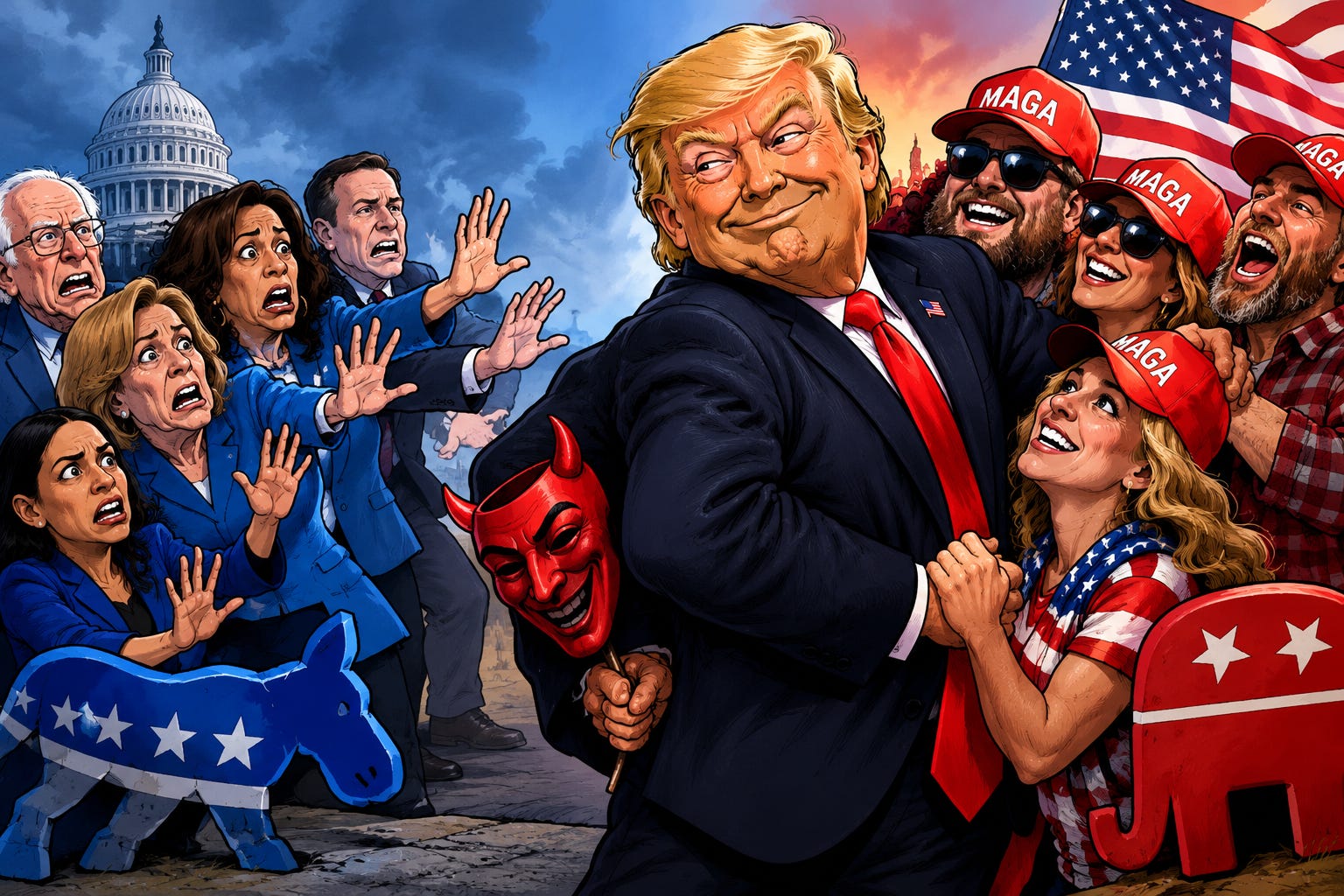
For example, take Trump’s candidates. Please! Seriously, the president has a habit of endorsing bad candidates who go on to lose winnable races, and it looks like 2026 will not be an exception to the rule. Ken Paxton is the best-known bad candidate, who may well be on the way to losing Texas, but he isn’t the only one. In Georgia, senatorial candidate Mike Collins’ campaign staff seems to be riddled with white supremacists, while Michael Whatley in North Carolina has been plagued by minor scandals and questions about credibility. Even in South Carolina, one of the reddest of red states, Trump’s hand-picked candidate, Lindsey Graham’s sister, is in a dead heat against a much better-qualified Democratic candidate.
The trend is also apparent in several gubernatorial races. Everyone is familiar with Vivek Ramaswamy’s implosion in Ohio, as Merrie Soltis discussed last week, but Trump’s pick in the conservative bastion of Florida, Byron Donalds, is in a dead heat with his Democratic opponent, as is Rick Jackson in Georgia. In Iowa, Trump’s anointed Republican lost the primary, and his second choice is trailing in the polls.
Even when Trump tries to help Republican nominees like Susan Collins in Maine, it can backfire. The president lifted some Canadian tariffs to help Collins in her tight reelection race, but lifting the tariffs to help Maine is a de facto admission that tariffs in general are a drain on the economy. If tariffs are slowing economic growth and contributing to higher consumer prices, why offer relief only to Maine and then only until the election?
The president is also giving more ammunition to those who are concerned about his abuses of power. The Trump DOJ is taking a third bite at the James Comey apple with yet another attempt at prosecution. The previous charges against Comey, making false statements to Congress and obstructing Congress, were dismissed due to a ruling that Lindsey Halligan, the federal prosecutor, was unlawfully appointed. The new charges stem from comments Comey allegedly made to a reporter in 2016, and may already be in trouble because there is no indictment and the 10-year statute of limitations elapsed earlier this month.
Comey may also have a good case that the government is engaging in malicious prosecution. Three shaky prosecutions following a 2025 Truth Social post in which Trump seemed to order the DOJ to go after Comey seems a lot like lawfare, and given the timing, may cause blowback on Election Day.
The new charges against Comey aren’t the only recent examples of lawfare. Rep. Ilhan Omar (D-Minn.) was the target of a federal raid on October 12 that reportedly centered on Omar’s immigration status, although few details have been made public since. A grand jury recently declined to indict former Trump aide Cassidy Hutchinson, who testified against Trump after January 6, and breaking news as I write this is that former congressman Eric Swalwell’s (D-Calif.) Beverly Hills home has been searched by federal agents. While acknowledging that there are good reasons to investigate Swalwell, who resigned amid allegations of sexual misconduct, the larger picture appears to be that Trump is working his way down an enemies list.
There’s also the Iran War, which the Administration probably thought would be a quick win to boost Republicans in the midterms a la Venezuela. It didn’t turn out that way, however, and now, not only are the resulting high energy prices a drag on Republican chances, but it’s an open secret that Trump and Netanyahu plan a resumption of attacks in the Persian Gulf after elections in both countries. That assumes, of course, that Netanyahu survives Israeli elections that are underway as I write this, and which don’t seem to be going well for Bibi. Republican losses in the midterms won’t be felt as quickly, but Democratic majorities in Congress would likely force a War Powers showdown and yet another constitutional crisis early next year.
Recent polling shows that the Iran War remains unpopular. Pew recently found 65 percent opposition to the conflict, with declining support among Republicans (63 percent today, down from 69 percent at the onset of the war). The open-ended Iran conflict may be a big reason that some Republicans choose to stay home next Tuesday.
Since I started with Ukraine, let’s consider that as well. Trump’s pivot towards Putin and Russia may be a historically bad move at the wrong time. A recent University of Maryland poll found that American sympathy for Ukraine has increased to 64 percent while support for Russia is practically nonexistent at two percent. Even about half of Republicans support Ukraine.
As Republicans get more and more nervous, Trump is singing to the choir at rallies in red states. Trump’s rally stops this week include Florida, Iowa, Mississippi, Ohio, and Texas. This may indicate a lack of strategic thinking on the part of the Administration, since usually a president would be visiting battleground states to boost candidates in tight races just before Election Day, or it may be that Republicans perceive that the battlegrounds have shifted to what have until recently been reliably red states.
Yes, according to rumors and vibes, even Mississippi may be in play. Republican Cindy Hyde-Smith is still the favorite, but recent polling has shown Democrat Scott Colom to be within striking distance. The polls also show a lot of undecided voters.
As Dick Morris often said, if you’re an incumbent polling below 50 percent, you’re in trouble. It’s likely (although not certain) that undecided voters have already decided to vote against you; they just don’t know it yet.
Going further, there are also Trump’s embarrassing comments when he does do rallies. Aside from the weird noise that Trump made in a speech in South Carolina, the president seems more interested in talking about men’s butts than explaining why voters should turn out for Republicans. On several occasions, the president has waxed poetic about the posterior of Ohio Senator John Husted.
If Joe Biden had committed these and other Trump gaffes, there would rightly be questions about his mental fitness for office. In fact, the same voters who were seriously concerned about Biden, as opposed to those who just wanted a wedge issue, are probably concerned about Trump as well. Since the president isn’t officially on the ballot this year, voters who see these clips might well want to elect a Congress that will provide a check on Trump rather than a rubber stamp.
The question I asked at the beginning was facetious. I know that Trump is legitimately backing the Republicans that he wants to have his back, but if Trump was trying to undermine GOP chances in the midterms, would he really have to do anything different?
Republicans are in trouble because they back Trump, and Trump makes bad decisions. When it comes to candidates, the president values (unquestioning) loyalty over competence. And when Trump’s incompetence leads the nation into more endless wars, rising consumer prices, and a general sense of chaos and ineptitude, the party that refused to hold him accountable is going to suffer.
EARLY VOTING Most states now have some form of early voting. While results are not released before Election Day, some data about his voting is made public. OnPointPolitics is a good hub for early voting data. Turnout has already been strong, and nationally, early data shows voters are more than nine points more Democratic than 2024. Gabriel Sterling, Georgia Deputy Secretary of State, tweeted on Tuesday that 27 percent of Georgia has already voted.
SOCIAL MEDIA ACCOUNTS: You can follow us on social media at several different locations. Official Racket News pages include:
Facebook: https://www.facebook.com/NewsRacket
Twitter/X: https://twitter.com/NewsRacket
Threads: https://www.threads.com/@theracketnews
Blue Sky: https://bsky.app/profile/newsracket.bsky.social
Mastodon: https://bird.makeup/users/newsracket
Our personal accounts on the platform formerly known as Twitter:
David: https://x.com/captainkudzu
Steve: https://x.com/stevengberman
Jay: https://x.com/curmudgeon_NH