


By now, you have heard that the Supreme Court struck down Donald Trump’s tariff regime. You’ve probably also heard that Trump has essentially decided to ignore the ruling and implement a new 10-percent global tariff under a different law.
To start at the beginning (a very good place to start), the case in question was Learning Resources, Inc. v. Trump, brought by two small family businesses that imported educational toys. In the 6-3 ruling, the Supreme Court held that the International Emergency Economic Powers Act (IEEPA) of 1977 did not convey the power to tax when it authorized the president to “regulate… importation.” Chief Justice Roberts wrote the majority opinion and was joined by Sotomayor, Kagan, Gorsuch, Barrett, and Jackson. Alito, Thomas, and Kavanaugh dissented.
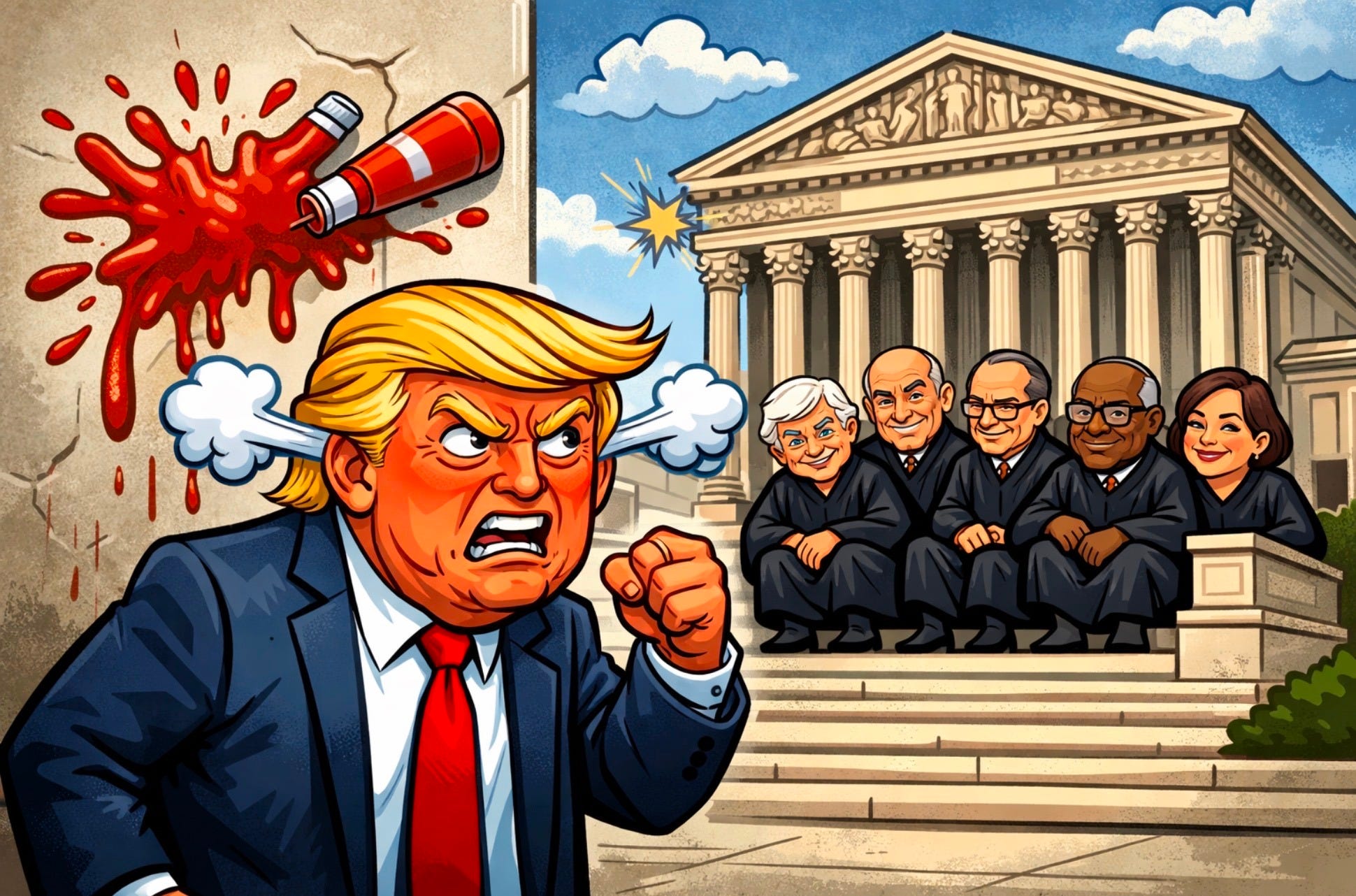
Justice Roberts points out that federal taxing power lies with Congress in Article I, “The Government thus concedes, as it must, that the President enjoys no inherent authority to impose tariffs during peacetime,” then dryly notes, “The United States, after all, is not at war with every nation in the world.”
For my readers who continue to deny that tariffs are taxes (and you know who you are), Roberts settles that question if the definition of the word did not, using the terms “tax” and “tariff” interchangeably. Roberts equates the two terms and cites the Constitution’s clauses granting Congress the power to tax as a refutation of Trump’s authority to levy tariffs.
Justice Jackson says it explicitly in her opinion, “Tariffs are different in kind. They are a tax on imports; a means of generating revenue from transactions between private parties.”
Tariffs are taxes.
While IEEPA grants the president broad authority (too broad for my tastes) to “investigate, block during the pendency of an investigation, regulate, direct and compel, nullify, void, prevent or prohibit” foreign trade, the power to tax is notably absent from the list.
Major questions doctrine also makes a prominent appearance in Roberts’ opinion. You may remember major questions doctrine from a host of recent Supreme Court rulings in which the Court held that Congress does not hide elephants in mouseholes. Put plainly, if Congress wants to delegate sweeping power to the executive branch, it must clearly spell out that power in the text of the law, in Roberts’ words, “in explicit terms, and subject to strict limits.”
“That pattern is plain,” Roberts writes, “When Congress grants the power to impose tariffs, it does so clearly and with careful constraints. It did neither here.”
Gorsuch gives an excellent rationale for major questions doctrine in his concurrence, writing, “Article I vests all federal legislative power in Congress. But like any written instrument, federal legislation cannot anticipate every eventuality, a point my concurring colleagues have observed in the past. And highly resourceful members of the executive branch have strong incentives to exploit any doubt in Congress’s past work to assume new power for themselves. The major questions doctrine helps prevent that kind of exploitation. Our founders understood that men are not angels, and we disregard that insight at our peril when we allow the few (or the one) to aggrandize their power based on loose or uncertain authority.”
In his dissent, Justice Kavanaugh cites the sweeping powers that Congress did delegate in IEEPA, saying, “As they interpret the statute, the President could, for example, block all imports from China but cannot order even a $1 tariff on goods imported from China.” That’s a fair point.
Kavanaugh also argues that tariffs are not subject to major questions doctrine because “tariffs were not an ‘unheralded’ power when Congress enacted IEEPA in 1977 and authorized the President to ‘regulate… importation’ of foreign goods” and that presidential preeminence in foreign affairs made the question moot. Kavanaugh supports his position by citing tariffs implemented by Presidents Nixon and Ford under similar language and circumstances, although not under IEEPA.
Roberts answers Kavanaugh by noting that Nixon’s were a “temporary measure,” in place for only five months, and were limited to congressional maximums. Kagan further notes that Nixon’s tariffs cited the Tariff Act of 1930 and the Trade Expansion Act of 1962, rather than the Trading With the Enemy Act, the predecessor to IEEPA.
The most important aspect of the tariff ruling is that the Supreme Court asserted its independence and acted to rein in a president whom it had previously granted almost unlimited power. Donald Trump has famously repeated that Article II of the Constitution lets him do “whatever I want,” including apparently being allowed to “destroy the country,” but on Friday, the Supreme Court shattered that belief.
For all Trump’s attacks on the Court, it is interesting to note that two of the three justices that he appointed in his first term ruled against him. This should make people who worried that the Court was rubberstamping Trump’s policies feel a lot better. In fact, it’s delicious that Trump’s own picks were instrumental in his defeat. I love hearing people who cited judges as the reason to vote for Trump complain when those same judges uphold the rule of law. It smells like… judicial objectivity.
I’m more concerned about Thomas, who seems to have gone over to the Dark Side, than the Trump Three. Thomas dissented that “The Court has long conveyed to Congress that it may ‘invest the President with large discretion in matters arising out of the execution of statutes relating to trade and commerce with other nations.,” and seems to put few limits, other than the Legislative Vesting Clause and the Due Process Clause, on Congress’ ability to hand the president its work.
Speaking of Thomas, it is extremely concerning that he and Alito, champions of originalism and constructionism under Democratic presidents, would find a taxing power for the president where none exists in the text of the statute or the half-century of history and tradition since it became law. Does anyone really think that these justices would find a similar policy by Barack Obama or Joe Biden to be constitutional?
The shift of conservative justices to twist the law to back Trump is just as concerning as the tendency of the Court’s liberal wing to find ways to rule for Democratic presidents. It is easy to dismiss both wings as partisan, but I think that there is a real human tendency to let our biases influence our opinion, especially in a subject as complex as constitutional law.
Likewise, Kavanaugh complains, “The United States may be required to refund billions of dollars to importers who paid the IEEPA tariffs, even though some importers may have already passed on costs to consumers or others. As was acknowledged at oral argument, the refund process is likely to be a ‘mess.’”
That may be, but should executive overreach be excused merely because undoing the mess made by the abuse is difficult? In most other instances, I would venture to guess that even Kavanaugh would say the answer to that was no. Saying that a government abuse is too large to correct is a course guaranteed to encourage massive government abuses.
And then there’s the aftermath. Trump probably set a land speed record for ignoring a Supreme Court order when he announced that tariffs would continue with a different legal justification mere hours after the ruling. Honestly, if you didn’t expect this, I don’t know where you’ve been for the past year.
First, I want to point out that going back to the well with a different legal theory is not technically defying the Court. In certain circumstances, the Court may give a roadmap to legal theory that it would accept. Joe Biden did this after the Supreme Court struck down his student loan forgiveness program. Biden revamped the program with a different underlying legal argument and tried again. Student Loan Forgiveness 2.0 was headed back to the Supreme Court when Trump won in 2024, and the DOJ dropped the case shortly after, so we will never know for sure if Biden would have gone 0-2.
The new/old tariffs are now being justified under Section 122 of the Trade Act of 1974. As Fortune explains, Section 122 tariffs come with some limitations. First, Section 122 tariffs are limited to 15 percent. Trump started at 10 percent but raised the tariffs to the 15-percent maximum on Saturday. Second, the maximum duration of the tariffs is 150 days, after which they must be extended by Congress. There is some speculation that Trump could remove and immediately reapply the tariffs to get around the time limit.
Finally, Section 122 tariffs are specifically to address a balance of payments problem. This is a problem for Trump for several reasons, including the fact that the US does not have a payment imbalance. Even though we have a trade deficit, which increased in December despite the tariff wars, foreign investment coming into the country has created a net balance of zero.
But Trump’s worst problem is that he and his lawyers have argued for the past year that his tariffs are about trade deficits, national security, lack of respect, and hurt feelings, basically everything except the balance of payments. As Neal Katyal, the lawyer who just beat Team Trump at the SCOTUS, pointed out on the platform formerly known as Twitter, the DOJ just finished telling the justices that Section 122 did not apply to the Trump tariffs.
The new tariffs will be challenged in court, but it is unlikely that they will get before the Supreme Court within 150 days. An exception might be if the Court grants a hearing on its interim docket (aka the emergency, shadow, or short-order docket) or if Trump renews the tariffs.
In the meantime, as Rick Woldenberg, owner of Learning Resources, told PBS, “At least our tax rate went down, because most companies -- most countries were being taxed at 18, 19, or 20 percent…. So now, at 10 percent, that's about a reduction in half. It didn't go to zero. And 122, Section 122 can only impose a tax for five months. So I guess we will see what happens after that.”
Of course, the new 15-percent tariff is close to what Woldenburg and the rest of the country had to deal with before.
At this point, there are two big takeaways. The first and most obvious is that the Tariff Man is not giving up his tariffs. With the economy slowing, the Supreme Court offered Trump and Republicans an escape route in which they could back off the trade wars, blame the judges, and hope the economy recovers by November. That was never in the cards. Find someone who is as dedicated to you as Trump is to tariffs. The Trump Administration will live and die for tariffs and trade wars, even if the economy crumbles around them.
Second, Trump never seems to even consider trying to go through Congress to get ironclad tariff authority. With his cult following in the GOP and the natural Democrat affinity to taxes and protectionism, it shouldn’t be that hard for a master dealmaker to get such legislation across the goal line. But no, it’s all about twisting existing law to let him do what he wants. It’s all about unilateral action.
As Justice Gorsuch wrote in his concurrence, “It can be tempting to bypass Congress when some pressing problem arises. But the deliberative nature of the legislative process was the whole point of its design. Through that process, the Nation can tap the combined wisdom of the people’s elected representatives, not just that of one faction or man. There, deliberation tempers impulse, and compromise hammers disagreements into workable solutions. And because laws must earn such broad support to survive the legislative process, they tend to endure, allowing ordinary people to plan their lives in ways they cannot when the rules shift from day to day.”
In other words, Congress, do your job.
JOHN BARRON RETURNS? A CSPAN caller went viral when he claimed to be John Barron, Donald Trump’s old alter ego. The network says the caller was not Trump, however, citing the telephone number and the fact that Trump was known to be in a meeting when the call was made.
GOVT GONE WILD Today’s story of government immigration abuse is about an Iranian woman who was adopted by a USAF veteran in 1973. She was brought to the US as a two-year-old child and raised as a Christian. Now, the Trump Administration wants to deport her back to Iran, a country she doesn’t know and where she will almost certainly face persecution or death. Her crime? Her adoptive parents never naturalized her, but she didn’t know this until she was 38. She has been trying to correct the situation since 2008 to no avail, and she has no criminal record. Read the full story at Associated Press.
A GOOD SONG FROM U2 I previously mentioned a new anti-ICE song from the Boss. Now, there is a new one from U2 as well.
SOCIAL MEDIA ACCOUNTS: You can follow us on social media at several different locations. Official Racket News pages include:
Facebook: https://www.facebook.com/NewsRacket
Twitter/X: https://twitter.com/NewsRacket
Threads: https://www.threads.com/@theracketnews
Mastodon: https://bird.makeup/users/newsracket
Our personal accounts on the platform formerly known as Twitter:
David: https://x.com/captainkudzu
Steve: https://x.com/stevengberman
Jay: https://x.com/curmudgeon_NH
These days, i often think about Ted Cruz...you know, the guy with the label: "constitutional conservative." Goodness, those days when republican's prided themselves on adhering to the constitution. That they were unlike those left-leaning SCOTUS judges who made up the rules as they went along as they rendered their decisions.
How times have changed. Those three that flung the monkey dung in hopes to placate trump were pathetic at best. This should have been a 9/0 slam dunk; that is if the constitution was really the thing their decision making was based on. Clearly for the three, it isn't/wasn't.
Best of all though David was your reminder that the "greatest deal maker of all time" was incapable of going before Congress (where he controls/dare i say owns both the house and senate) and make his case. His bluster that spewed out after losing the case was classic trump; babbling something about the US being destroyed by their foolishness.
No Donald; you and you alone are doing a fine job of that.
How pathetic a human being he is; how truly pathetic.
And by placing a global tariff, Trump blows up every "deal" made in the past year.