


Let me start by saying that I’m a conservative. I’ve been a conservative since the days of Ronald Reagan and the first George Bush. I even had the privilege of seeing President Reagan live back in the 1980s (I wrote about that experience several years ago), and I have a long record of my political views on my blog that goes back almost 20 years. In some ways, my blog is like a fossil record of conservative political opinions that encapsulates conservative thought in stone, unchanged for two decades.
I say that to point out that most of my political views are unchanged from 20 years ago. The difference is that back then they were mainstream Republican opinions. Nowadays, I’m no longer Republican, and most of the people who share my opinions have been chased out of the party. I didn’t change, but the Republican Party changed around me.
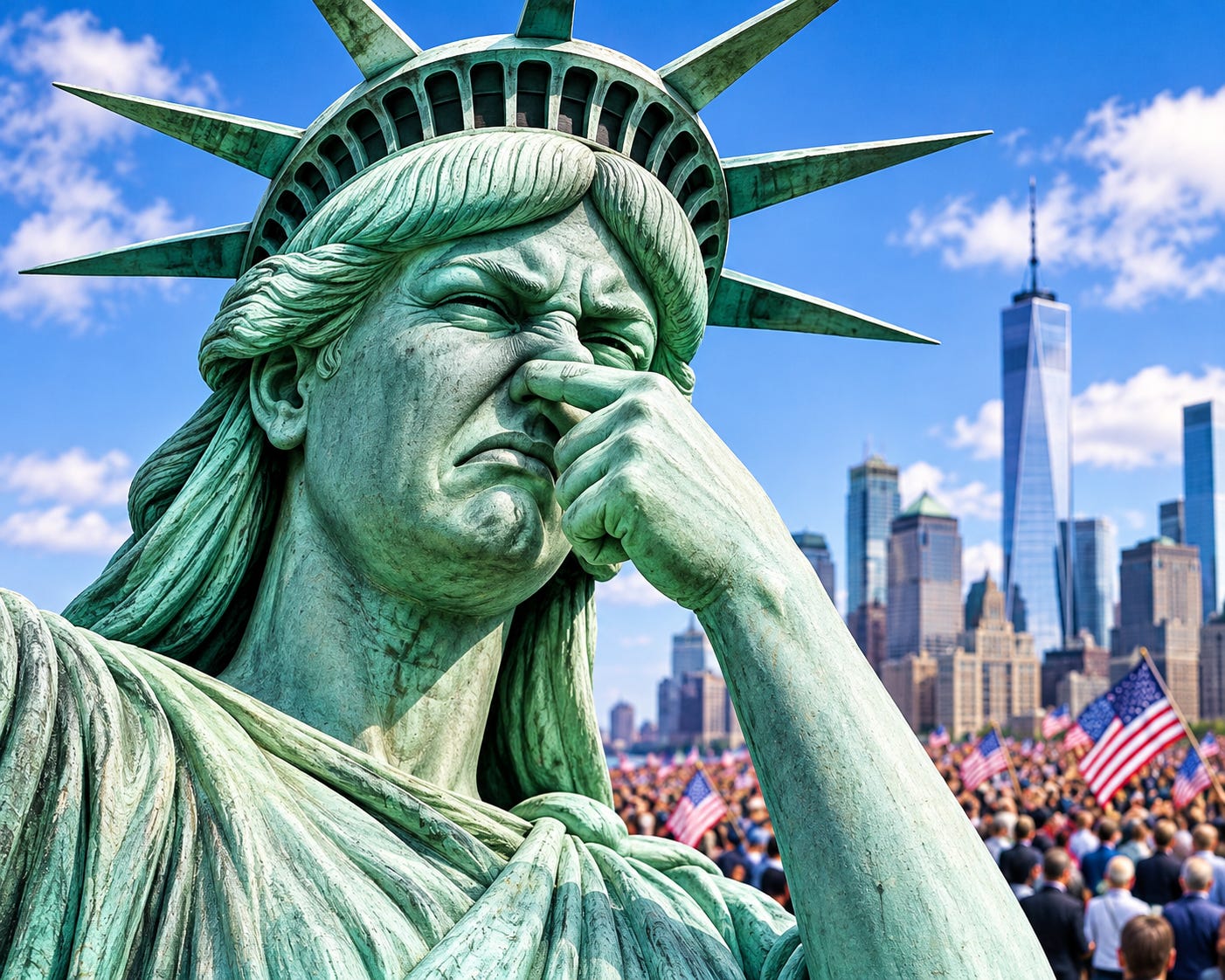
The reason I bring this up is that I’ve seen people posting recently that, if only the Republicans (or even the Democrats in some cases) would nominate a conservative, that candidate would certainly win, and America could have a conservative renaissance. I’ve been hearing versions of this for a long time, and even though I think that conservatives have a lot of good and practical ideas, I don’t think it has ever been less true. America is not clamoring for conservatism.
If you doubt me, just look at the Republican Party. For at least the past three presidential cycles, Republicans have rejected conservatives in favor of Donald Trump. I’m not sure you can even find an actual, traditional limited-government conservative in their ranks to vote for these days. (And yes, I am aware of Ted Cruz and Ron DeSantis.)
Even when conservatives manage to get nominated, they don’t always win. Just ask Mitt Romney, John McCain, Bob Dole, and the elder George Bush. Many factors are involved in determining who wins an election. These include the economy, which is the big one, as well as partisan fatigue, funding, grassroots organization, and general vibes in the country. If Trumpists snicker, they should note that Trump lost a third of his elections and paved the way for midterms that erased half a century of Republican gains.
Republicans have not only rejected conservatism, they have ruined the brand. The GOP kept the conservative label because everyone knows that “conservative” is just a synonym for “Republican,” except that it isn’t. Although there was a lot of overlap between the two for a long time, the Republican Party no longer represents traditional conservative ideals such as constitutionalism, respect for the law, free trade, colorblind application of the law, anti-authoritarianism, and respect for international alliances.
In many ways, today’s Republican Party stands for the opposite of traditional conservatism. By definition, the modern Republican Party is not conservative in that it is not resistant to change and it does not favor preserving institutions and norms. MAGA’s political philosophy is more of the burn-it-down school of radicalism.
After 10 years of Trump’s domination of the party, most people think that conservatism is just shorthand for “Trump supporter,” and, as a result, conservative identification has declined from a high of 40 percent in 2010 to 35 percent last January, per Gallup.
Those numbers obscure the most alarming aspect of the decline. Public Religion Research Institute polling found that conservative identification decreases sharply with age. Trump and MAGA radicalism and corruption have severely damaged conservatism among Americans younger than 50. It is probably no coincidence that much of this cohort has no political memory of a Republican Party without Donald Trump. They don’t really know what conservatism is, which explains why young conservatives are more likely to be Nick Fuentes “Groypers” than disciples of George W. Bush or Ronald Reagan.
When we look at the last 10 years, is it any wonder that Americans are souring on conservatism if they think it’s synonymous with Trumpism? Trumpism, a form of populism, has brought us unmatched corruption, high prices, wars and rumors of wars, racism, and general chaos. Young Americans are running from all this.
So, to repeat, Americans are not screaming for conservative leadership. Democrats want liberal or progressive leadership, and Republicans basically seem to want anyone who isn’t a Democrat.
In a nutshell, that’s why conservatism is disappearing. I blame Republicans for not adhering to their own principles. They handed the party over to populists, and now the populists are asking what conservatism has ever conserved. The answer to that would include the Free World, the Constitution, and the global economy, by the way.
And now that Donald Trump has one foot out the door (God willing), the populists aren’t willing to simply hand the keys to the party back over to any remaining conservatives. Whether the label applied is the New Right, the Alt-Right, or the Post-Liberal Right, of which 2028 frontrunner J. D. Vance is a part, there are common threads that include expanded government control, antipathy to minorities, and the authoritarian notion that their brand of government knows what is best for you, so it should get to tell you what to do.
There is going to be an intraparty civil war over the direction of the Republican Party after Trump (whenever he gets around to leaving), and there is no guarantee that conservatives will come out on top. Republicans junked the conservative ideology sometime between 2016 and 2020, and it won’t be easy for the elderly traditional conservatives to reassert control over a party base that doesn’t know much of anything other than Trumpism. The Faustian bargain that conservative Republicans made in 2016 has altered the soul of the GOP.
As the Bible warns, “Bad company corrupts good character.”
As I pointed out earlier, Republican beliefs have changed over the past two decades. They also changed over the decades prior to that. An alert reader recently sent me a link to the 1956 Republican Party platform. The Eisenhower Republicans of that year sound a lot more like today’s Democrats than they do today’s GOP.
The bad news is that parties can change for the worse. The good news is that they can also change for the better.
The Democrats have changed also. Republicans like to point out that Democrats wore white hoods and robes in the 1870s and supported Jim Crow laws in the 1950s and 1960s. Yet today, Democrats typically get about 90 percent of black votes. That’s a heckuva change.
There are signs that the Democratic Party is still changing. There is a lot of focus on the DSA candidates who were elected this year, but an underreported part of the election is that moderate Democrats grew in numbers and outperformed progressives. There are only eight DSA members in Congress, but there are now 22 members of the moderate Blue Dog caucus.
I think that the expansion of Democratic moderates is largely due to the exodus of moderates and conservatives from the Republican Party. Conservatives who chose to bite the bullet and vote Democrat to block MAGA are making a real difference in changing the culture of the Democratic Party. As I’ve said in the past, sitting out elections and voting third party doesn’t make a difference. Choosing to vote for moderate Democrats does.
I’ve also said in the past that the parties are undergoing a political realignment. It’s a slow process, but both parties are changing, for better or for worse.
Conservatives haven’t been welcome in the Republican Party for a long time, and I won’t say that we are particularly welcome in the Democratic Party either, but they do want to win. It isn’t impossible to continue growing the Blue Dog coalition of moderate and conservative Democrats and increase Democratic appeal to the working class and independent voters that they lost over the past decade.
How Democrats respond to that will vary by faction. The DSA and progressives won’t be happy with it, but establishment Democrats will appreciate that it makes the party more electable across broad swaths of the country. This month’s midterms are an example.
And hopefully, Republicans will see their surge to the radical right as the electoral poison that it is. I’d like to see two moderate, sane parties because that would be good for the country as a whole.
Neither party wants conservatives right now, but as our national problems grow, maybe the country will look back at some point and decide to try the ideas that spread freedom and prosperity for decades. As for me, I plan on remaining an independent swing voter.
FAA ON THE OUTS I haven’t written in detail about the ATC outage and ground stop last week for several reasons. First, I’m a pilot, and I don’t have any special knowledge of the backside of the ATC system. Second, the cause of the outage is still in dispute. We know the problem was related to a router in Arkansas, but there are still questions.
I can tell you that the ATC system is enormously expensive, and every 20 years or so, it has to be totally upgraded to keep up with emerging technology. I’ve been flying long enough to remember more than one NEXTGEN ATC upgrade.
Having said that, here are my suspicions. First, I think it may be too much of a coincidence that the FAA rolled out a new AI tool for ATC just before things fell apart. It would be totally in character for the Trump Administration to ignore the need for caution and rush upgrades without waiting for them to be fully tested.
Second, FAA maintenance workers were caught in last year’s DOGE buzzsaw. It seems likely that the cuts snared workers who were needed both to maintain the current system as well as build the new one. I would be unsurprised if the FAA’s problems were not an aviation version of the measles outbreak, in which incompetent (if not malevolent) leadership is breaking things that used to work well. If you’ve read Atlas Shrugged, this probably sounds familiar.
A third possibility is cyber warfare. This seems especially likely in light of some sort of similar tech problem occurring on an almost daily basis. The Trump Administration has denied that these glitches are security-related, but we really can’t take the Trump Administration’s word to the bank. Of course, just because they are liars doesn’t mean they are lying now.
If any case, we likely haven’t seen the last of the disruptions.
SOCIAL MEDIA ACCOUNTS: You can follow us on social media at several different locations. Official Racket News pages include:
Facebook: https://www.facebook.com/NewsRacket
Twitter/X: https://twitter.com/NewsRacket
Threads: https://www.threads.com/@theracketnews
Blue Sky: https://bsky.app/profile/newsracket.bsky.social
Mastodon: https://bird.makeup/users/newsracket
Our personal accounts on the platform formerly known as Twitter:
David: https://x.com/captainkudzu
Steve: https://x.com/stevengberman
Jay: https://x.com/curmudgeon_NH
"Those numbers obscure the most alarming aspect of the decline. Public Religion Research Institute polling found that conservative identification decreases sharply with age. Trump and MAGA radicalism and corruption have severely damaged conservatism among Americans younger than 50. It is probably no coincidence that much of this cohort has no political memory of a Republican Party without Donald Trump."
One variable that would be interesting to look at is how Trump attitudes are different between voters who watched (or aware of) "The Apprentice" (2004 - 2017) and have an impression that someone is competent or business savvy just because they are on TV. My "Trump" is the guy I watched bankrupt companies repeatedly, and hawk sketchy goods ("Trump Steak") on infomercials. #MAGA's "Trump" seems to be the guy from "The Apprentice". Younger voters' "Trump" is probably just the President, the same way that I have no real mental version of Jimmy Carter or Reagan before they became POTUS.
As for conservatism, I think that a strongly Federalist implementation is the only way out for our country, given that Washington is too centralized and sclerotic to be an effective mechanism for crafting and implementing most policies. I'd like to see a return to a federal gov't of strictly delegated (and clearly enumerated) powers, and a return of most policymaking to the various Statehouses, governors, and local legislatures. Brandeis' "laboratories of democracy" where States are given the latitude to experiment more with policy (and the freedom to get those policies wrong, and the responsibility for righting their ships), and other States can adopt what works well elsewhere and should work well in the local State context.
Unfortunately, politics today is a winner-take-all game, an NO ONE seems interested in the devolution of political power to locales where what the locals might choose something different than the person wielding the power at the moment.