


Whenever the government acts, the effect often flows to other areas of the country like ripples in a pond after a stone is tossed in the water. These ripples often affect things in unexpected and sometimes counterproductive ways. This phenomenon is sometimes called the Law of Unintended Consequences.
Donald Trump’s war on Iran is a government action that is ripe for unintended consequences. In fact, we’ve already seen a few.
The initial, limited attack has given way to a lengthy stalemate over control of the Strait of Hormuz. That stalemate, along with the loss of control over the Strait and its associated energy crisis, themselves represent an unintended consequence of the airstrikes. I am 100-percent certain that Donald Trump expected a quick Venezuela-style strike followed by another capitulation and victory lap rather than a protracted quagmire that rapidly morphed into a threat to the world economy.
A world economic collapse could be another unintended consequence of Trump’s Iran policy. Spirit Airlines has already become the first major corporate casualty of the new status quo, but it likely won’t be the last. Chevron’s CEO recently predicted “physical shortages” and economic slowdowns as the nations adapt to the new, constricted flow of oil supplies.
“Demand needs to move to meet supply,” Chevron CEO Mike Wirth said on Monday. “Economies are going to have to slow.”
The laws of supply and demand tell us that oil and gasoline prices will rise until they find an equilibrium with falling demand at the new level of supply. The increased price level will merely be painful for consumers and some businesses, but it will be financially fatal for others.
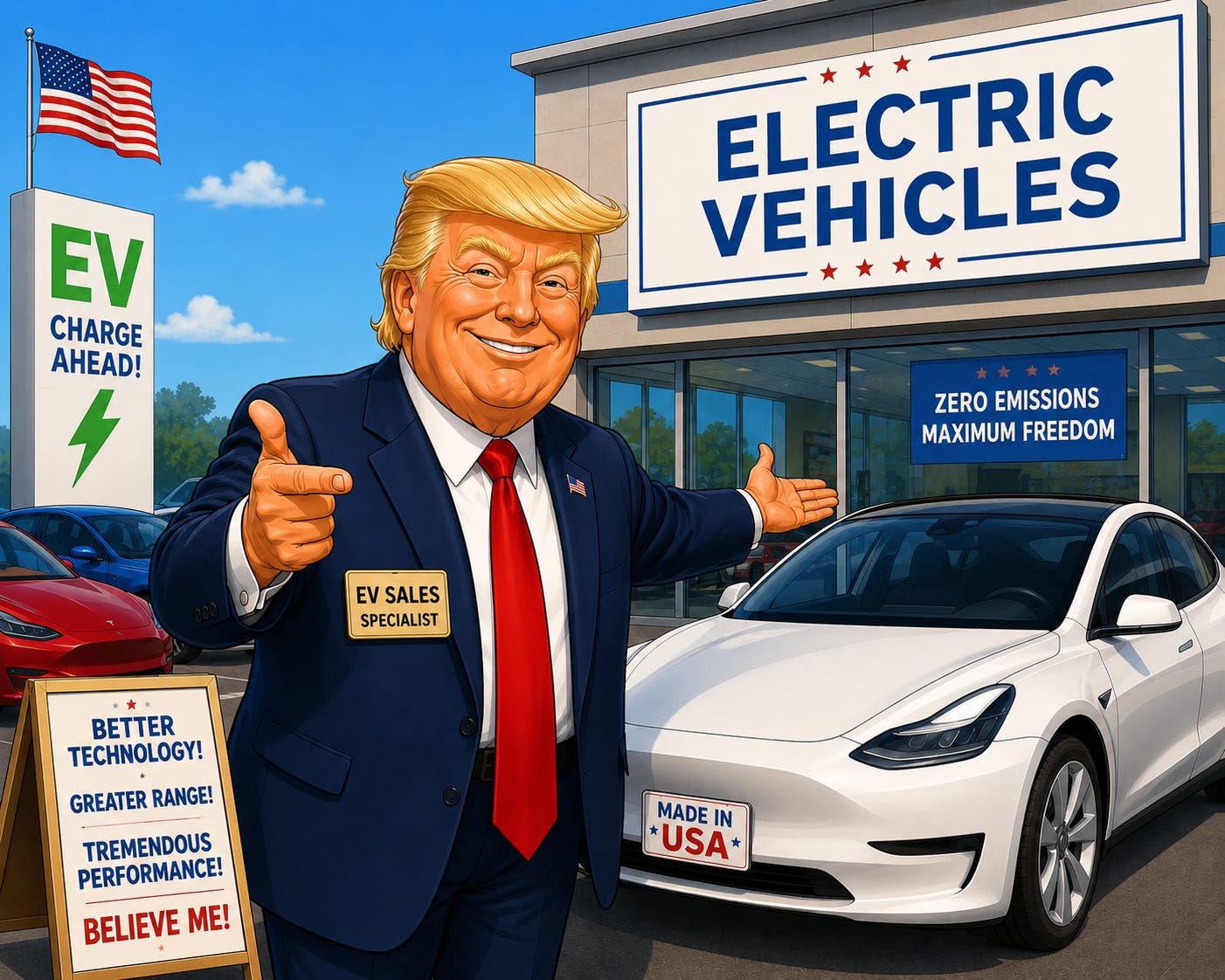
All this brings me to my hypotheses of the day: What if Donald Trump turns out to be a boon to the adoption of EV technology?
With the exception of a brief flirtation with Tesla Cyber Trucks when Donald Trump and Elon Musk were in the midst of their bromance, the right has long been a vocal opponent of electric vehicles. Not only have anti-EV memes been a staple of the online right, but the Trump Administration has been hostile to EV incentives. Criticism of EVs has included questions about costs and efficiency, the environmental friendliness of battery production, and prepper concerns about the availability of electricity in an apocalyptic scenario. (Spoiler alert: gasoline probably won’t be widely available in a doomsday scenario either, and it normally takes electricity to pump gas.)
One of the big roadblocks to the adoption of EVs has been low gas prices. There was little reason to consider an EV when you could fill up even the large fuel tank of an SUV for $2.50 per gallon. Even the much-maligned gas spike during the Biden Administration, which was actually due to Vladimir Putin’s attempted invasion of Ukraine, was a temporary blip lasting only a few months. Domestic energy production also spiked, reaching a record high during the Biden Adminstration although few realized or admitted it. By the end of his term, gas prices were in line with historic averages.
The irony is that Republicans have long accused Democrats of secretly trying to raise gas prices as a means of coercing Americans into transitioning to EVs. Now that gas prices are rising and will soon break records under conditions that can be traced squarely back to the policy choices of a Republican president, they call for patience and even make false claims that prices are already falling.
The current situation is much different from the short spike under Biden. Experts warn that gas prices won’t return to pre-war levels anytime soon. The war and the dueling blockades have created systemic chaos and shortages that will take months to sort out after the Strait is reopened, and there is no sign that the Strait is going to reopen anytime soon. No reliable sign anyway.
At minimum, we are looking at elevated gas prices for months, possibly for years. As I write this, the US average price for regular gasoline is $4.56 per gallon. In February, it was $2.92. To put it in consumer terms, filling up a 15-gallon gas tank just went from $46 to $68. That’s an extra $22 per fill-up. If you’re a commuter or soccer mom who fills up two to three times per week, those costs multiply. If your family has several cars, the costs multiply again.
And gas prices are still rising. Where they stop, nobody knows.
An extra $100 per week isn’t enough by itself to justify trading in your gas guzzler for a hybrid or an EV, but the Trump Effect on gas prices has removed a powerful disincentive against considering EVs: the idea that gas prices are low, so there is no reason to consider new technologies. As prices continue to rise, many consumers who are in the market for new cars will take a close look at hybrids and EVs as a way to reduce their exposure to high energy costs.
Other objections to EVs have already been largely overcome. EV prices have fallen even as ranges and efficiency have increased. Charger availability has expanded with many public chargers available at no charge. (A little EV humor there.) New battery and charger technology also allows charging so fast that charging time can rival the time it takes to make a fuel stop at a gas station. EV battery life has also improved, and many automakers include warranties that cover the battery for the typical usage life of the car.
EV technology has come a long way in the last few years. EVs are now practical for a large share of the population’s typical driving needs, but unfamiliarity and anxiety about range and batteries have made adoption of the technology slow. Few would have expected Trump’s war on Iran, a war in which he once openly fantasized about taking Iranian oil, to provide the impetus to overcome the fears about adopting EVs, but oil prices that are above $4 and climbing may be the incentive that many Americans need.
I would not be surprised if EV sales didn’t increase due to the energy crisis. I’d be more surprised if they didn’t. And like Republicans giving credit to Barack Obama for being the best gun salesman in history, Donald Trump’s failed Iran policy may get a lot of credit for unintentionally spurring many Americans to take the leap towards electric vehicles.
History shows that government programs often often have results that can be the opposite of what was intended. It looks like that will be the case with the attack on Iran in multiple ways.
And did someone say “gerrymandering?”
RELATED That time I drove a Tesla for a week…
How to rent a car and not pay for gas

I’m a truck guy, but I admit to being electric-vehicle curious. So it was that when I had to go to Dallas for a week of training recently that I decided to rent a Tesla and see how the other half lived. After all, I reasoned, the price of a Tesla rental was almost the same as an equivalent gas burner, and I’d probably save my company money in the long r…
ALSO RELATED Steve learns the EV ropes…
Climbing the EV learning curve

Stephen Colbert told Americans worried about gas prices, let them eat cake. “OK, that stings, but a clean conscience is worth a buck or two. It's important. I'm willing to pay $4 a gallon. Hell, I'll pay $15 a gallon because I drive a Tesla.”
TARIFF STRIKE TWO A three-judge panel at the US Court of International Trade ruled against Trump and imposed a permanent injunction on Trump’s “can too” 10-percent tariffs imposed after his loss at the Supreme Court.
SOCIAL MEDIA ACCOUNTS: You can follow us on social media at several different locations. Official Racket News pages include:
Facebook: https://www.facebook.com/NewsRacket
Twitter/X: https://twitter.com/NewsRacket
Threads: https://www.threads.com/@theracketnews
Mastodon: https://bird.makeup/users/newsracket
Our personal accounts on the platform formerly known as Twitter:
David: https://x.com/captainkudzu
Steve: https://x.com/stevengberman
Jay: https://x.com/curmudgeon_NH
Meanwhile, Trump and his cronies are shooting Americans in the foot by spending taxpayer dollars to decrease America's energy supply, just because Boomers (who like Trump) think that wind is "woke" and Trump lost a fight against a wind farm outside one of his golf clubs[1].
Morons.
[1] https://theconversation.com/why-trumps-2-billion-buyoff-to-cancel-offshore-wind-farms-is-a-bad-deal-for-american-taxpayers-and-the-us-energy-supply-282456
I agree with "the right" that EV subsidies deformed the market, which was/is headed toward hybrid and BEVs. Many carmakers opted to create "compliance cars" just to have the "EV" badge. It has ruined Honda--and it's not the end of subsidies that ruined it, it is the market effects of bad incentive policy. It has made Elon Musk billions of dollars, which is another unintended effect of Liberal policies regarding green energy. I am grateful that Musk used Tesla to spark the market and show what really can be done with a blank slate and good battery tech.
I am also an EV early adopter. Drove either a plug-in hybrid (PHEV), full electric (BEV), or hybrid since 2018. We now have an electric SUV (Kia EV9) and a hybrid Subaru Crosstrek. Love them. Wouldn't change back to full gas engines, ever. The market is moving to EVs, slowly, over a generation. It will happen. Gas prices might be a temporary spike, but for now, if you are looking for a car, there are literally thousands of off-lease, traded, or low-mileage EVs out there to buy for cheap.
Yesterday I looked at my Recurrent (recurrentauto.com) dashboard for my EV9 and it says we saved $1000 in gas in less than a year. Hell yes I'm going to drive electric. And when gas prices fall, I'll still drive electric. I'm more worried about data centers and AI consumption spiking electricity rates than the temporary effects of expensive gas.