


If you’re triskaidekaphobic, today is a whammy. Since 1941, this is the 13th occurrence of December 7th falling on a Sunday. Young people who were born sometime after me (I’m 61) might not have relatives who fought in World War II. The number of surviving veterans of that war is vanishing quickly, and the number of surviving Pearl Harbor veterans number under 20, and I think none of them are under 100 years old. The next time December 7th will fall on a Sunday will be in 2031. It's a fair certainty that this is the last time the day will be commemorated on a Sunday with any living survivors.
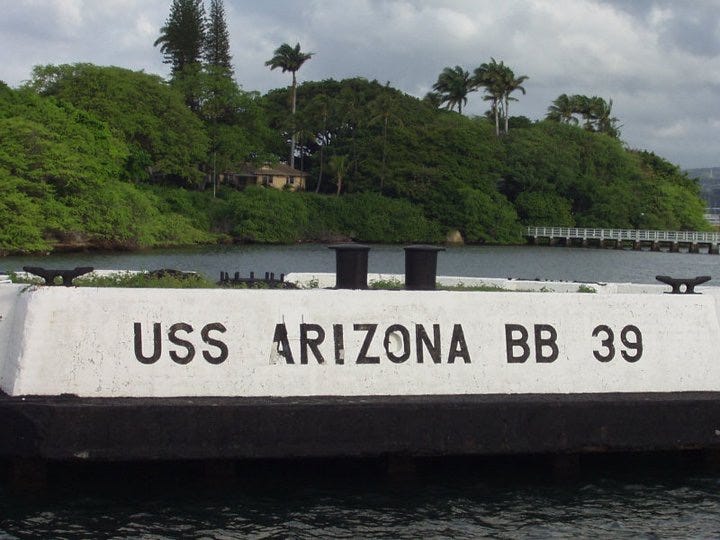
I don’t have to tell the tale of Pearl Harbor Day and its related events. It has been memorialized in countless books, and fictionalized in movies. What we will always have with us is the memorial of the sunken ships, visible under the surface of the oil-stained water in Pearl Harbor. They are more than memorials, they are tombs. The motor launches that take tourists to and from the “bridge” memorial are now run by the National Park Service. For many years, they were run by the U.S. Navy, which, to me, is more appropriate. Aboard the “bridge,” visitors are reminded to maintain a respectful atmosphere, but I think many are there for the selfies.
The Arizona still leaches oil, drop by drop, from its sunken hull and bilge, in a constant stream of tears that float to the surface. It’s a moving experience to know that more than 900 sailors’ remains are entombed there. The remains of many other sailors, airmen, and soldiers of all combatant navies and merchant marines litter the Pacific Ocean’s depths from that theater of the last truly global war.
President Franklin Roosevelt called December 7th a date which will live in infamy. Congress declared war on Japan, in response to Japan’s declaration of war against America. The history has always shown that the Japanese ultimatum and declaration arrived in Washington too late, after the strikes in Honolulu had begin. Not that it really would have made a difference: it’s unlikely that even an hour’s warning would have changed the outcome by much.
Hawaii’s military leaders were much more concerned about sabotage than they were about a large-scale military operation. The consensus among top planners was that Japan would hit the Philippines, and of course we know they did. The concept of a single “knock-out blow” was not top of mind in our strategic thinking. Even Japanese military leadership was not in full unity over the effectiveness of a strike against the U.S. Pacific fleet.
Japanese Admiral Isoroku Yamamoto, who planned and executed the Pearl Harbor mission, had lived in the United States for several years. First as a student at Harvard University, then as a naval attaché in Washington, D.C. He got to know U.S. Navy officers and became very proficient at poker. Yamamoto spent a year traveling around America and got to know Americans from every facet of society. It was his opinion that an attempted knock-out blow would only enflame American passions and commit the U.S. to a war which Japan could only lose. The military establishment in Japan, with the emperor’s ascent, thought differently.
I won’t get into the reasons, but much of it has to do with the way our societies are ordered. Japanese society is based on harmony, cooperation, and honor. The Japanese felt Americans lacked all three, and therefore would retreat in the face of humiliation and loss. Yamamoto knew differently. He saw swagger and risk-taking, independence and courage in Americans. He also saw our immense economic and natural resources that could crush any attacker. Yamamoto correctly picked out our blind spot, that a knock-out strike would be possible because Americans wouldn’t consider it seriously.
We didn’t. Admiral Husband Kimmel let his air wings group the aircraft together to better protect them on the ground. He didn’t deploy long-range aircraft to search for a Japanese fleet because he never thought one was coming. The only reason our aircraft carriers (which were the real prize for Japan to sink) were not at port in Pearl Harbor is that they were out at sea on an exercise. The battleships were not so fortunate.
Americans in Hawaii remained suspicious of Japanese who lived there. On June 4, 1900, the Hawaiian Organic Act, signed by President William McKinley, went into effect, retroactive to the signing date of April 30. All who were citizens of the Republic of Hawaii on August 12, 1898, were granted immediate U.S. citizenship on June 4, 1900. The official government of the Territory of Hawaii was transferred to governor appointed by McKinley. A legislature and court system was created by law. Hawaii went from a conquered archipelago kingdom to a U.S. territory.
Section 91 of the Organic Act ended the contract labor system that was used to run plantations on the islands. Tens of thousands of Japanese, Chinese and Portuguese workers labored under this program. The act also banned Chinese immigration to Hawaii, and prevented Chinese immigrants from naturalizing. By 1920, there were about 109,000 Japanese living in Hawaii. Since most of them were not citizens of the Republic of Hawaii, they were not U.S. citizens. But children born to those Japanese were citizens by the 14th Amendment.
By 1941, of the 157,000 Japanese living in Hawaii, about 110,000 or around 70 percent of those were Neisi, second-generation Japanese, and American citizens. American military leaders were concerned that this large number (over a third of the entire population of Hawaii) would constitute some kind of fifth column, with split loyalty to their ethnic nation of origin. After Pearl Harbor, over 120,000 Americans of Japanese origin or ethnicity were force relocated to internment camps in the U.S. This doesn’t include Hawaii because it was considered impractical to arrest and confine a third of the entire population.
With all the fears of a fifth column, stoked by politicians and amplified by Secretary of the Navy Frank Knox, none of that ever happened. After the war, the FBI, U.S. Army, and the Commission on Wartime Relocation and Internment documented no instances of espionage, sabotage, or fifth-column activity in the Hawaiian Islands. The Japanese, both Issei and Nisei, first and second generation, remained loyal to the United States. Yamamoto would likely have predicted this—living in the U.S. was a change in head space—but the Japanese didn’t see it.
We know there never was an invasion of Hawaii, or California, by Japan. They did briefly occupy an island in Alaska, and of course, they occupied the Philippine Islands, which was at that time a U.S. territory. After WWII, the Philippines received independence; Hawaii got its statehood (the U.S. would never give up its strategic mid-Pacific base by granting Hawaii independence, and Hawaiians wanted statehood).
Today, on the 13th occasion of December 7th falling on a Sunday, and the last time it will happen with veterans of the event living with us, the Supreme Court has agreed to take on President Donald Trump’s assertion that birthright citizenship, which granted hundreds of thousands of Japanese living in Hawaii citizenship by dint of being born in American territory, is not a constitutional right.
This would not strip the citizenship of all who served and lived as Americans for decades in Hawaii, of course. But it will make the fifth column argument much more likely in the future. History would have been greatly changed if McKinley, instead of Trump, had signed an executive order ending birthright citizenship, and consigning the Neisi to forever immigrant status. Perhaps that would have made the difference in moving Japanese to support Tokyo versus Washington in the war.
As we commemorate Pearl Harbor Day, we should think of future Americans and what might be the next war. Who is on our side? I’d rather have American-born Somalis, Haitians, Mexicans, Chinese, Japanese, and others fighting as American citizens than have them as potential adversaries and fifth-column saboteurs. Today is a date which will live in infamy, but in the end, we Americans—all of us—won the war, and Japan is better off for it. If the Supreme Court undoes the power underlying our ability to win future wars, that America is a truly pluralistic society, I’d call that another date which will live in infamy. Let’s hope it doesn’t happen.
There WAS an attack on Oregon. This is a fascinating story:
"The plan was to firebomb the vast forests of America’s northwest in retaliation for the April 18, 1942, Doolittle Raid on Tokyo. The Japanese hoped their modest effort would torch millions of acres of trees and deprive the U.S. defense industry of tons of wood crucial to the war effort. The Americans would have to send thousands of troops to fight the fires."
"Nobuo Fujita, a veteran Japanese Navy pilot, advocated the attack and was given the honor of taking the war to the American home front."
"Twice he would fly his submarine-launched floatplane over the forests near Brookings, Ore., release his bombs and make his way to a rendezvous with the I-25 transport submarine waiting for him off the coast."
"Though Fujita did not know it at the time, nearly all the bombs fizzled. An alert student forest ranger stomped out one small flare-up. The wet forest floors took care of the rest."
https://www.stripes.com/history/2023-09-29/japanese-pilot-wwii-oregon-bombing-11526281.html
There was never an intent to grant citizenship to the offspring of tourists and illegals.