


On September 30, FlyDubai captain Smit Machchhar nearly lost his life, and 174 people nearly perished in an air disaster over the Middle East about an hour from Tel Aviv. We do not yet know what the flight’s co-pilot, who has now been identified as Hammam al-Hammami, was intending when he attacked his flight deck partner with the cockpit crash axe. We may never know for sure, because this case is complicated.
This post ended up going very long, so I apologize in advance. But news is moving fast and I’ve worked all weekend, struggling to keep up with new facts and statements. It is as accurate as I can make it.
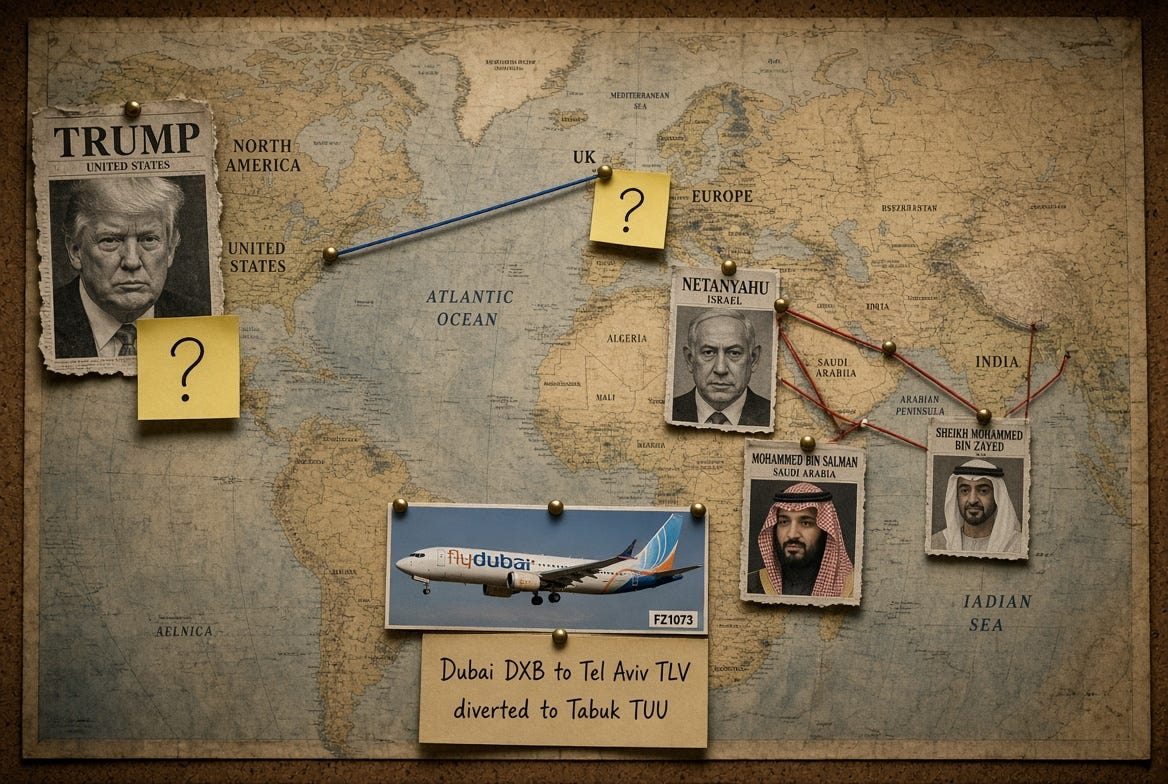
Let’s start with the nations involved and the aircraft itself. FlyDubai is a UAE-flagged, state-owned airline. The airline hires qualified pilots to fly its fleet, which is made up of 98 Boeing 737 aircraft: 69 737 MAX-8 and 4 MAX-9, and 25 737-800 aircraft. The flight on September 30 was scheduled to fly from Dubai International Airport (DXB) to Tel-Aviv’s Ben Gurion (TLV), designated FZ1073, on a Boeing 737 MAX-8 with registration (tail number) A6-FKF. The plane, serial number 61013, was delivered to FlyDubai in December 2022.
The aircraft remains parked at Prince Sultan Bin Abdulaziz International Airport (TUU) in Tabuk, in the Kingdom of Saudi Arabia. It is likely to be there a while, if it ever flies again. As David Thornton wrote, the aircraft descended nearly 17,000 feet (16,575) in just over a minute, reaching an airspeed close to the speed of sound at altitude; the recorded groundspeed was 598 kt.
For aircraft technical mavens: The maximum airspeed (commonly known as VNE for “Velocity, Never Exceed,” and for commercial transport aircraft, published as MMO meaning “Maximum Operating Mach Number”) of the 737 MAX-8 is 0.82. The recorded groundspeed of 598 kt would be well in excess of the 584 kt sound barrier at 32,000 feet. That means it’s likely at some point, FZ1073 approached the speed of sound and exceeded its engineered structural limits. In recovering the aircraft, the pilots who landed the flight learned that the rudder had been torn off. It’s a miracle the wings did not separate from the fuselage.
The flight’s captain, Smit Machchhar, is an Indian national. He is celebrated as a hero, telling India’s Prime Minister Narendra Modi, “I was fighting for my life” when he managed to open the cockpit door while sustaining serious injuries from the attack.
FZ1073’s fate hung in the balance, not just from the attack, and the possible motives and intent of al-Hammami, but also from the multiple threats that happened afterward. This video from air safety YouTuber known as Captain Steeeve serves as a fairly good summary, from the point of view of a passenger, who seems to me to be well-versed in aviation, if not a pilot himself.
Many events combined to save the flight and all aboard, according to this passenger’s account.
A woman passenger had brought her 6-year-old daughter to the bathroom at the front of the aircraft by the galley, and heard the commotion from the flight deck. She informed the flight attendant, who agreed it needed to be investigated.
When Captain Machchhar opened the cockpit door, the woman, seeing blood all over the flight desk, screamed loudly, getting the attention of many passengers. The passenger compartment, mostly Israelis, reacted by rushing to the flight deck. Just about all Israelis have military experience, and the screams would quickly give them the situation that all is not as it should be.
The co-pilot was quickly disarmed, subdued and restrained by at least three passengers, using the cord from a headset. Flight attendants then applied flex-cuffs, as the aircraft began its terrifying descent.
A passenger took the controls and brought the aircraft into stable flight. At the same time, the two pilots who flew the previous leg on the same aircraft, “deadheading” while the active crew flew, reached the flight deck and took control of the aircraft.
Following procedures, the two pilots “squawked” two transponder codes in sequence: first 7700, the international emergency code, then after about 30 seconds, 7500, the code for hijack, and then back to 7700. This alerted every air controller in the area that the flight had been hijacked on its way to Tel Aviv.
The Israeli air force scrambled jets to intercept the flight, which was apparently in Jordanian airspace. At that time, the pilots acted to determine the flyability of the aircraft, no doubt realizing it had been damaged.
The passenger related that the plane circled for about 20 minutes, before heading toward Saudi Arabia. It then landed at Tabuk, where the Saudis were ready with emergency response, and ensured that the aircraft was secured after landing.
The landing itself must have been challenging, without a rudder to maintain directional control once on the ground. The passenger spoke to the pilot who landed the plane, describing the landing as one of the smoothest he’d ever experienced. The pilot responded, “thank Boeing,” because the 737 MAX-8’s nosewheel steering had kept the plane on the runway. A large jet landing without rudder authority is dangerous, because any yaw—loss of directional control—could force a departure from the runway, and easily destroy the aircraft, killing many, or all aboard.
In July, 1989, United Flight 232 lost all three hydraulic systems in flight due to a catastrophic failure of the rear jet engine. The crew heroically controlled the aircraft using nothing but the two remaining wing engines and excellent coordination to bring the DC-10 in to Sioux City, Iowa. But the aircraft still ended up cartwheeling during landing: 111 of the 296 souls on board perished, but due to the skill of the crew, 185 survived. This flight spurred airlines to focus on Crew Resource Management, or CRM, as a cornerstone of their safety programs.
Flight FZ1073 survived because of Boeing’s nosewheel steering system, and also because a backup crew was present, intimately familiar with this particular jet, and able to employ CRM to bring it in safely. If anything is miraculous, all of the events that had to occur to prevent a tragedy—or a terrorist act—must be evidence of what the captain told Modi, “God would save us.”
According to the passenger’s account, the Saudis were gracious, respectful, and incredibly kind and responsive to their Israeli guests. Small things matter: no Israeli would ever imagine themselves guests of the Kingdom at the heart of Islam, so none of them had cell phone SIMs for Saudi carriers. They needed to call family, and it turned out one passenger had a satellite-enabled device that was used to purchase SIMs for other passengers, and tech-minded passengers helped them activate service to contact their loved ones. Saudi counselors made themselves available to help the passengers process their trauma, and medical staff attended to any injuries, while others ensured privacy, and provided food and drinks.
Don’t let anyone say that one particular ethnic group or another lacks empathy and kindness. Human beings can in fact display humanity to one another. We all live on the same hunk of iron, rock, and water. We all live under the same sky, and we all fight the same evils of those who wish destruction.
The Saudis did well.
The attacker was taken into custody by the Saudis, who also provided medical assistance to the injured Captain Machchhar. Hammam al-Hammami, the flight’s co-pilot, is an Omani citizen.
So far, we have a UAE airline, a Saudi airport, Israeli passengers, an Indian captain, and an Omani co-pilot. Five nations: five motivations for narratives; five complicated motivations.
United Arab Emirates
The UAE, as the origin and flag (FlyDubai is Emirati, and owned by the government) of the flight, are by international agreement the principal investigator. The UAE Attorney General has announced he is forming the team to perform that function. That team includes the Israelis, whose Mossad foreign intelligence and Shin Bet law enforcement investigators are conducting a parallel investigation.
Both al-Hammami and Captain Machchhar reportedly been transferred from Saudi Arabia to Abu Dhabi, where the first remains in custody, and the victim is receiving medical care. This gives Emirati investigators full access to both individuals, along with all the other nations, as UAE maintains diplomatic relations with all.
What does UAE want?
A clean ending. It would be best if the attacker were determined to be a lone wolf, acting on his own, with no larger state control or backers. If he was radicalized, that can be contained due to the man’s own reading, viewing videos, or online or personal communications. It would be best if there were no complications like who dispatched or ordered the co-pilot to commit an act of terrorism.
If the whole event were a mental health issue, that would be clean for the Emirates. That doesn’t appear to be the case, as UAE’s prosecutor general has said the co-pilot “attempted to carry out a terrorist act.” The remark could be interpreted several ways, not necessarily that the attack was motivated by terrorism, only that the act itself was characterized this way.
One problem the UAE has already avoided is how a co-pilot brought a weapon aboard one of its flights. The attack was made with the crash axe kept in the cockpit in case of an emergency where the flight crew had to hack the door open. Possibly air safety officials, airlines, and manufacturers could reconsider the accessibility of the crash axe, and the trade-offs on safety if it were not so easy to retrieve. That will be for later. For now, the mystery of bringing a weapon aboard is solved.
Another question is for Israel to ask, and for the UAE to answer.
Israel
Israeli Prime Minister Benjamin Netanyahu has claimed the Omani attacker was “radicalized” and “had Islamist ties.” He said the man underwent “Islamist radical indoctrination.” He didn’t elaborate who did the indoctrinating. The PM believes that the man “was going to down the plane.”
The evidence is spotty here. The aircraft didn’t begin its descent until both the captain and co-pilot were out of their seats, and the cockpit door was open. It’s not clear if the co-pilot commanded the descent with flight controls, or if the autopilot was disconnected, and the plane simply went out of control with nobody flying. Airplanes in level flight are usually stable and won’t head nose-to-the-ground simply because nobody is providing control input. This means it’s likely something or someone either changed the trim (which is what the aircraft uses to maintain level flight) or pushed the yoke forward. It doesn’t necessarily mean al-Hammami did it before leaving his seat.
Whether it happened one way or another is both irrelevant to motive, and also an important distinction. Let’s say al-Hammami’s goal was to incapacitate the pilot, take the controls, and execute a 9/11-style attack on Israeli soil. That would mean the descent over Saudi airspace was not his intention, but it is what happened.
Israel had the option to down the jet, but the pilots in control were undoubtedly talking to controllers—Israeli, Saudi—or their own flight operations, and possibly the IAF jets. At some point, the decision to divert to Tabuk was made, in part due to the wounds the captain had sustained, and also to keep a damaged aircraft out of busy Ben Gurion. The last thing Israel needed was a crash of an airplane with its own citizens aboard at its only international airport.
Again, it was gracious of the Saudis to accept the flight and to do the right thing.
What does Israel want?
Justice, first. The Israelis would love to charge, try, and convict al-Hammami of an act of terrorism. They would love to sentence him. But Israel, though it has diplomatic relations with UAE, has no extradition treaty with the Emirates. Demanding the attacker’s extradition does no good, unless UAE agrees to it, and why would they?
There are reasons. It might be embarrassing for UAE to try the case and have certain details public, or to have al-Hammami acquitted of the most serious charges. Having Israel handle the trial, while UAE gets credit for the investigation, may satisfy many political checkboxes. But on the other hand, Oman would likely object.
Israel has no formal relations with Oman, but Oman and Israel have aligned interests against Iran and the Houthis. If the investigation turns up an Iranian connection, Oman may be less averse to its citizen being tried in Israel. And having al-Hammami locked up in an Israeli prison might be a public relations and negotiating boon to Arab nations—a piece to trade later.
But this too is complicated. Israel can certainly charge the attacker with an act of terrorism, but with no Israelis harmed, and no Israeli equipment, property, or territory threatened, it’s unclear how justice would be served, or what specific charges could be levied. That didn’t stop National Security Minister Itamar Ben-Gvir from calling for the man’s extradition, the Jerusalem Post reported.
Anyone who planned to crash a plane and murder 180 Israelis must be extradited to Israel and pay the heaviest price here," Ben-Gvir said. "We cannot be satisfied with the fact that the disaster was prevented through abundant divine mercy and thanks to our heroic passengers."
Surely, divine mercy may have been involved, but how can Israel be satisfied because a group of Israeli passengers were inconvenienced, experienced some level of trauma, yet were treated professionally, kindly, and respectfully by the Emirates authorities, its airline FlyDubai, and the Saudis? What more can Israel ask for?
Bev-Gvir wants the man’s head on a plate, but it’s unclear he can or will get that.
Israel also wants enhanced cooperation with its Middle East neighbors. This is an excellent opportunity for the Mossad and Shin Bet to work with both the Saudis and the UAE, behind the scenes and publicly, to help gather the threads of this events, and in some ways to control the narrative.
If there is some Iran connection, or some other Islamic radical group directing things, it’s better for all the nations involved to know and coordinate about it in advance, rather than surprise each other with ambush new releases. Of course, fringe wingers like Ben-Gvir are going to spout, no matter what.
Saudi Arabia
The Saudis largely got what they wanted. They portrayed themselves as kind, merciful, professional, and competent. These are all qualities that Saudi Arabia has lacked over many years in the public eye. And for all the good vibes, in general the Kingdom still lacks these attributes in many ways.
The Saudis have executed at least 100 people in 2026 alone, through June. In 2025 and 2024, they set an all-time record with 356 and 345 executions, respectively. In 2022, they conducted a mass execution of 81 people in a single day. About three quarters of those executed for drug offenses are foreign nationals from nations such as Pakistan, Ethiopia, Sudan, Jordan, and Syria.
Barbarically, Saudi Arabia still beheads most of its condemned. Sometimes they crucify the headless body for public inspection. When an executioner by sword cannot be obtained, the Saudis will resort to a firing squad, but mostly it’s still by public beheading.
Also, the brutal assassination of Washington Post columnist Jamal Khashoggi still looms over the Kingdom. The eighth anniversary of that murder was October 2nd. There has never been justice for this, and in fact, the Saudis have cultivated a close relationship with President Trump.
The Saudis have a reputation as a military filled with nepotism, laziness, and incompetence as well. After a 10 year war with the Houthis in Yemen, the Saudis gave up trying to defeat the terror regime backed by the IRGC, even with U.S. support. Now, the Houthis are attacking Saudi oil facilities and causing a crisis as both the Strait of Hormuz and the Red Sea routes for export are threatened. Crown Prince MBS asked Trump for U.S. military assistance in suppressing the Houthis, but with American missile stocks not at full capacity due to the extended Iran war, the president demurred.
What do the Saudis want?
Having a feather in their cap for the handling of FZ1073 is a public relations coup for MBS and the Saudis. Now they are out—except for the aircraft sitting at Tabuk, Saudi Arabia has done its part. The Kingdom’s main concern is keeping any connection to Saudi Islamic radicals out of speculation or the news. Unless the investigation moves in that direction, the Saudis will be satisfied.
They want to cooperate with Israel, but are not ready to move toward formal relations until the Gaza issue is dealt with, as in the war ending. Israel has no motivation to end that war until Hamas is disarmed, and Hamas will never disarm. It may be a long time—or never—until Saudi Arabia and Israel have a formal diplomatic relationship. Right now, I think both countries are comfortable keeping their cooperation in the back channels.
Oman
There’s not much upside to Oman, other than distancing itself from al-Hammami. No legitimate government, especially one friendly to the United States, wants to claim a 9/11-style terrorist or defend one.
There are some questions regarding Israel, however.
Israel’s immigration policies are generally ironclad. My brother Jay told me a story of traveling to Israel on business with an associate, who, if I remember correctly, was a Syrian refugee (this was years ago). The company, which was based in Israel, insisted they wanted this person on the trip, but the man had his doubts. He never made it off the plane. The Shin Bet had tagged him from the passenger manifest before the plane even landed, and gave him the option of taking the next flight back to the U.S., or perhaps he wanted to be deported to Syria?
There is supposedly a rule in Israel that any commercial pilot flying for a foreign airline must be a citizen of a country that maintains diplomatic relations with Israel. Oman does not.
This policy is apparently very weakly enforced, and has loopholes permitting the Transportation Minister to submit foreign pilots from these countries for security checks. The co-pilot on FZ1073 did not hold credentials for any other nationality, according to the Jerusalem Post.
Also, the agreement between the UAE and Israel regarding FlyDubai “did not stipulate that pilots operating flights between the two countries must be nationals of countries maintaining diplomatic relations with Israel.” That is disputed by prior statements from the Transportation Ministry. Apparently, “dozens” of Omani flight crew have been with FlyDubai, and have routinely flown into Israel. This prompted the airline, and, I assume, Israeli authorities, to suspend all FlyDubai operations into Tel Aviv.
What does Oman want?
It is difficult to say whether Oman would benefit from Israel accepting Omani pilots, but it probably is not good for whatever relations exist—informally—between the two countries for Israel to treat Omanis differently from other air crew, especially if the no-fly rule enforcement is historically spotty.
Omani authorities, speaking anonymously, have already begun distancing themselves. Sources have told ABC News, also reported by The Times of Israel, that al-Hammami was “previously banned from flying by Oman’s national airline over concerns that he had been radicalized.” This raises questions on how FlyDubai vetted him and hired him to fly to Israel, of all places. It also leaves Israeli authorities with egg on their faces over who is supposed to vet these air crew.
The facts as reported would put Oman on the “good guys” side of the issue.
According to ABC, al-Hammami is “cooperating” with investigators and has suggested to them that he intended to crash the plane in Israel. Quoting sources briefed on the investigation, ABC reported: “Al-Hammami… has indicated that his intent was to crash the aircraft in Israel.”
It also buttresses any Israeli calls for extradition, since Israel was the target.
India, the U.K., and the United States
India has a hero. India enjoys a very close relationship with Israel. Israel’s Prime Minister Benjamin Netanyahu characterized his May 2026 visit to India as a “love fest.” Netanyahu invited Indian PM Narendra Modi, along with Captain Smit Machchhar to light the flame at the ceremony on the next Israel Independence Day celebration; this is normally an honor reserved for Israeli citizens.
India has its share of aviation issues, including what appears to be an intentional crash by a crew member; David Thornton wrote about the tragedy of Air India Flight 171 in July, 2025. But the tragedy Captain Machchhar prevented highlights the bravery and humanity displayed by all involved.
What does the U.K. have to do with this? Nothing, maybe, or perhaps, a lot. The Fairford incident where five young Brits were arrested, then released on bail, along with a dual citizenship UK-Iranian man, on suspicion of terrorist actions could be a link to radicalized Islamic terror, including the intent to crash an Emirati airliner inside Israel.
The threat is apparently continuing, and concerning enough to the U.S. Air Force that the bombers stationed at RAF Fairford have been removed, according to a PBS report.
Aviation watchers such as the Military Air Tracking Alliance have observed dozens of B-52 and B-1 bombers operating out of RAF Fairford since the opening days of the Iran war. Observers noticed a host of B-1 bombers fly out of the base on Sunday.
As the U.S. has officially completed its exit from Iraq, more Marines and the USS Theodore Roosevelt, a Nimitz-class carrier, are headed to the Gulf, to keep the pressure on Iran, and to keep it from exporting oil through the Strait of Hormuz, while attempting to keep oil flowing from nations friendly to the United States. Crude exports in the last week of September were reported at 12.34 million barrels per day, about 80 percent of their levels before the start of the Iran war.
The prospect of a negotiated end to the war is not considered in the calculation by shipping companies, Argus Media, which covers oil shipments, reported.
"You don't even need peace now in Iran, you just need the oil to come out," Robert Bugbee, president of shipowner Scorpio Tankers said.
What does the U.S. want?
Obviously, the U.S. wants the oil to flow, so prices at the pump can begin to decline, and the price of everything else Americans buy won’t be so painfully high. But Iran continues to attack shipping in the strait, stepping up its activity; in the last five days, six ships have been attacked, according to Argus.
If the FZ1073 attempt was related to Iranian efforts against the U.S. or Israel, the Trump administration, I think, would want to use it, not just to protect Americans, but also as a political tool in the upcoming November midterms. I know that’s crass, but that’s the sharp-elbow politics and blunt hammers of the Trump White House.
If President Donald Trump can insert himself into the headlines, he will.
Uncertainty and Events
Let’s say MI5 concludes the RAF Fairford event was orchestrated by Iran, which seems more likely every day. Who recruited British citizens to commit sabotage, or to spy for Iran? Was the FluDubai co-pilot, al-Hammami, part of the same network? I’m sure this is top of the list in any investigation.
Here are some scenarios that could throw a wrench, or a grenade, into the news cycle, and end the celebration.
Hammam al-Hammami dies in custody, either by suicide, or in an escape attempt, or simply murdered. I’d call this “the Epstein option,” because it leaves a huge mystery. Such things happen: look at the JFK assassination. The death of the attacker would amp things up in disinformation and conspiracy theories that will never end.
A copycat. Some other radicalized pilot or crew member could conduct another attack, on a jet filled with Jews, or a flight to New York. A recent attack against messianic Rabbi Jonathan Cahn by an enraged passenger highlights the danger of idiots on airplanes. Interestingly, Cahn’s first novel, “The Harbinger,” was published in September 2001, while containing some alarmingly parallel events to the actual 9/11 attack. I read that book, and it was chilling. A particularly difficult variant of this would be if a European airline was targeted, or if a European pilot were radicalized. It could start a panic over flight security and who is flying.
Iranian retaliation against Oman. Oman has tried to remain as neutral in the Iran war as it can be. Muscat opposed the Iran war, and maintains some relations with Tehran. Attacks by Iran proxies have frustrated Oman, but a direct attack would be destabilizing, since Oman is a member of the Gulf Cooperation Council, which is headquartered in Riyadh, Saudi Arabia. President Trump told reporters Iran would be “hit very hard” if it was involved in the FZ1073 plot. Why the U.S. would make this threat is unclear—America was not involved at all—but Trump has the ability to continue the Iran war until someone stops him (namely Congress).
A false flag. The attacker is reportedly cooperating with investigators. What if some kind of “9/11-style chatter” is uncovered, but not related to Iran? What if hacks against the FBI, and other events are related, but not through Iran? Do we have another rising terror organization that intelligence assets are aware of, but has not been made public? Uncertainty is a powerful source of panic.
Benjamin Netanyahu told Fox News host Sean Hannity that Israel had warned Britain that Iran was planning an attack on British soil against an airbase. “You want to hear how absurd things are there and how far the anti-Israel propaganda has gone?” Netanyahu said. “We gave the Brits the intel that there was going to be an attack and it's an Iranian-sponsored attack. And pretty much the next day, they slapped sanctions on us.”
Iran, which has diplomatic relations with the U.K., denied any involvement in the RAF Fairford events, through its embassy. Meanwhile, the five men who were arrested were released on bail after police failed to find any evidence of explosives in their possession. However, Iran has threatened to attack any foreign base hosting U.S. bombers as a “legitimate target.”
Iran wants to use FZ1073 to sow chaos and suspicion among western and Middle Eastern intelligence agencies, and their masters. Any division it can create between the U.S. and Israel, or the U.S. and Saudi Arabia, or the fragile agreements between Israel and the Emirates, is a win for Tehran.
Expect a lot of disinformation, propaganda, and flat out falsehoods.
Conclusion and Questions
Who will prosecute al-Hammami? What will he be charged with? A terror plot that went wrong, resulted in injury and damage to a jet aircraft, is not necessarily a capital crime. The call for al-Hammami’s head on a platter from Israel notwithstanding, the actual harm from the crime was minimal.
Hammam al-Hammami may end up serving a jail sentence in Abu Dhabi. Or he may end up serving one in Ayalon Prison, in Ramla, Israel, which, ironically, is less than 10 miles from Ben Gurion International Airport.
What will the fallout from this attempted act of terror be? Will crash axes be locked up more securely? Will air crew be vetted more closely? Will there be less flights into Israel from foreign airlines? Will the U.S. use this to justify more attacks on Iran? Will Iran use this to sow discord between the U.S. and its allies?
Will an “overcome by events” scenario occur?
Or will this be the beginning of a new era of cooperation between states that have few shared interests, other than being human and showing kindness? That would be the best outcome, no matter what happens to al-Hammami.
It’s best to bask in the moment of heroism and celebration for now, because from here, it just gets complicated.
SOCIAL MEDIA ACCOUNTS: You can follow us on social media at several different locations. Official Racket News pages include:
Facebook: https://www.facebook.com/NewsRacket
Twitter/X: https://twitter.com/NewsRacket
Threads: https://www.threads.com/@theracketnews
Blue Sky: https://bsky.app/profile/newsracket.bsky.social
Our personal accounts on the platform now known as X:
David: https://x.com/captainkudzu
Steve: https://x.com/stevengberman
Jay: https://x.com/curmudgeon_NH