


With the state Supreme Court’s rejection of Virginia’s redistricting map and new Republican maps in Florida and Tennessee, it seems that Republicans have won the 2026 redistricting wars. What they’ve won remains to be seen, however. As I alluded to in my post last week, the Law of Unintended Consequences may interfere with the GOP’s victory celebration.
Where the rub may come in is that, to gerrymander the Democrats out of seats, Republicans had to disperse Democratic voters into heretofore safe Republican districts. Simple mathematics tells us that if we subtract Republican voters from safe Republican districts and add Democratic voters, the district becomes less Republican.
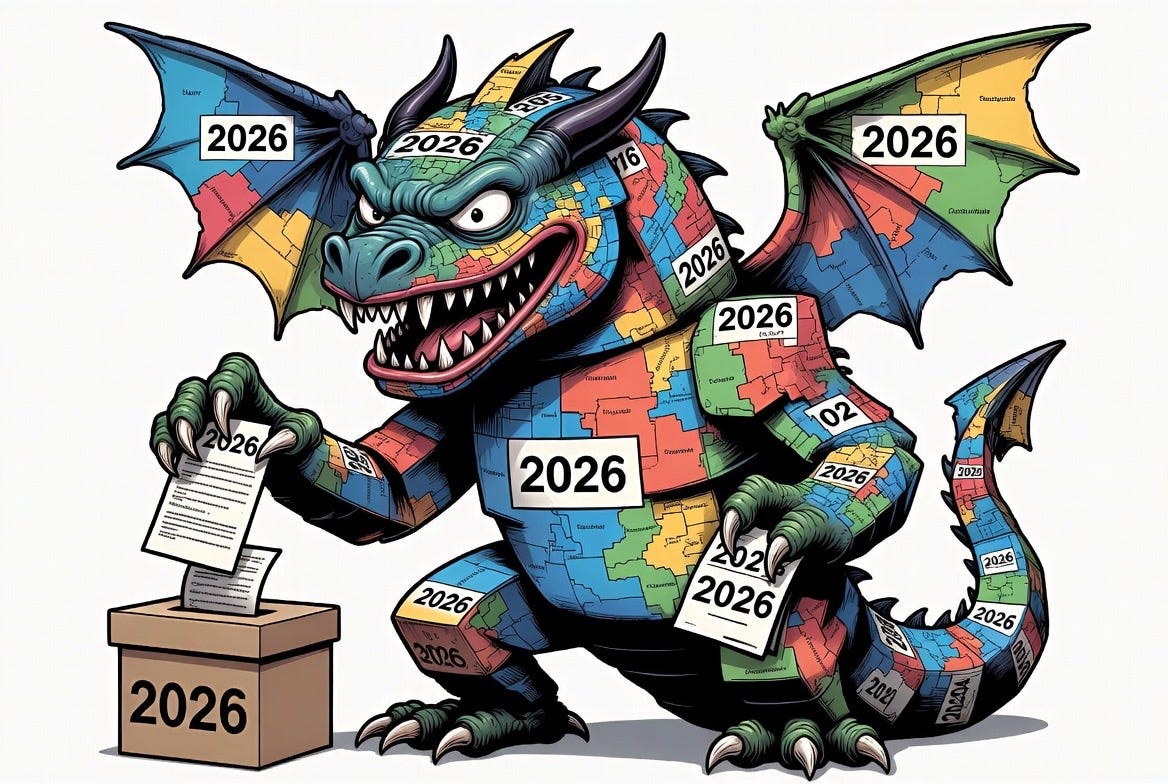
Image created by Grok
Often, that wouldn’t be an issue. If a 20-point Republican district becomes a 10-point Republican district, the odds are still good that the Republican candidate will win. In elections, anything over 51 percent doesn’t really matter.
Except sometimes it does. When we talk about a 20-point Republican advantage, we are talking about averages. By definition, an average means that sometimes Republicans will get more than a 20-point advantage and sometimes less.
Which do you think Republicans can expect in 2026?
Waving my hands wildly, “Ooh, ooh, Mr Kotter! Pick me!”
First, it’s an off-year election, and the president’s party almost always loses seats in an off-year election. Without knowing anything else, we can predict a Democratic electoral advantage in this year’s midterms simply by the fact that they are out of power.
Second, Donald Trump is the most unpopular president in polling history surpassing his own first-term record, and recent history shows that Democrats have overperformed in recent elections. In elections held in 2025 and 2026, Democrats have gained an average of 13 to 15 points. Again, that means that some races were closer while some Democrats won by margins of more than 20 points.
Republicans knew there was a disaster in the making. That is why they started the redistricting war. The question is whether the gerrymandered seats will be enough to stave off the electoral collapse. Republicans certainly hope so, but a 15-point swing is a rather large tide to weather. You might even call it a tsunami.
Eliot Morris, a data analyst for The Economist, ran the numbers. He found that the net estimated loss of six seats by redistricting means that Democrats need to win the national popular vote by four points to win a House majority. In a D+13 (or better) year, that seems very attainable. Democrats are already exceeding that four-point margin in generic ballot polling.
Another way of looking at the numbers is that Democrats need to flip three seats under the current balance of power, plus another six to offset possible losses due to redistricting. That means they need a net gain of nine seats to win control of the House.
Currently, the Cook Political Report shows three Republican seats that are very likely to flip, and another 14 that are tossups. Subtract five Democratic seats that are likely to flip and consider another four Democratic tossups, and we get a net gain of eight seats if all the possible seats are flipped by both sides. That would be one short of the majority.
But if this turns out to be a Democratic wave year, the swing districts are likely to break for the Democrats while Republicans miss some opportunities. It is not inconceivable that in a D+13 year Democrats could run the table on the toss-up races and even pick up some unexpected upsets.
The Republicans made several crucial errors. First, they governed in a way that made people angry. They enacted unpopular policies and then forged ahead anyway when public opinion turned against them.
Enacting unpopular policies was a gamble that might have paid off if the policies had worked. Ronald Reagan and Paul Volcker famously enacted high interest rates and sparked a recession to defeat 1970s inflation. The policy was unpopular, but it worked, and then Reagan became immensely popular, winning 49 states in 1984.
Not so for the Trump Administration policies. From economics to foreign policy to immigration, Trump is underwater in every area. As the old trope goes: #ETTD. Everything Trump touches dies.
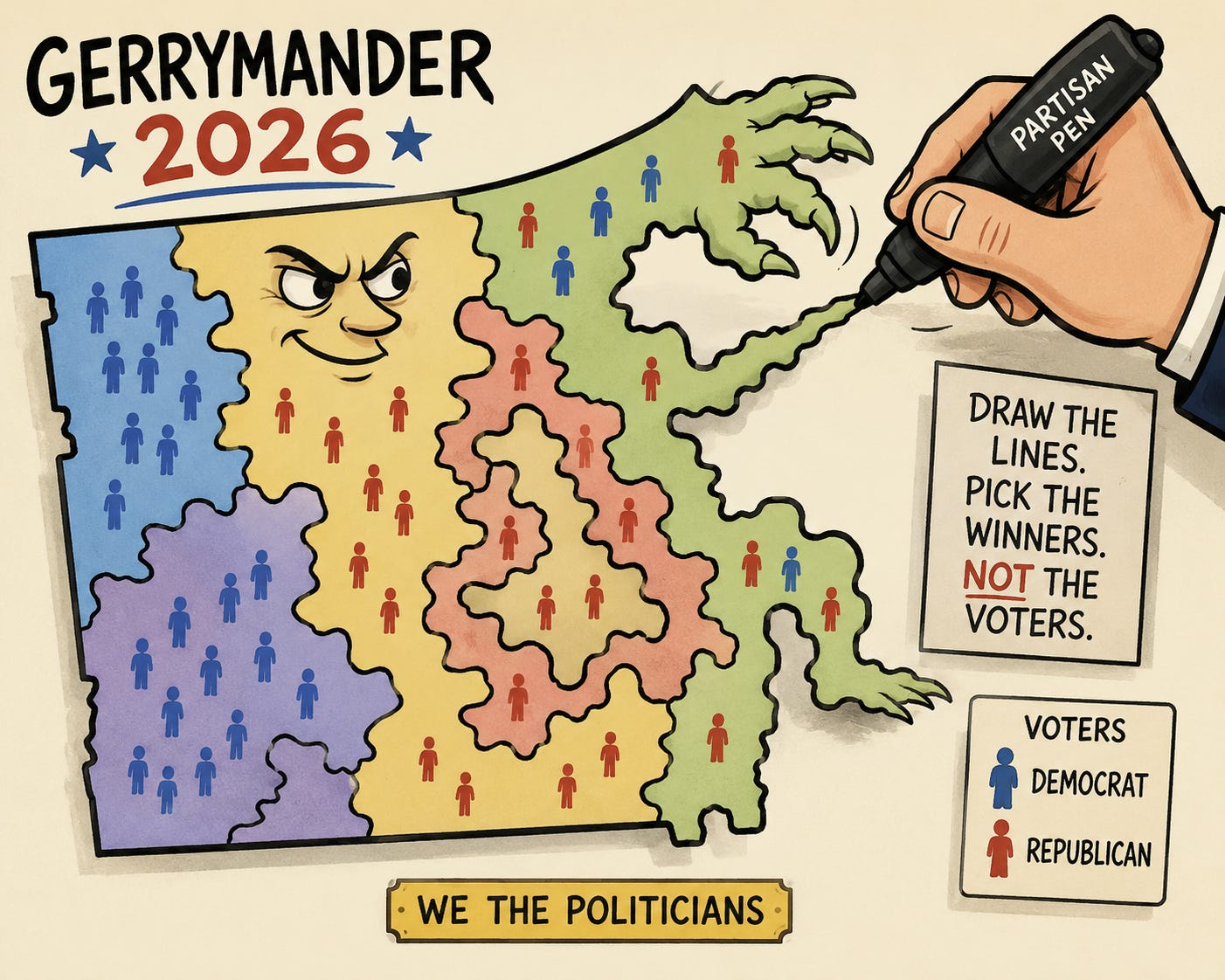
Image created by ChatGPT
The most recent Republican error was to assume that they couldn’t (or wouldn’t) lose voters. But political affiliation is not an immutable characteristic. The party bases might seldom or never change their tribal preferences, but a lot of voters do. That’s particularly true of swing voters. In fact, that’s why they call them “swing voters.”
To assume that people who voted for Trump in 2024 would never go back to voting Democrat reflected MAGA hubris. Or maybe it’s just a lack of imagination, the inability to comprehend that Trump’s policies would fail or that any voter could fail to love Donald Trump as much as Republicans do.
Now the last error is sowing seeds of disaster even as Republicans frantically gerrymander away Democratic seats. Polling shows that some core Republican demographics are starting to crack. An NPR/PBS News/Marist poll found that Trump’s support among white evangelicals was down by 18 points from 2024. Some polling even shows Trump underwater with non-college white voters, one of his strongest demographics, but one that is heavily affected by rising prices. While Trump retains high support among Republicans, Republicans say they are less likely to vote than Democrats. That is the other side of the equation. Republican voters don’t have to vote Democrat, they can just stay home.
Not only can voters change their minds, redrawing congressional districts won’t make an unpopular and failing party any more popular. The odds are pretty good that it might make that party even less popular and drive even more voters away.
Miscalculating gerrymanders and misunderstanding voter behavior doesn’t happen often, but sometimes the Law of Unintended Consequences takes over. There’s actually a term for this phenomenon in gerrymandering. It’s called a “dummymander.”
I asked ChatGPT about the potential Democratic net gains. The estimate was 25-45 seats at the D+13 level even considering the new maps. At D+15, the wave would likely exceed the 41 seats Democrats gained in 2018. Kalshi Politics is currently predicting 223 Democrat seats before 18 tossup races are considered. As primaries conclude and Election Day draws nearer, more voters will make decisions, and I’ll bet the numbers shift to favor Democrats even more strongly, especially since the Iran war is likely to drag on, keeping energy prices high.
Republicans aren’t redrawing congressional districts because they are a strong, popular party. They are gerrymandering because they know the people are pissed, and they are trying to escape accountability. Unfortunately for them, finagling a handful of districts isn’t likely to overcome the full weight of an unpopular war, rising gas prices, and a general feeling that Trump and the GOP are both incompetent and out of touch.
Redistricting only tinkers around the edges of looming Republican midterm losses. At best, it might staunch the potential hemorrhaging of House seats. At worst, diluting their margins in safe districts might prove to cost the GOP more than it would have lost under the old maps.
In November, Republicans might well look back on their redistricting victories and empathize with King Pyrrhus, from whom we get the phrase “Pyrrhic victory,” who lamented after a costly battle against the Romans, “Another such victory and I am undone.”
THE GOLDEN FLEECE Last June, 590,000 people paid $100 deposits for a $499 TrumpMobile gold smartphone. A year later, not a single phone has been delivered and the release date, which has been delayed several times, has been removed from the company’s website, reports MoneyWise.
SOCIAL MEDIA ACCOUNTS: You can follow us on social media at several different locations. Official Racket News pages include:
Facebook: https://www.facebook.com/NewsRacket
Twitter/X: https://twitter.com/NewsRacket
Threads: https://www.threads.com/@theracketnews
Mastodon: https://bird.makeup/users/newsracket
Our personal accounts on the platform formerly known as Twitter:
David: https://x.com/captainkudzu
Steve: https://x.com/stevengberman
Jay: https://x.com/curmudgeon_NH
Only comment: never trust ChatGPT with facts.
This David, this 100-fold: "Republicans aren’t redrawing congressional districts because they are a strong, popular party. They are gerrymandering because they know the people are pissed, and they are trying to escape accountability."
Accountability, simply a word that does not exist in the GOP playbook. As i watch the daily chaos of a president who can't stay awake during the day and cannot sleep at night, it has become crystal clear the man is well past his prime.
The funny thing is, his prime is/was and always will be that of a con man. Man of the people, my ass. His one and only concern has been how much can he grift from the 30% of the rubes who adore him?
Nothing he does is about us, only him. Nothing.