


I once rode along with the police on a tactical arrest.
This happened back in the earlier days of the Internet, when dial-up was king. I ran an ISP. One of my employees encountered someone in a chat room claiming they had hacked a local television station. It turns out we hosted the particular station’s website and server, so it peaked our interest. We checked into it and found that yes, indeed, someone might have obtained certain account information (they didn’t break into the server itself). So we decided to find out who the miscreant was. Through some clever work, my system admin learned the person was logged in—currently, at that moment—through one of our dialup ports. It was rather a simple matter to get their caller ID, and with some—ahem—friends at the phone company, we soon had an address.
Anyways, I called my friend, the county DA. He confirmed we should be talking with the local police department based on where the call originated, and didn’t ask too many questions (prosecutors would rather not know how the sausage is made until there’s a case). I contacted a detective and we came up with a plan to gather more evidence (the person was bragging online, it wasn’t hard), then shared proof of the user’s phone number, technical details, etc. with the police. We believed the user was a minor, a 17-year-old.
The detective said they’d go talk to the boy, bring him in, and then find out if anyone wanted to pursue charges. You know, put the scare into him, but I wasn’t out for throwing the book at a precocious kid (again, this was a different time, a more naïve time, on the Internet). Then I got a call; the detective told me things had changed. When he put the address through their “watch list” database, he got a hit. The home was the address of a known felon. It turns out the mother of the boy had a boyfriend, who happened to be out on either probation or parole or some such thing. In any case, they can’t just go knock on the door and say “hi”.
So that afternoon, the detective called the judge to get a search warrant, along with an arrest warrant against the boy and anyone else involved. Given the status of the home, the judge read the detective’s statement and signed off on a “no-knock” warrant. I don’t expect you to know what that is—I didn’t—but it’s exactly what it sounds like. It means the police have a warrant to enter a premises without knocking. They can breach the door, or make whatever entry they want to fulfill the warrant and keep themselves safe. The detective asked if I wanted to ride along with him. I thought about it and said sure.
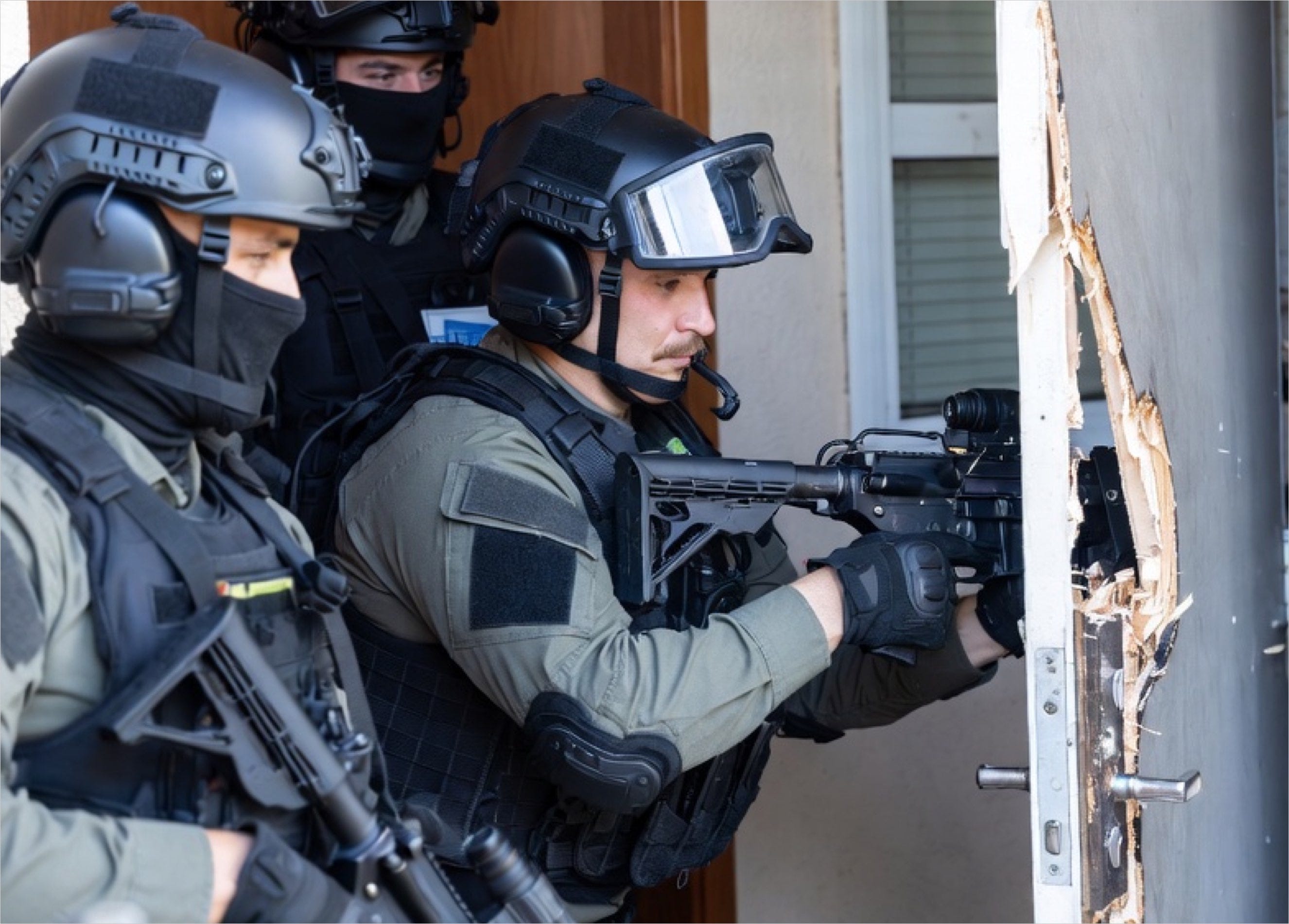
Around sunset, about eight unmarked police cars crept up to the street where the house was located, and parked far enough away so as not to be spotted. The police tactical squad, complete with rifles, took up positions around the house. The detective told me to stay put in the car, then got out to join them. After observing the home for a bit, someone (the detective or whoever decides such things) decided to knock instead of going in with a breach. Once the door opened, they all flooded into the place and put everyone down at gunpoint, shouting loud commands, like on television.
I sat in the car, bored, for it seemed like an hour while the squad went through the home and tagged evidence (the computer and related items), and did their police work. I got sick of sitting, and got out for a moment to stretch my legs, right at the time when the felon was being marched out in handcuffs. He got a good look at me. Oops. I got a scowl from the detective.
Turns out, they found at least one SKS rifle and, if I remember correctly, 2,000 rounds of ammunition in the home. That felon guy was set to go away for a long time, I guessed. But he didn’t get thrown in the jail right away. See, a few days later, I got a visitor at work. He walked right through our lobby into the back area where my desk was, to talk to me. It was the felon guy. He asked me to be lenient with the boy. I told him I couldn’t talk to him. He pleaded. I told him he had to go or I was going to call 911. To be honest, it shook me. He could have blown my head off and there was nothing I could do.
I don’t know what happened to the boy. I remember the DA asking what I’d like to see happen. I just want the kid to learn his lesson, I told him, and if being arrested like he was didn’t scare the boy, I don’t know what would. After that day, I began keeping a loaded gun in my desk drawer1. When we moved our office, I ensured we had steel doors and iron-tight security in the new building. I wasn’t going to have surprise visitors again.
Many years later, thinking back on that incident, another lesson has emerged. I learned just how close American society rides on the line between law abiding citizens obeying law enforcement, and a police state that can kill you or your loved ones without hesitation. It is upon the strength of that thin thread that we hang our peaceful lives every day.
Think about it. The difference between a stern visit from a couple of police officers, one wearing a sport jacket and the other perhaps in a polo shirt, badges on their belts, and a full tactical team putting everyone in the home down at gunpoint, is the signature of one judge, on the statement from one officer. The judge believed that in his interaction with the detective that he was telling the truth, had performed proper police work and followed procedures dealing with this situation, which involved a minor, his mother, and the other members of that household (it was the grandmother’s house). The detective and the tactical squad used their best judgement to the safety of all, including me. I, as a citizen, the DA, and the boy himself, all trusted the system, which was based on trust, judgement, and sound policy and procedures.
But it was the signature of the judge that gave the police permission to possibly use deadly force. If any part of this chain of trust gives way, things can easily go sideways. We hear about the stories—the New York Times has filled pages with them, “tiny missteps” that end in tragedy. Police going to the wrong address, misidentifying the target. They say it’s guns that are the problem. I don’t buy that (yes, guns are a problem, but not the problem when police go in tactical). It’s really hard to prosecute police for making deadly mistakes while doing their jobs. The bar is awfully high for a conviction, as the public believes in the system of trust, as well as the officers.
For that system to fail, for the thread that holds the line between law enforcement and a police state, to fray and break, is almost unthinkable, which is why juries almost never convict police in the line of duty who end up killing innocent people.
Now think about ICE and the current events going on in Minneapolis. It’s almost the perfect formula for breaking that thread of trust. To begin, let’s go back to April, not in Minneapolis but in Milwaukee, where ICE was operating in the county courthouse. Judge Hannah Dugan knew the federal agents were in the courthouse, but it was her courtroom. After she led a man ICE was about to detain through the side door of her courtroom to help him escape, she was charged by federal prosecutors with two charges. A federal jury acquitted her of the misdemeanor charge of concealing an individual to prevent his discovery or arrest, but convicted her of the felony charge of impeding or obstructing a proceeding. Dugan resigned earlier this month, after Democratic Gov. Tony Evers reluctantly asked for her resignation with a “heavy heart.”
Not all judges are perfect. Many judges over the years have been found taking bribes, buddying up with criminals, or otherwise succumbing to corruption. But in general, the United States has a stellar record of judges doing the right thing and maintaining the integrity of the legal system. In this case, Dugan’s motivations and judgement could be called into question, but it’s clear she was made an example for ICE to ignore the wishes of judges sitting in their own courtrooms. It was clear that ICE is an entity above judges, because it works for the president himself.
After the killing of Renee Good in Minneapolis, President Donald Trump promised complete immunity for ICE agents involved in the shooting. The FBI was ordered to focus on Good and her partner than the actions of the ICE officers involved in the shooting. One FBI investigator opted to resign rather than to participate. After protests in Minneapolis multiplied, including an ill-advised takeover of a church service, the government went after the media and the protesters. An appeals court rejected the DOJ’s request for an arrest warrant against CNN reporter Don Lemon. Many protesters were arrested, but a federal appeals judge denied another request to detain three protesters accused of a “crime of violence” in the church protest.
It’s good that judges are still able to exercise power over ICE, but only after the agency, and the DOJ, oversteps its authority, or acts with “no factual or legal support” for its assertions. We have the situation where two arms of the federal government, the executive branch, and the judicial branch, are at odds. Add to this the situation where state and local police are at odds with the federal agencies. It’s not like these things never happened before—think segregation, or the 60s and anti-war protests—but the degree to which the feds are openly defying any oversight and telling lies is fairly unprecedented.
Remember that ICE was much smaller a year ago than it is now. It has added well over 10,000 Deportation Officers to its ranks, with up to 18,000 authorized. These new recruits responded to ads on ICE’s careers page, which featured propaganda-style posters of President Trump and Kristi Noem, to “defend the homeland.” No prior police experience was required, and training would be provided. That training is about what a U.S. Marine gets in basic. Imagine releasing thousands of newly minted Marines onto the streets, heavily armed, with little supervision, to clean things up, being promised full immunity by the president.

The training that these ICE agents are getting includes some very shaky legal opinion. They are told they can forcibly enter people’s homes without a warrant signed by a judge. Remember the “no-knock” warrant that judge signed back when I rode along on a tactical arrest? ICE agents believe they don’t need it. Their paperwork, an administrative order for final removal, they are told, is enough to justify forcible entry into any place where they think their target may be. It could be your house, or my house, for all I know.
I wrote about Chop, the pet dog ICE shot, because Chop’s owner answered the door and let ICE come in to look for someone they had on their target list. Chop’s owner told the agents he put the dog in the bathroom, because Rottweilers can be aggressive with strangers. They ignored the owner’s advice and killed his dog, because they were acting on a tip. Now, if Chop’s owner had not opened the door, ICE could just bust in anyway, kill Chop and anyone else they deemed as a threat. They’d have no compunction about doing this, because they are going after “the worst of the worst.”
Filled with this confidence, ICE believes its mission is above all other law. Anyone with a “foreign” accent is subject to being asked for “papers, please.” If they can’t immediately produce documentation that the 13-week wonder ICE agents can understand and interpret, ICE will pick them up and detain them, regardless of whether they are on a “target list” or not.
I’ve read stories of people who wrote they were on their way going about their business and just happened to be driving behind an ICE vehicle in places like Minneapolis, and find themselves pulled over and grilled, accused of impeding ICE in its mission. I am skeptical of many of these stories, because social media is overrun by bots and AI-generated garbage (which is why I won’t link it). But some of this seems very plausible indeed.
Impeding ICE in its mission is cause for extreme caution. Alex Jeffrey Pretti, a 37-year-old U.S. citizen—law-abiding, with no criminal record—was carrying a weapon while protesting ICE in Minneapolis. Pretti was shot and killed by ICE agents, who claimed he pulled his gun. In fact, video shows Pretti was holding a cell phone. Agents had already pulled Pretti’s gun from his waistband. DHS Secretary Kristi Noem called Pretti a “domestic terrorist.” In a letter to Minnesota Gov. Tim Walz, Noem accused Walz of allowing “lawlessness” on the streets.
The question is: who is lawless? The federal government refuses even to investigate these ICE shootings of Americans. The Hennepin County DA and the State of Minnesota have filed a federal lawsuit to enjoin the government to “ prevent the destruction of evidence related to the fatal shooting of Alex Pretti.”
ICE is operating as if what judges sign is irrelevant to their orders, which come from Washington, D.C. It is operating as if its agents are free from any responsibility for their actions. It is operating as if it has the ability to ignore the Bill of Rights because its mission is to clean up the “worst of the worst” illegal immigrants with criminal records. It is operating as if anyone who opposes their methods, policies, or actions is a “domestic terrorist” and subject to extreme force.
If what ICE is doing in Minnesota is not an example of a police agency out of control, then the thin thread that separates the judicious use of extreme force and a full police state may already be broken.
If the courts rule that ICE must cease its operations in Minnesota, and the agency refuses, it could be the most consequential legal battle in Trump’s second term. One thing I do know, is that I don’t want any police agency able to break down my door on a tip, or come into my home without a judge signing a warrant. I don’t want to be questioned on the street of my intentions because I happen to be somewhere I don’t know I shouldn’t be, or have friends who are U.S. citizens asked “papers, please” because they have an accent.
I don’t think I’m crazy or acting with TDS to believe those things I don’t want might be real or happening now. There’s just too much evidence to ignore.
SOCIAL MEDIA ACCOUNTS: You can follow us on social media at several different locations. Official Racket News pages include:
Facebook: https://www.facebook.com/NewsRacket
Twitter/X: https://twitter.com/NewsRacket
Our personal accounts on the platform formerly known as Twitter:
David: https://x.com/captainkudzu
Steve: https://x.com/stevengberman
Jay: https://x.com/curmudgeon_NH
Tell your friends about us!
For the record, I did have a Georgia concealed carry permit. I had off and on carried for years, and was a member of a competitive shooting club when I lived in New Hampshire, where I also had a permit to carry. I was competent with firearms and safe handling.
When a US judge has to issue a restraining order[1] against DHS preventing them from altering or destroying evidence - as they have done numerous times in Chicago[2,3] - we've already crossed the Rubicon.
[1] https://www.cbsnews.com/minnesota/live-updates/reported-shooting-south-minneapolis-federal-agents-protesters/
[2] https://www.404media.co/two-weeks-of-surveillance-footage-from-ice-detention-center-irretrievably-destroyed/
[3] https://www.cnn.com/2025/10/16/us/chicago-car-ramming-case-ice-protests
Amen Steve, Amen.