


It’s been 40 years to the day since the Space Shuttle Challenger broke up in flight on its way to orbit. I wrote about it ten years ago, at the 30 year mark, and have republished that piece in this blog. I remember that terrible day with vivid precision. I learned of the SRB explosion from a friend, while I was sitting in the UNH Memorial Union Building—the “MUB”—and I told him it was a very poor joke. He persisted that it was not a joke, and I walked into the TV room to see the endlessly replayed loop of the demise of seven astronauts.
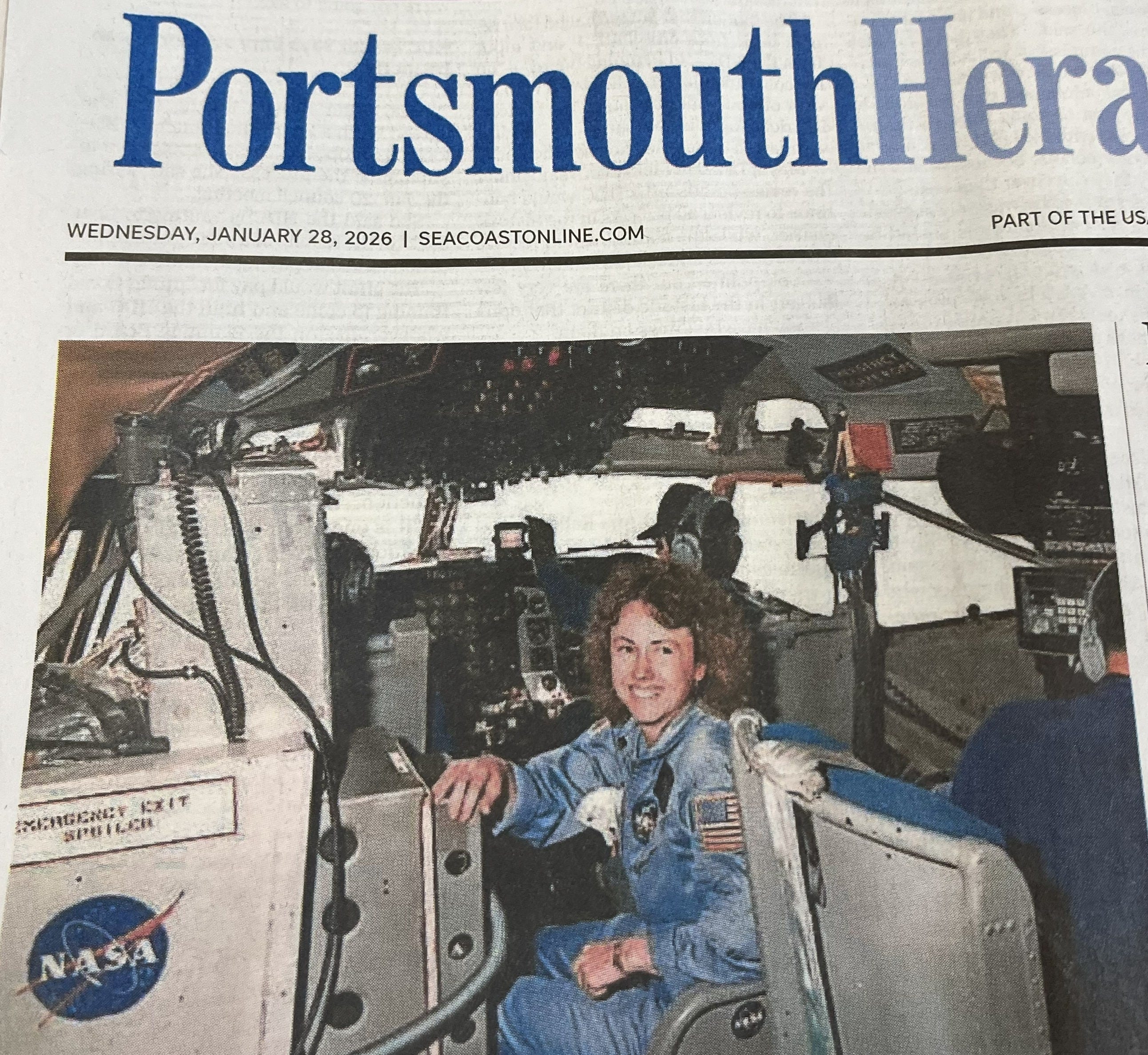
One of those astronauts was New Hampshire teacher Christa McAuliffe. She was selected among thousands of applicants to be the first “teacher in space.” She wasn’t one of the special individuals who go to engineering school, or become medical doctors, or are simply multi-talented like Jonny Kim—who was a member of SEAL Team 3, a combat medic, earned a Bachelor of Mathematics from USC where he graduated summa cum laude, then attended Harvard Medical School to earn his M.D. and become only the 79th individual to attain an Aerospace Medicine Dual Designation from the Navy as both a physician and naval aviator, and just returned from the ISS Expedition 72/73 on December 9, 2025. McAuliffe taught social studies at Concord High School.
She was going to teach lessons from space, two 15-minute classes were planned. One was a tour of the Shuttle, “The Ultimate Field Trip,” and the other about the benefits of space travel, “Where We’ve Been, Where We’re Going, Why.” She didn’t get to teach either, but I think, in retrospect, Christa would still agree with the sentiment behind the second lesson. Nobody agrees to fly in the most complex machine ever designed by mankind, into the microgravity and near-vacuum of space, unless the risks were outweighed many times over by the rewards, settled in the mind and spirit.
You’d think NASA would have canceled the “teacher in space” slot after the Challenger disaster. But McAuliffe’s backup, Barbara Morgan, decided to pursue a permanent career as part of the astronaut corps. She flew on STS-118, on the Endeavor, which launched on August 8, 2007, one of the many ISS assembly missions. During the flight, which she flew as a full Mission Specialist member of the crew, a position she fully earned, she operated the robotic arm and did her part, but also conducted Q&A sessions via amateur radio (which NASA still does). She now lives in Idaho, teaching at Boise State University, enjoying snow sports in Idaho.
The spirit of Christa McAuliffe and the NASA of more innocent times, in 1986, lives on, but the loss still stings. NASA learned a hard lesson about ignoring the voices of those way down the decision tree, who can predict when a part they designed is about to fail. They had to reboot their entire approach to mission safety. Even so, Columbia was lost, not due to hubris, but simply due to the shuttle’s mission being too wide, its technology bed spread too far, its safety margins too narrow, making the loss of a vehicle unacceptably common for the number of missions flown. It’s really a testament to the excellence of the engineers, the mindfulness of the trades people, and the commitment of the entire operation, that so many shuttles launched, flew, and landed without incident.
My brother Jay and I were on the access road to the gate of Canaveral AFS, outside Kennedy Space Center, to watch a launch on January 5th, 1986, 23 days before Challenger. The pace of missions was that fast back in the mid-80s, up to two launches a month. Columbia had a very short launch window that day, and scrubbed at T minus 31 seconds, which is the point when the shuttle’s onboard computers take over the countdown. Pilot Charles Bolden, who later rose to NASA Administrator, said of that day, “There had actually been a probe, a temperature probe that in the de-fueling, they had broken the temperature probe off, and it had lodged inside the valve, keeping the valve from closing fully.” He added, “So that would have been a bad day. That would have been a catastrophic day, because the engine would have exploded had we launched.”
But Challenger did launch, because there was no circuit to prevent a launch due to an O-ring being too cold. Once lit, the SRBs burned until there was no more fuel. There was no way to stop that burn. Once the SRBs were lit, at the “Throttle up” call after Max-Q, there was no way to for the crew to abort, or to escape. I am sure you know, but the crew did not die immediately when the SRBs separated and were detonated by ground control. They continued on the flight deck, strapped in, on a parabolic arc that ended in the Atlantic Ocean. Of course, they knew that they were doomed. Contact with the ocean at that speed is not survivable. It was a risk they had all accepted before they strapped in.
For a tragic short time, Christa McAuliffe knew she was not going to teach those lessons in space. But I have to believe she thought it was worth it, for her, and for all who—horrified—saw the awful spectacle that day. And look at us now. We’ve done so much in space, we’ve made it a passenger ride. You can buy a seat on Blue Origin’s New Shepard rocket. Virgin Galactic is also selling rides. SpaceX has taken adventurers, civilians, up to orbit. The lesson McAuliffe taught is not the one she planned for her students, it’s the one she taught all of us, that space travel will one day not be for only the selected few, controlled by governments, but will be for everyone.
The cost for McAuliffe was exceedingly high. The cost for America, and New Hampshire students who witnessed it, was, and still is high. There are still lessons to be learned, as our space program, flabby, without direction or sure leadership, is technologically superior, but floundering all the same. These lessons cannot be lost on the four astronauts about to fly to the moon for the first time in 52 years, as they prepare for the Artemis II mission.
Seeing Christa McAuliffe’s face, smiling her infectious smile, on the front page of today’s newspaper, still stings. But her lesson lives on.
There was a loss of innocence with the Challenger disaster. All of New Hampshire was watching. People back then went out of their way to watch shuttle launches. Sure it was dangerous, but we all innocently believed that the launches and missions would be successful. I watched Challenger from a television at work with several coworkers. It was shocking to watch Challenger fall in pieces.Thanks Steve for reminding us all with your post.
The root cause of that O-ring failure was attributed to group think. Group think became the focus of millions of manhours of management and technical training -especially in areas such as engineering and nuclear power operations. I suspect it got a lot of attention in aviation also.