


Georgia has a history of naming counties after people of repute. Stephens County, home to Toccoa, of Toccoa Falls fame, was named for Alexander Stephens (actually, Alexander Hamilton Stephens—The Pedant). Stephens was most famous for being Vice President of the Confederate States of America, after which he was elected to Congress (the U.S. one), and then governor of Georgia, where he died after serving just four months. He sits comfortably, legs crossed, in the statue depicting him on display at the U.S. Capitol in Statuary Hall. It’s been there since 1927. The statue was carved by Gutzon Borglum, who carved Mount Rushmore (and also began a bas-relief honoring the Confederate Army at Stone Mountain, which he never finished, but was completed in 1972—The Pedant).
What does this have to do with Iran? Why, nothing, really, other than I like history, and I needed something to segue into a less interesting person. Oh, and also, that the people we tend to idolize, like Borglum, have nasty secrets in their past, like being a Confederate sympathizer.
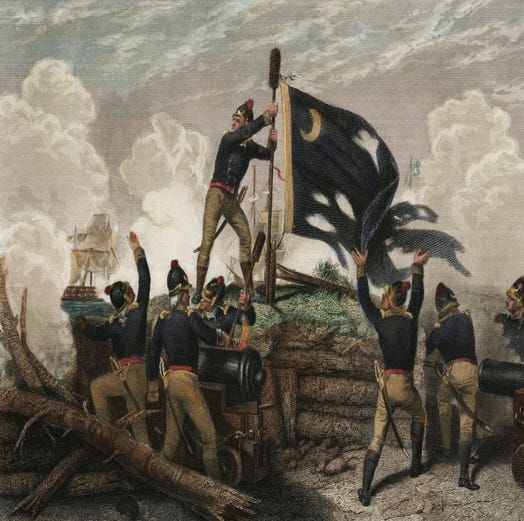
Another Georgia county is named after Sergeant William Jasper. Jasper County’s seat is a beautiful little town called Monticello. You’ve seen the courthouse: it was the courthouse in the movie My Cousin Vinnie. I don’t want to get deep into the history of Jasper County, because like so many things down here in the deep south, it makes little sense to anyone who wasn’t living at the time (and none of us were). Sergeant Jasper is famous for dying. Or rather, the way he died: he was killed, in 1778, while raising the colors of his regiment, the 2nd South Carolina during the Revolutionary War. Before he was killed, he won fame when, as the story goes, he retrieved the flag that had been shot down during the Battle of Fort Sullivan (now Fort Moultrie), which guarded Charleston Harbor. There’s a statue of him in Madison Square, Savannah.
In 1776, Henry Knox brought 59 cannons liberated from the British at Fort Ticonderoga all the way down the Hudson and across Massachusetts, to arrive at Dorchester Heights, where they could rain down death to the redcoats holed up in Boston. This led a different Henry, Henry Clinton, the British commander, to abandon the city, but he ordered the navy to take New York City, and also Charleston, in a move to end the rebellion quickly. Well, we know how New York went, but Charleston was a different story. Knowing of the approaching fleet, South Carolinians reinforced Fort Sullivan at the harbor’s entry. When the British frigates anchored in gun range of the fort, the sturdy but flexible palmetto logs held, while the Americans trained their guns on the ships.
Boom, boom, boom at a steady pace went the Patriot guns. It didn’t go so well for Admiral Sir Peter Parker (Spider-Man?—The Pedant), who personally took a hit in Forrest Gump style, leaving him—exposed.
Parker’s flotilla of 11 ships received quite a lot of damage. His flagship, HMS Bristol, suffered 40 killed and 71 wounded (including Parker). The ship took over 70 hits, damaging the hull, yards, and rigging. Four other ships were badly damaged, and one, HMS Acteon, had to be abandoned, set fire to by the crew, and was raided by Americans before her magazine exploded. His Majesty’s Navy never tried to take that fort again. In fact, the next time the British went to Charleston, in 1780, they laid siege to the city instead of assaulting it.
Thus Admiral Sir Peter Parker added his name to the long list of naval officers who told their landlubber counterparts “nope!” when things got rough and ships were lost. In 1778, the British took Newport during the Battle of Rhode Island. During the occupation, the garrison relied on the Royal Navy for support, but the French were always prowling around, and the harbor itself wasn’t amenable to large ships, and its tricky weather had proved difficult for all the navies involved. So, when the garrison asked for naval support, many times the navy replied, “nope!” Too dangerous, sorry.
During General George Washington’s siege of Yorktown, Charles Cornwallis expected to be evacuated by the Royal Navy, or at least get some relief. But Admiral Thomas Graves was busy fighting the French fleet, and after suffering a strategic loss at the Battle of the Chesapeake, Thomas just left Cornwallis to his own devices (which resulted in surrender, and basically the end of the war, since the crown wasn’t willing to commit any more to the effort).
In 1944, during the Anzio landings, American naval commanders refused to move their large capital ships into the shallow waters in support of the army. The Germans had large coastal guns and still had some air assets in the area. The navy preferred to stand off a bit and lob shells. During Guadalcanal in 1942, the Marines were left to their own devices after Vice Admiral Jack Fletcher pulled his carriers and support ships after taking heavy losses at the Battle of Savo Island.
Before that, in 1915, when the Allies tried to grab the Huns and Ottomans by the Dardanelles at Gallipoli, the British and French battleships decided the Straits of Gallipoli could not be held by naval power because: the strait was infested with mines, and it was narrow, and subject to easy attacks by land-based troops and guns. So the navy withdrew and left the army to its own devices.
Why do I bring all this up? It’s very relevant to Iran, of course.
The Iranians control the Strait of Hormuz, and they are using various small boats and other measures to mine it. Big ships and even small naval vessels fear minefields. You won’t see a large cruiser or aircraft carrier come within many miles of one. Clearing minefields is a slow and careful operation, just the kind of predictable movement that even the Iranians with their limited ability to fight against American air power can exploit.
So when Pete Hegseth at the Department of War calls up his admirals and says to secure the Strait of Hormuz so that oil tankers can safely move through, what he hears on the other end of the line is some version of “nope!” Too dangerous. There’s mines, and the strait is narrow, and subject to attack from land. All the air power in the world cannot clear a single maritime minefield. The Iranians know where the mines are, and they provide safe passage to their tankers headed to China. U.S. naval forces are not about to attack tankers headed to China, and some under the Chinese flag. So China gets something like nine million barrels of oil, while we continue to bomb Iran, and the strait remains closed.
No sea captain in history is going to sail his ship into a minefield and hear the laughter of the enemy as they shout “you lost your ship because you’re stupid.”
So the Strait of Hormuz will be closed until further notice, except for oil tankers bound for China.
I wonder if this came up in all the meetings about how we’re going to crush Iran? Do you think some guy in the Pentagon, deep down in the sublevels, is pulling out a plan from 1981, then breathlessly running up to the third floor E-ring, yelling “I have the answer!” Or does that only happen in movie plots.
Speaking of movies, I am reminded of the best anti-terrorist movie in the history of cinema. I’m talking about The Delta Force, of course. They should be watching it on a loop in Hegseth’s office suite about now. Did you ever notice that every airport in the Golan-Globus movie is really Ben Gurion in Tel Aviv, shot at different times, in different light, from different angles? Did you ever notice that the terrorists in that film speak Hebrew? Because American audiences can’t tell the difference. But who cares? It’s Chuck Norris. Chuck Norris kicking ass.
Here’s the details of the 1981 plan, the one the young E-4 found in the sublevel of the Pentagon, buried under Cap Weinberger’s collection of vintage Playboy magazines. Send Chuck Norris to Iran, and he will open the Strait of Hormuz. Just drop him in, HALO-style, along with Sly Stallone, and maybe even Schwarzenegger, to offer some one-liners, like “ayatollah-ya so!” as the mines all explode at once.
Then they swim to the carrier, while Tom Cruise flies an old F-14 Tomcat out of Bandar Abbas, strafing the speedboat full of bloodthirsty IRGC stooges just as they are about to murder the Action Triumvirate.
That’s it. That’s the plan. Because the U.S. Navy is going to say “nope!” when they are told to clear minefields within artillery range of fortified, well-hidden shore batteries and mobile missile launchers.
SOCIAL MEDIA ACCOUNTS: You can follow us on social media at several different locations. Official Racket News pages include:
Facebook: https://www.facebook.com/NewsRacket
Twitter/X: https://twitter.com/NewsRacket
Mastodon: https://federated.press/@RacketNews
Threads: https://www.threads.net/@theracketnews
David: https://www.threads.net/@captainkudzu71
Steve: https://www.threads.net/@stevengberman
Our personal accounts on the platform formerly known as Twitter:
David: https://twitter.com/captainkudzu
Steve: https://twitter.com/stevengberman
Jay: https://twitter.com/curmudgeon_NH
Thanks again for subscribing! Don’t forget to share us with your friends!
"(Spiderman?—The Pedant)"
(Spider-Man—The Pedant)
Spidey is hyphenated while The Man of Steel is one long run-on word: "Superman".
The Delta Force was one of my favorite 80s movies.
Since you mention the Revolution, I’ll also plug my favorite historian, Rick Atkinson. I’m currently reading the second volume of his Revolutionary trilogy. He has a a great series on the US campaigns against Germany in WWII.
His history is very detailed and readable. Highly recommended.