


Who thought it was a good idea for the U.S. government to regulate the earth on behalf of envirokooks, faddists and catastrophists? It was politics, not stewardship, that drove this decision.
Fifty-five years ago, President Richard Nixon signed Reorganization Plan No. 3 of 1970. The plan consolidated functions then carried out by 10 separate bureaus in four different cabinet level departments and put them under one agency, the EPA. None of the things the EPA does were new. Nixon merely wound them up under one administrator. Doing so put the environmental cause under his authority, versus under the thumb of a dozen congressional committees controlled by Democrats.
Nixon got what he wanted, politically. But from the beginning, the agency was filled with “Earth Day” people who saw their mission as sacred, and big industry as their evil nemesis.
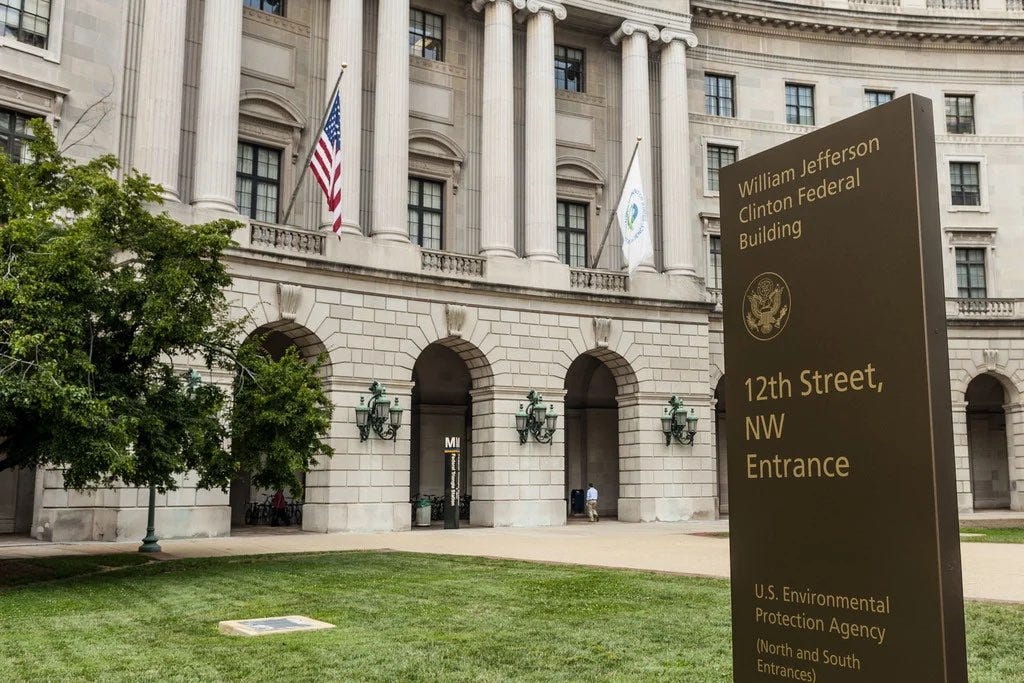
Every hair-on-fire doom catastrophe theory has found friendly ground in the EPA. I could go on for thousands of words about why the whole place deserves to be shuttered. In 2014, I summarized this position when I wrote at RedState:
There’s only one purpose for the EPA: as a haven for guilt-ridden liberals to fantasize how they will rule the country at gunpoint, although other kinds of fantasizing goes on there (child porn) too. The problem is, at least some of these fantasies carry the weight of law, making the EPA the National Mafia, shaking down corporations at will. They are more effective at targeting political enemies than the IRS, and they have less oversight than practically any other Federal department1.
Thus, the EPA has run a racket for decades, going after various companies in their targeted industries: oil, power generation, chemicals, manufacturing, and slapping them with penalties and settlements which require them to pay out money to favored non-government organizations, leftist envirokooks whose greatest wish is to cleanse the planet of humans and the things we build.
Now before you call me some evil pollution-lover, I am not anti-environment. I believe in organic farming over Monsanto genetically engineered seed and chemical pesticides. I believe in preserving the oceans, not dumping 11 million metric tons of plastic waste into them each year. I believe companies should be accountable for their treatment of the natural environment. I believe the government has some role in this, as standards are important. However, the EPA has gone well beyond measuring and studying, and has gone all-in on practically every environmental fad of the last 50 years.
First it was the “population bomb” and running out of resources. How many times have we heard that we will run out of oil by (insert year here)? Yet global oil production remains greater than it has ever been in history. Then it was the ozone layer, and we’d all be fried by ionizing radiation, and those who weren’t burned would die of horrible genetic mutations and new cancers. Granted, the elimination of many ozone-depleting chemicals being sprayed into the air (like chlorofluorocarbons—CFCs) was very effective, and the ozone quickly recovered. The issue was that scientists of that day thought there was no recovery or reversal, or it would take decades—centuries—for the earth to heal. They always talk in terms of “tipping points” and death spirals.
This is the same panic we see about man-made climate change, with its ever-moving goalposts. Again, before you label me a “climate denier,” I believe there is such a thing as man-made climate change. I believe that the industrial revolution and its reliance on coal, oil, and other CO2-producing reactions has pumped more greenhouse gases into atmosphere than before mankind built cities. Where I differ with the catastrophists is in their priors, specifically the committed belief that our planet has no natural defense or ability to heal from our activities, and that government control is the only way to stop the march to global disaster.
There is a lot about this planet that we simply don’t know. We don’t know how much water is subducted into the mantle of the earth, filtered through the crust, and blasted back into the oceans through deep vents. We’ve barely explored the oceans deeper than the Bathypelagic Zone, which accounts for well over 50 percent of the water on the planet’s surface by volume. We have never drilled deeper than 7 kilometers (the Kola well), and it’s unlikely we will ever breach the Mohorovičić discontinuity (the Moho) to see what lies beneath it.
Yet climate change science depends on models, some of which were faked, and some which have proven unreliable, to explain complex processes of weather and natural disasters, that involve “space weather” (solar cycles), the “wobble” of the earth’s orbital inclination, magnetic variations, ocean chemistry, and other natural rhythms and cycles that consume and produce energy far in excess of everything humans have ever artificially generated in our short history on this planet. It is hubris to believe that we have the answers.
But science is not, and has never been, the impetus behind regulation of greenhouse gases. In 2009, the Supreme Court ruled in a 5-4 split, with Justice David Souter siding with Justice John Paul Stevens that Massachusetts was “protecting its quasi-sovereign interests” and had standing to sue the EPA to force the agency to regulate greenhouse gases. The case found that the EPA did not have the authority to decline to issue emission standards for motor vehicles based on strict reading of the Clean Air Act—the agency didn’t have the power to interpret the law narrowly. Also, “air pollution agent[s]” must include carbon regulation, putting the burden on the agency to justify why it refused to regulate greenhouse gases. Notably, Justice Antonin Scalia dissented (joined by Chief Justice John Roberts, arguing that the Clean Air Act was not intended to combat global climate change.
Under President Barack Obama, the EPA went forward with its now-legal mandate, called the Endangerment Finding, determining that six specific greenhouse gases: carbon dioxide, methane, nitrous oxide, hydrofluorocarbons, perfluorocarbons, and sulfur hexafluoride, posed a threat to the public. Of these, hydroflourocarbons (HFCs), perflourocarbons (PFCs), and sulfur hexaflouride, have no natural sources. The others are naturally present in the atmosphere and have their own biological and associated chemical cycles, as well as human-caused sources.
It’s fine for the EPA to regulate the manufacture and use of HFCs, which include air conditioning refrigerants like R22 (which is now banned from new manufacture), PFCs, which are used in semiconductor manufacturing, and sulfur hexaflouride (SF6), which is used as an insulator in electrical applications. SF6 is a good candidate for regulation, in fact, because it is 1) completely synthetically produced, 2) extremely persistent in the atmosphere, and 3) a highly reflective greenhouse gas. But the annual global production of SF6 is about 8,000 tons; the U.S. share of that is hard to say, though only about six specialty gas companies and three large manufacturers—less than 10 total companies—are major producers.
Regulating under 10 companies making a specific chemical, or an industry like HVAC or semiconductors, is a wholly different thing than regulating CO2 gas, which is produced by every kind of machine, manufacturing method, construction site, biological process, agriculture, and our very breath. So the EPA has taken to pursuing narrow political and economic channels in its quest to make America’s carbon footprint smaller. Oil, energy, transportation, consumer goods and agriculture, some of the largest segments of our economy, was under the EPA’s purview.
The Trump administration has announced that the EPA is no longer following the Endangerment Finding, and many media outlets and progressive pundits are freaking out. Their reaction reveals a different agenda than simply protecting the environment from a climate disaster. This has always been about politics and economic control. There is only one way that the human inhabitants of earth will be able to fight human-caused climate change, and that’s when we all agree to simply pay the “green premium” and use cleaner processes and energy sources.
This includes, of course, solar and wind, but also nuclear, which has been the victim of 50 years of lies by the “no nukes” crowd. We’ve seen the world’s proclivity to move to smaller carbon-footprint vehicles, not just when the government is forcing the issue. I believe EVs are the future, and if our generations don’t adopt them in full, our kids and grandkids will certainly be driving them as their primary transportation.
As Bill Gates (yes, I know, some of you cringe at his mention) said: “there is no known tipping point.” We have at least 70 years to work out these issues, and the key will be investment, not divestment. Making the “green premium” smaller, so regular folks can afford green technology, investing in nuclear and other carbon-neutral products, over time, is the way forward. Bashing companies and individuals with onerous regulation is not an answer, it is about control.
There are plenty of technologies we are studying and trying to scale today that could be the key to dealing with CO2 and other greenhouse gases tomorrow. As I said, solar, wind, and nuclear fission, But there’s also tidal, geothermal, nuclear fusion (always 30 years away), fuel cells, and supermaterials like graphene. Plus, it’s always possible to make existing fuel sources cleaner. Oil and natural gas plants can be treated to produce nothing more than water. There is such a thing as “clean coal,” using advanced scrubbers. We don’t have to succumb to the lies that existing fossil fuels must billow filth into the sky. As long as we’re moving along the investment path to a smaller carbon footprint, all available energy, transportation, and agricultural methods should be used.
But that’s not how many progressives want to proceed. They want their impact felt now, and their proposed outcomes to happen now. They want to eliminate, not simply taper off over 70 years, the sources of greenhouse gas production. So they tie every problem back to catastrophic predictions of doom, and attribute every storm, change in climate, or global meteorological trend, to man-caused climate change. They want everyone to believe we are at the edge of a tipping point, so we will bow to their control.
The climate change culture is more of a religion than a scientific movement. The science is merely a justification for their actions, which they’ve already determined by faith are needed. And the government is a lever they can move through legal action, because the science isn’t enough, especially when the science isn’t settled by any means.
I don’t want the U.S. government, certainly not the EPA, regulating every facet of my life, through CO2, methane and nitrogen controls. I especially don’t want that when China, and many other nations that produce as much or more carbon than America, are pursuing the technology and investment for the future, but also using existing fossil fuels while we are told to eat bugs.
I am glad the Endangerment Finding is gone. I don’t believe this will result in a return to smoke-billowing stacks and black-exhaust belching vehicles. It will, however, trim the feathers of the envirokooks, doomsayers, faddists, and catastrophists who have always exerted their control over the EPA. The next logical move is to shut down the agency and return its functions to agencies who used to do them. But I think that is too much for the Trump administration. The president can dismantle the Kennedy Center, and render the East Wing into a pile of wreckage, but he doesn’t have the ability to snip the EPA from its hippie dippy roots.
The best we can hope for is what we got, and for that, at least, I offer my gratitude.
SOCIAL MEDIA ACCOUNTS: You can follow us on social media at several different locations. Official Racket News pages include:
Facebook: https://www.facebook.com/NewsRacket
Twitter/X: https://twitter.com/NewsRacket
Our personal accounts on the platform formerly known as Twitter:
David: https://x.com/captainkudzu
Steve: https://x.com/stevengberman
Jay: https://x.com/curmudgeon_NH
Tell your friends about us!
The EPA is overseen by no less than 5 major committees and 6 subcommittees in the Senate (none of which have direct responsibility for oversight of all the EPA is supposed to do), and 12 more subcommittee in the House (again, none of which has direct oversight of everything). Essentially, the EPA can get away with murder and pass it right under Congress’ nose.
Great article, Steve. I have a slight disagreement about organic farming. While it's great for family gardens, it will not feed the world. From what I've seen in supermarkets, organic produce is marred by insect damage, fungus and spoilage. We do need to make sure crops are treated with safe chemicals. Chemicals have enhanced human health and longevity, so they are not necessarily harmful.
The earth is ours to use. I'm sure humans and the eco-system will mutually evolve to form a good working relationship.
Respectfully, I disagree. While these gases do occur naturally, that really isn’t the point - unregulated human release of such gases is. I liken It to going into an ecosystem and releasing an invasive species that throws the ecosystem out of whack - the additional human release is the invasive species which left unchecked can have grave consequences to the overall balance of the ecosystem.