


I’m back.
I feel like haven’t written in weeks. I’m rusty. The last thing I wrote was something half incoherent, noting that I was sick, I just didn’t know how sick I was. I had developed a group A streptococcal infection in my left leg. It was severe and fast-growing, and put me in the emergency room Tuesday night a week ago, where the hospital swallowed me whole and would not spit me back out until late Sunday afternoon.
I wrote the following paragraphs when the memory of being a hospital patient was much fresher than it is now, me having been home about four days. Funny how that particular memory fades so fast.
No need to bore you with the details of it or of hospital life. I will say the particular place I was in is a luxury spa compared to what most people tell me what hospitals are like for them. Daily, someone would arrive with a tablet to ask me my dinner and next day breakfast choices. The nurses were incredibly fast to respond to the call button (which was routed to their phones). Every single person who came to my room, from the care team assigned to me, to management, was kind, considerate, and never left the room without asking if I needed anything. And if I did need something, they got it for me. Perhaps the healthcare system in the U.S. is irretrievably broken. But it if it is, then the rest of the world must be operating in mud huts because the level I saw was stellar. Maybe I’m just the lucky one.
While I had many hours of time in the hospital and no laptop—working from only a phone causes me headaches even with my best reading glasses; I simply cannot do it—I pondered a lot about nothing. I don’t mean “nothing” in the sense that I was thinking null thoughts. I could have turned the TV on to MTV2 reality shows, or some true crime, or HGTV playing 24 hour of renovation fake hell stories and really done that, filling my mind with mush and slop. Fortunately for my brain, it rejects slop in such large quantities, leaving me with a void to, as I just said, think about “nothing.” It’s a deep subject.
“Nothing is what rocks dream about,” is famously attributed to Aristotle. That’s the nothing of the void, of what things dead think. Non-existence. You know what’s worse than the void? Being self-aware, and living in the nothing. I spent five days in the hospital; Henry David Thoreau spent years living in seclusion in a cabin on Walden Pond. He wrote: “The mass of men lead lives of quiet desperation,” reflecting in Walden on the nature of people to default back to meaninglessness. Until the last 120 years or so, most of life was spent on subsistence—unless you were one of the super-rich or privileged—people had to get enough food for themselves and their families, provide shelter, clothing, and other material goods, and “make a living.”
Specialization and economic advantage changed all that. No longer do we worry about growing enough corn or grain to feed our animals. We don’t worry about if our vegetable crop will be eaten by weevils or moles, or freeze in a snap frost. We don’t think about most perils (we have insurance). When sickness hits quickly, we go to the emergency room. In 1826, we’d probably be dead. Even in 1926. Now, we buy what we need at Walmart or Costco, store it in our freezer, and drive big SUVs around complaining about the price of gas.
Yet people are defaulting back to nothingness, to the void of living purposeless, grinding, desperate lives of subsistence in the information age. Worldwide, we are having less children. Year over year, with few exceptions, live birth rates around the world have dropped from 37.84 per thousand people to the low of 16.33 in 2023. The birth rate recovered briefly in 2024, and then went right back to the baseline decline in 2025, at 17.13. The world’s population keeps growing, but not because of children; it’s because we are all living longer. Of course there are exceptions: war, starvation, genocide, those invert the age stack. The rest of the world is aging into nothingness.
But it’s more than an aging problem. I think nothingness pops its head out in so many places and ways it’s getting hard to count. There’s a quality of “sameness” and conformity that has always run through youth, especially as cliquy as young people can be. Back in 1963, Esquire ran a piece by Tom Wolfe (the GREAT Tom Wolfe) titled “HERE GOES (VAROOM! VAROOM!) THAT KANDY KOLORED (THPHHHHHH!) TANGERINE-FLAKE STREAMLINE BABY (RAHGHHHH!) AROUND THE BEND (BRUMMMMMMMMMMMM)” In one sweeping vista of The Valley car and youth culture, Wolfe captured the prison of conformity led by adult rebels, some of whom were in it for the money, and others, for the art.
(You really should read the article. It’s an amazing trip into another planet, where today there’s at least a dozen (likely dozens of) professionally produced shows, some with people who grew up in the time Wolfe was writing about.
At thirteen, this kid was being fanatically cool. They all were. They were all wonderful slaves to form. They have created their own style of life, and they are much more authoritarian about enforcing it than are adults. Not only that, but today these kids—especially in California—have money, which, needless to say, is why all these shoe merchants and guitar sellers and the Ford Motor Company were at a Teen Fair in the first place.
The suits at Ford saw they could make bank on cash-rich kids craving cool cars in The Valley, and it was a cheap trick for them to pay for some music, food, dancers and a pool to hook these kids. Even the ones who didn’t have money to buy would one day grow up to be “Ford” guys (and the gals who hung with them). They knew a good investment where they saw it.
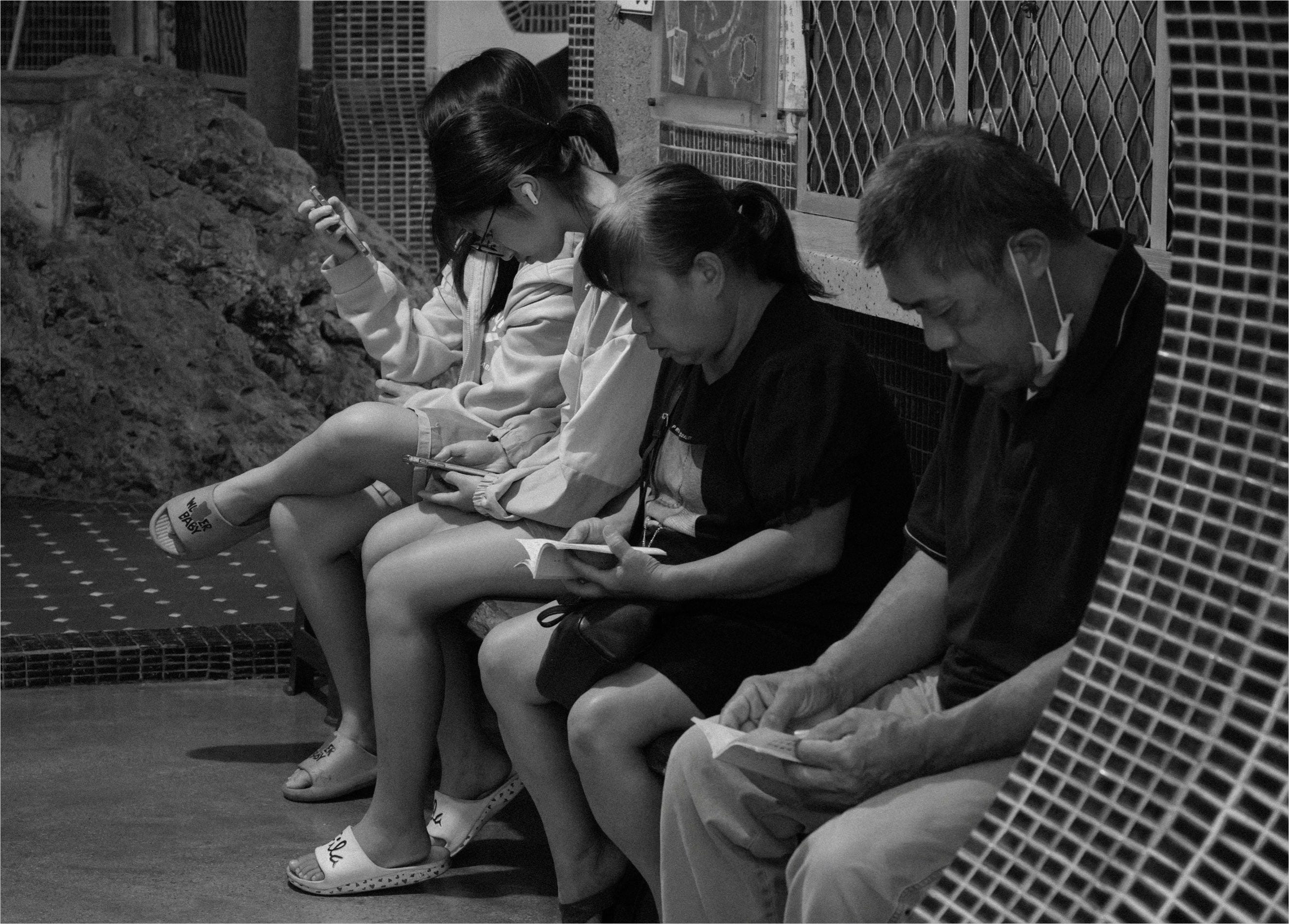
But today, none of this would work. The new style of life is one of nothingness. And instead of Ford Motor Company investing in it, a cabal of Big Tech is invested in keeping the next generation stuck in subsistence. Go into any high school or college event, and you’ll see groups of young people, head down in their smartphones, endlessly scrolling, sometimes posting, trying to catch the perfect selfie. There is no regard for place, or decorum, or respect. Women taking Instagram selfies at the gates of Auschwitz. There is a sign at the Empty Sky 9/11 Memorial in Jersey City, across the river from the site of the WTC towers, that reads something like “no pictures, honor the purpose of this place” (I’m sure I have it wrong). Things like that exist because visiting a place no longer means taking in the solemnity, or energy, or flavor, or ethnic history of it; it means documenting that you’ve been there in the most wasteful, empty way possible.
It’s not just the youth hooked on TikTok, or college kids spending four years using a generative AI to complete every single assignment, or lawyers writing briefs with imaginary citations; everyone seems to be phoning it in. In politics, attaining and keeping office was once the peak of cynicism, but in the end it’s about power. The craven have found it more profitable and powerful to lead from outside, so we have Marjorie Taylor Greene, former Member of Congress, who delights in spending time with Candace Owens and her ilk.
Unrestrained by history, decorum, institutions, the United States pursues a policy of nothingness. We don’t want immigrants. We want our traditional allies to pay more for things the U.S. used to do for principle and peace, making them no longer allies. We want our enemies to give us oil, money and power, when we can have all those things now without war. President Trump is now going to stamp his signature on U.S. dollars. He is applying his name and image to everything he sees, like the youth taking selfies to prove they’ve been to a place.
I am not sure if Trump is in rushing ahead, or dragging behind the culture here. It’s like institutions are dissolving before our eyes, while America expends its power on the shortest-term goals. Yes, I’m all for deposing the evil regime in Tehran. Yes, I want us to “win” that war. But that’s not the war we’re fighting. And the reason I support overthrowing the regime is not simply because they’re evil. I think the Iranians themselves would eventually deal with their oppressors. But Trump made a promise to the protesters massing in the streets that America would come to their “rescue.” Not doing so would be an act of extreme wickedness, so therefore I believe our nation should keep our word.
Yet that’s not the war we’re fighting. We aren’t going for regime change, because we have no means to effect it. All we can do is extort oil, and we’re not doing a very good job of that. Watch as we deploy U.S. Marines and ground troops into harm’s way in an Iran that still has command and control of a large standing army. Sure, we’ve truly degraded their ability to fling missiles around the region, but taking and holding even Kharg Island is a different ballgame, never mind opening the Strait of Hormuz to the satisfaction of global shipping insurance carriers. Meanwhile, the Iranian people are no better off; they are living under the evil regime, and suffering the effects of war with the United States and Israel. On the day when the regime does finally fall, let’s hope whoever takes its place isn’t chanting “Death to America!”—and with reason.
This isn’t nihilism, which is the belief that moral systems themselves are meaningless. This is nothingness, the search for meaning in subsistence level grinding, day after day of small goals, tiny wins, ephemeral acts of violence upon anything that once held meaning to someone. It’s random graffiti, a dog peeing on every signpost.
Since Roe v. Wade was overturned, the abortion rate in the U.S. has gone up. This is because the demand for having meaningless sex, then dealing with the consequences with a pill has risen. And something I’d normally applaud, young people having less sex (outside of marriage), doesn’t ring right to me. It’s because as kids, they were exposed to an ocean of pornography, and now there’s AI-enhanced porn. Desensitized to sex, violence, and addicted to mindless self-pleasure, the desire to work to build a relationship is now a more rare thing than it has ever been.
What is at stake? Ultimately, society, because the benefits of society ride on the back of a billion turtles, pursuing specialization and economic advantage. When the turtles find themselves placed on fence posts, they no longer carry anything. This country has already lost much of its former ability to mass design, build, scale, and economically sell useful products to the world. Instead, we have a few massive tech, energy, information, and defense conglomerates controlling giant swaths of the manufacturing, design, and sales economy, while what is not done in service to Google, Microsoft, Tesla, NVidia, or Boeing, is spent taking care of our aging population.
I think I’ve hit the bottom of the pit now, so let me take you back up for air, and maybe even some sunshine and hope. I’ve also gone very long, so let me bring it home. I had written another two paragraphs about my health and deleted them. Thank me for sparing you.
What will heal the nothingness? The answer to nothing is something. But something has a cost. In my case, I had built my life around certain limitations in my life, work, and human/self-imposed rules. I was living a subsistence life, which led me to ignore my own health and end up missing a week of work, kind of the opposite of what I wanted to happen. Ultimately, we control our decisions, but not the outcome. The cost of my lesson is worth the knowledge gained.
Something is living engaged in the moment, in conversation, relationship, love, encouragement. It’s leaving those things and people that drag back into the cycle or subsistence to their own devices.
The nothingness subsistence life leads to despair, drug use, violence, self harm, mental illness, and sometimes, great violence. Many times it ends in violent or tragic death. It drowns in failure and condemnation. The younger generation is raised in it and they don’t know they’re drowning. The answer is something, a connection.
How do you teach kids to put their phones down and begin to care about others? Older folks can’t tell them how; they must be shown. Then they need a safe place and caring adults so they can build their skills. How to listen. How to ask questions. How to greet another person. How to show interest. How to demonstrate care and love. Kids aren’t losing their ability to do these things; they never had them in the first place.
I was recently fortunate enough to be invited to a charity dinner. I know, those kinds of things are not generally fun. Instead of a boring dinner, I found a group with a mission to replace nothing with something. It’s called the Whisper Movement, and its vision is nothing less than “next generation will change the way the world interacts.”
One school at a time, high schools, middle schools, colleges, Whisper gives kids the training, skills, and space “for conversation.” That’s it. They build genuine interaction with other people, face to face, and in small groups. No phones, no apps. Social potential, ending loneliness, replacing nothingness with something.
The pursuit of nothing goals, marking time and location on apps by taking selfies, working a day for the next day, even while pretending to find meaning in family, or church, or school, or helping others, is a pernicious diseases infecting our social fabric, and I mean worldwide. It’s why the mass killer’s neighbors say “I thought he (or she) was just a normal person.” Nobody took the time to know them, or parents were more concerned with their own lives, or their ex-spouse, than engaging with their kids.
Enough. Let’s begin to listen. Let’s learn to ask questions. Let’s build skills at bringing back real conversation, listening, and loving. Let’s provide those skills to the next generation Let’s train them to train others and end the loneliness of screen time and the tragedy of nothing.
If you have an extra dollar or two, consider giving to the Whisper Movement. Go to their site and watch the videos. Read the stories, catch the vision. Even better, do it. Put your phone down and begin a conversation. Look them in the eye, listen, and show them your love. It took me a week in the hospital to come out with a new attitude. Maybe someone reading this can benefit from it.
SOCIAL MEDIA ACCOUNTS: You can follow us on social media at several different locations. Official Racket News pages include:
Facebook: https://www.facebook.com/NewsRacket
Twitter/X: https://twitter.com/NewsRacket
Mastodon: https://federated.press/@RacketNews
Threads: https://www.threads.net/@theracketnews
David: https://www.threads.net/@captainkudzu71
Steve: https://www.threads.net/@stevengberman
Our personal accounts on the platform formerly known as Twitter:
David: https://twitter.com/captainkudzu
Steve: https://twitter.com/stevengberman
Jay: https://twitter.com/curmudgeon_NH
Thanks again for subscribing! Don’t forget to share us with your friends!
Glad to hear you're alright, and it sounds like it wasn't MRSA (please correct if wrong).
My wife and I don't let the kids have general access to any tablets/phones yet, and perhaps in the future we'll get them a dumb phone when the time comes. Sure don't need them constantly browsing away, at least not until they're adults.
On the topic of nihilism, it should be noted there are many different forms of which moral nihilism is but one. I personally fall into the optimistic nihilist camp - that there is no inherent meaning to life, which grants us the freedom to find our own individual meaning and joy in life.
Welcome back to the living. Your absence was noted; for sure.
I long for the day when as a nation we embrace accountability, responsibility and ownership. I'm hard pressed to hold my breath.