


Over the weekend, an airline died. Spirit Airlines, 34, of Dania Beach, Florida, passed away suddenly on Saturday after a prolonged illness. Spirit was a true Florida company, quirky, rowdy, and sometimes tacky, but also beloved. (Like many Floridians, Spirit’s age is disputed. The company had its roots in 1964 as Clippert Trucking Company, but Spirit Airlines was formed in 1992.)
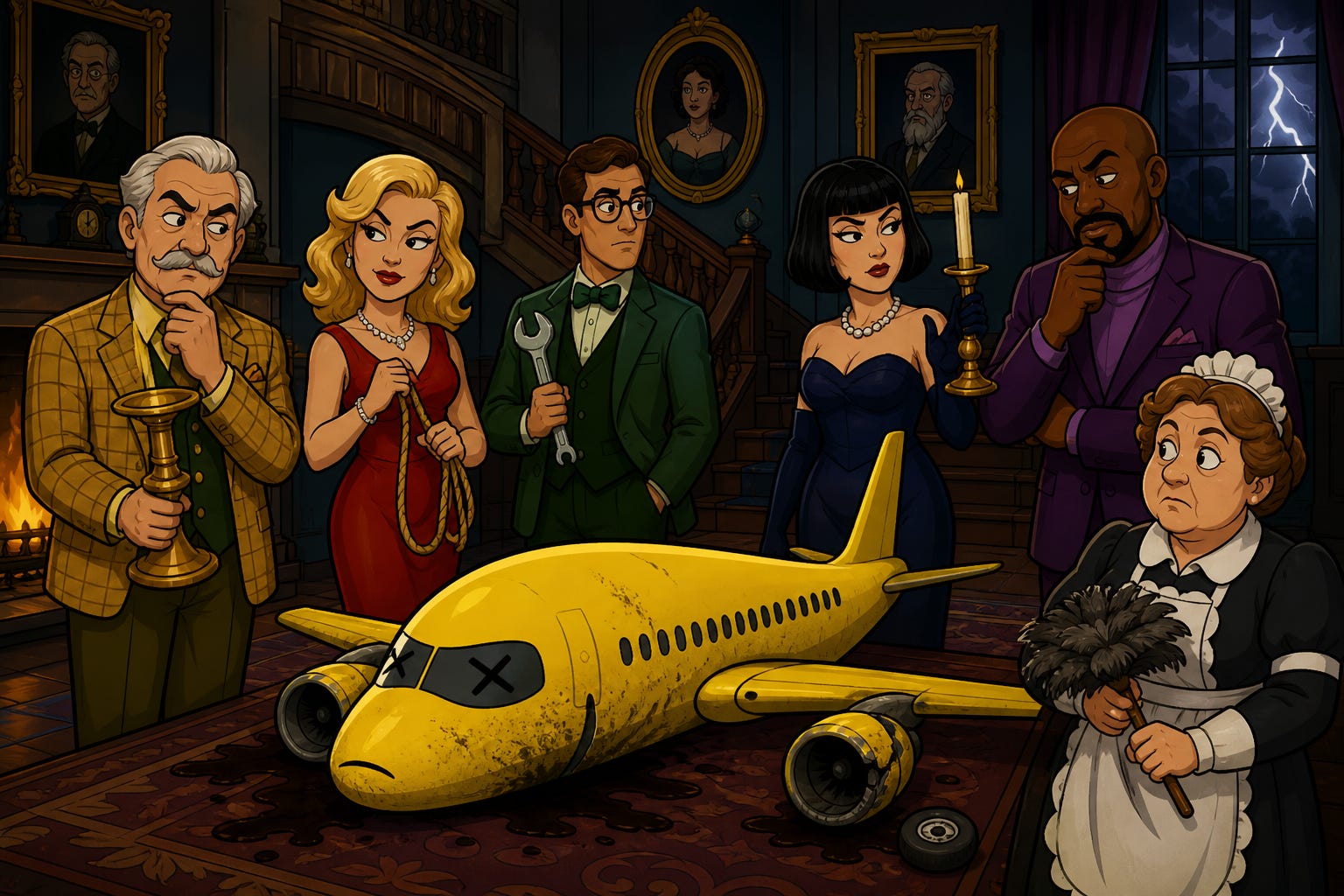
As with many sudden deaths, the focus quickly shifted from the life and legacy of the departed company to the question of “Whodunnit.” I’ve been doing Community Notes for a while now, and normally it’s difficult to get Notes published, but I noticed that a bevy of Notes were somehow approved with astonishing speed accusing Elizabeth Warren of orchestrating the carrier’s demise. While it’s true that Warren did oppose a proposed Spirit merger, that is not the full story of Spirit’s death.
When I said that Spirit had suffered from a prolonged illness, I wasn’t kidding. The airline was a company that people loved to hate. Just 10 years ago, the company was very profitable as an ultra-low-fare carrier that introduced American travelers to a la carte pricing, but that business model was never very popular.
If you’ve never flown Spirit, here’s how it operated. When you booked a fare, you would see a really low base price, but that price would rise as you paid extra for services that other airlines included with their fares. Spirit was the first US airline to require passengers to pay for checked bags, but it didn’t stop there. You had to pay for snacks, you had to pay to pick a seat, you even had to pay for a boarding pass and to put a carry-on bag in the overhead bin. If you bought the extras, you might end up paying more to the low-fare airline than you would for a ticket on a more well-known competitor.
Spirit was a niche airline that specialized in flying a small number of routes with a small number of flights. It didn’t try to be everything to everyone. It mainly tried to get vacationers to tourist hot spots as cheaply as possible, not necessarily as conveniently as possible.
Spirit boomed in the 2010s with both profitability and a number of safety awards, but then came the pandemic and the havoc that it wreaked on the travel industry. Spirit’s niche of elective travel to leisure destinations was hard hit.
In 2022, the company was the subject of several takeover attempts. The first suitor was Frontier Airlines, another low-fare carrier, but Spirit shareholders rejected that offer in July. Shortly after, JetBlue came calling with another attempt to acquire rather than merge with Spirit. This is the deal that you’ve seen referenced on social media.
The Biden Adminstration’s Department of Justice sued to block the deal, saying “If allowed to proceed, this merger will limit choices and drive up ticket prices for passengers across the country” and “eliminate Spirit’s unique and disruptive role in the industry.” It was ultimately a federal judge appointed by Ronald Reagan, rather than Joe Biden or Merrick Garland, who blocked the deal. Elizabeth Warren, a senator at the time, opposed the deal but was not directly involved.
After the deal was blocked, Spirit’s stock value was halved and the company filed for bankruptcy in November 2024 amid mounting losses in the post-COVID world. The company reorganized to trim its costs and went on flying, emerging from bankruptcy in March 2025 after rejecting yet another offer from Frontier.
In August, it was back after posting losses and burning through much of its cash. Frontier tried to do what most airlines do at that point and cut costs, parking airplanes and furloughing (i.e., laying off) employees. The airline planned to reduce its workforce by about a third and its flights by 25 percent.
Then came the Iran war. After Donald Trump launched his attacks on Iran in February 2026, the Iranian regime blocked the Strait of Hormuz. The number of tankers carrying oil from the Persian Gulf dropped from thousands to a trickle.
Airlines have three main cost centers: Labor, aircraft, and fuel. The first two are relatively predictable. Fuel prices are not.
To address the volatility of fuel prices, airlines “hedge,” that is, they buy contracts for future fuel deliveries at a given price. These futures contracts are a gamble because the price can either go up or down, but at least the company has reduced an unknown variable to a known quantity.
The problem for Spirit was that an airline in bankruptcy has a difficult time getting the money or credit to hedge fuel. Spirit’s “shrink to shine” plan was undercut by the skyrocketing price of jet fuel that increased its operating costs and the fact that it did not have a fuel hedging program in place.
Patrick De Haan of GasBuddy pointed out that Spirit’s restructuring plan assumed jet fuel prices of $2.24 per gallon for 2026. Instead, they were faced with $4.51 per gallon and rising. The price of fuel was double what Spirit had planned for.
Why didn’t Spirit just raise its fares and pass along the higher costs to its passengers, you might ask. There are several reasons with the most obvious being that a low-fare carrier’s customers are very price sensitive. Further, the low-fare customers that were Spirit’s target market are also being squeezed by higher prices for gasoline, food, and other consumer items. They have less disposable income than they did a few years ago.
Finally, Spirit’s rising prices eroded its edge over airlines that were able to hedge their fuel prices. Delta Air Lines even owns its own refinery. If the price of the ticket is close, most passengers would fly one of the traditional airlines, especially considering Spirit’s added fees and more limited schedules.
So who killed Spirit? The answer is not as simple as either side would have you believe.
In aviation, we have a model called the accident chain. A crash rarely has one cause. In almost every crash, there is a chain of linked causes that contribute to the accident. If one or more of these links is broken, the chain is broken and the accident can be avoided. The same theory applies here.
Could the merger (acquisition) by JetBlue have prevented Spirit’s ultimate crash? Perhaps, but there is no way of knowing for sure. The failure of the deal definitely left Spirit weakened and vulnerable, but JetBlue is also on the verge of bankruptcy and may declare it by the end of the year. Combining the companies might have given them enough strength to carry on, but it might have only delayed the inevitable.
And it could also be true that the deal might have been good for the company, but not the country. I, along with many other Americans, am concerned about the steady growth of monolithic megacorporations that reduce our consumer choices. Merrick Garland may have been right that the merger would have reduced consumer options while driving up prices and making it harder for new companies to enter the airline marketplace.
Earlier this year, United and American discussed a possible merger as a way to better compete with foreign carriers. The combined company would have been twice the size of Delta, with 2,800 planes and about 40 percent of the US domestic market. How big is too big, and do consumers really benefit when “all restaurants are Taco Bell?”
One thing that the merger would not have done was save the Spirit we know. This would have been JetBlue acquiring the weaker company, and buyouts seldom go well for aviation employees. Many jobs would still have been lost from duplicated positions and the fact that the new company likely wouldn’t need as many pilots and flight attendants as the two separate companies had. Flight crews who kept their jobs would have likely lost seniority, which is very important at the airlines.
Whether the merger would have saved Spirit or not, it is indisputable that high fuel prices were the final nail in the company’s coffin. Even with the JetBlue deal, the new company might have failed anyway, but without the fuel price spike, Spirit would be flying today. Spirit specifically cited high fuel prices in its announcement that it was shutting down, while making no mention of failed mergers.
Spirit isn’t the first airline to be killed by high fuel prices. I don’t like to brag, but my career has lasted longer than three of the airlines that I worked for. One of those was Independence Air. Independence was a low-fare carrier that was formed in the wake of the airline bankruptcies of the 2000s. The company was an attempt to reinvent Atlantic Coast Airlines, a regional carrier that had operated as United Express and Delta Connection but lost its contracts as those companies restructured.
A major reason that Independence failed was that another fuel spike occurred in 2003 just as the company was taking off. Like Spirit, the newborn Independence was in a weak state, and like Spirit, fuel prices that were dramatically higher than expected killed it.
The point here is that a strong company can weather storms that a company in a weakened position cannot. A strong company can absorb the shock of unexpected higher costs that can be the death knell for a company with other problems. Spirit had problems.
Weak companies can also be a bellwether for stronger companies and the larger economy. The weak die first, but if the problems continue to mount, even companies perceived as strong can fail.
With oil and fuel prices continuing to rise and no relief in sight, Spirit is likely to be the first of many to suffer serious problems. As fuel prices rise, fares will rise, and demand will fall. There is already concern about a looming shortage of jet fuel, and many airlines, even big, strong ones, are cutting costs and reducing flights.
And the problems extend beyond the airline industry. Farmers are another sector that is perennially on the edge of failure, and farm bankruptcies are already rising sharply. In addition to last year’s tariffs and trade wars, farmers now face higher fuel costs and shortages of fertilizer, yet another commodity that is tied to the Persian Gulf.
The partisans on both sides are spinning their simplified versions of Spirit’s demise, and to a certain extent, they are both right. But a merger deal might have saved only one (maybe two) companies, while high energy prices threaten countless businesses and farms, the entire economy. And as the failures mount, it will be increasingly hard to blame Biden.
And as the sticker says, Donald Trump can point to all the “creative destruction” that his Iran policy has wrought and say, “I did that.”
THE WAR IS OVER As I predicted last week, Donald Trump announced on Friday that the war with Iran was over. The announcement came as the conflict reached the 60-day deadline established by the War Powers Act.
LONG LIVE THE WAR But the US blockade of the Iranian blockade, an act of war, continues, and on Sunday, Trump announced that the US will escort ships through the Strait of Hormuz, following an Iranian attack on a cargo ship, also an act of war. Trump’s announcement allegedly coincided with another multimillion-dollar market bet that paid off handsomely for some insider.
MAY THE FOURTH BE WITH YOU In celebration, enjoy the viral AI video of General Grievous appearing on Pawn Stars.
SOCIAL MEDIA ACCOUNTS: You can follow us on social media at several different locations. Official Racket News pages include:
Facebook: https://www.facebook.com/NewsRacket
Twitter/X: https://twitter.com/NewsRacket
Threads: https://www.threads.com/@theracketnews
Mastodon: https://bird.makeup/users/newsracket
Our personal accounts on the platform formerly known as Twitter:
David: https://x.com/captainkudzu
Steve: https://x.com/stevengberman
Jay: https://x.com/curmudgeon_NH
It also didn't help that Spirit flew into the major airports - with their higher fees - rather than the smaller airports most other low-cost carriers do.
Nor that Spirit - and low-cost carriers - face increased competition from the "Basic Economy" offerings from the major airlines.
I think if JetBlue had acquired Spirit they'd be just as likely to have failed now - 'cause they'd have also taken on Spirit's debts.
Fuel prices have been a sticking point for many industries for decades. In the early 1980s, the President of our company sent a directive to my bosses to evaluate alternatives to diesel fuel which we purchased in bulk for a specific process - millions of gallons per year. I ended up with the assignment. After a few days of collecting purchasing and usage information and simple arithmetic, I determined that the price of diesel fuel would have to rise to $0.32 per gallon (even if the alternatives did not also experience similar price increases) before changing would become feasible. Our then current price was about $0.18 per gallon. Compare that to today's prices. All fuel and energy prices are much higher.
Everything would cost less if fuel prices were lower. There is nothing to stop the long-term increase in oil prices. Airlines and other major fuel users know this. The hedging you speak of simply results in occasional jumps in customer prices that the airlines hope to blame on someone else. I have long been skeptical of airlines as investments. I always thought they were gambling on their fares and passenger demand.
Congratulation for outlasting some of the airlines you worked for. That indicates you are good at your job. At least you haven't clipped a truck and a light pole while landing.